In London – a city of some nine million people – I’ve always thought that it is strange that you can sometimes find yourself entirely alone in public. I felt this surprise recently while sitting in the central square of Hampstead Garden Suburb in the shadow of St Jude’s Church.
The vast prim and proper lawn of the square was deserted, and as I sat eating a picnic, stuffing my face, I wondered where everyone was. Given it was the hottest day of the year with the temperature edging 40 degrees and the sun not even over the yardarm – I concluded that I was probably the only person stupid enough to be out and about.
It was architectural writer Ian Nairn’s ‘Nairn’s London’ that had brought me on a sunny Monday morning to Hampstead Garden Suburb – which was built from scratch as a model community in the 1920s. Following his guidebook, which offers insightful, often catty, descriptions of some of the city’s best and least know landmarks, provides a wonderful way to explore London.*
Nairn was not that impressed with central square in Hampstead Garden Suburb. He said it suffered from a “central blankness of imagination” and lashed out at the design’s inhumanity because the square doesn’t have a pub and is instead filled with churches and institutes. It is a valid argument – especially on a hot day.
In my mind – in my heat-induced delirious fever dreams dreamed on that roasting central lawn – I was walking with ghosts through Hampstead Garden Suburb that Monday morning. Ghosts of all the famous people who used to live in that once fashionable area of the city. Maybe if I’d stayed around longer I would have spotted Tony Hancock on a park bench reading a script for the next episode of Hancock’s Half Hour of Robert Donat on his way to the studio. Maybe I would have rowed past Eric Coats, rowing across an imaginary boating lake, as By the Sleepy Lagoon played in my mind.
Sadly, these were just the daydreams of someone with an antique sensibility.
As I made my way back down Hoop Lane, I walked past Golders Green Crematorium, a bizarre looking nondenominational building that is based on the Italian architecture of Lombardy. I’m not sure what Nairn made of it – not much I assume – given it doesn’t appear in his guidebook. But I am easily swayed to investigate a graveyard of quality – so I had a quick look around.
I found myself in a little courtyard – as the soft chanting from a Hindu funeral drifted through the hot summer air – the walls of which were lined with monuments honouring the great and the good of British entertainment.
All generations were represented. The newest plaque was for Barbara Windsor and there is a corner dedicated to musical hell raisers, with one for Keith Moon and another for Marc Bolan. There is a jazz section too, I spotted a plaque for Tubby Hayes and another for Ronnie Scott. But the one that caught my eye read ‘This tablet is dedicated by the Grand Order of Water Rats to the Revered Memory of King Rat – Teddy Brown’.
The words immediately piqued my overheated imagination. What was the Grand Order of Water Rats? In my mind, I sketched an image of a fraternity of sophisticated drunkards that rampaged through Soho’s pubs and caffes in the pre-war years and that Teddy Brown was a kind of Oliver Reed or Jeffrey Bernard of his day, tottering his way into a drink-sodden oblivion.
Some swift googling quickly revealed that I was wrong. The Grand Order of Water Rats are a group of entertainers, founded by music hall comedians, that do good works for charity. Every year they elect a ‘King Rat’ from their community and in 1946 the King Rat was an overweight xylophonist called Teddy Brown.
Brown, it turns out, was very famous in the 1930s, largely for his xylophone skills, but also for his girth, which appears in old black and white Pathe films to have been considerable. He was so fat, apparently, that he had to have an especially wide door fitted to his Rolls Royce, and in one Pathe skit he appears to get lodged in an elevator door.

Often nicknamed ‘The biggest musician in the world,’ – films of Brown, who was American and spoke like a Chicago gangster, tend to start with the camera panning upwards from his feet past his huge trousers – which could have doubled as an enormous wind sock at an airfield for zeppelins – before he starts tapping away at a jaunty tune on the xylophone backed by tuxedoed men playing double bases and saxophones.
It struck me, as I stood there learning about Teddy Brown and his giant trousers, that there were whole generations of wonderful entertainers like him that had cut a dash across the music hall stages of London, who now, like the stages themselves, were lost to history.
Teddy Brown died half way through his term as King Rat. He had a heart attack in a hotel in Birmingham. This prompted, one assumes, the Grand Order to gather a conclave to elect a successor. The Order plumped for Bud Flanagan, another renowned music hall entertainer of his day.
Flanagan was exceptionally famous in London, and the wider UK, in the first half of the twentieth century as a member of the Crazy Gang – a kind of home grown Marx Brothers. This group of vaudeville comedians appeared in music hall revues and made films, including 1941’s Gasbags, in which the Crazy Gang float into Nazi Germany in a mobile fish and chip shop attached to a giant barrage balloon. Out of the frying pan and into the Fuhrer.

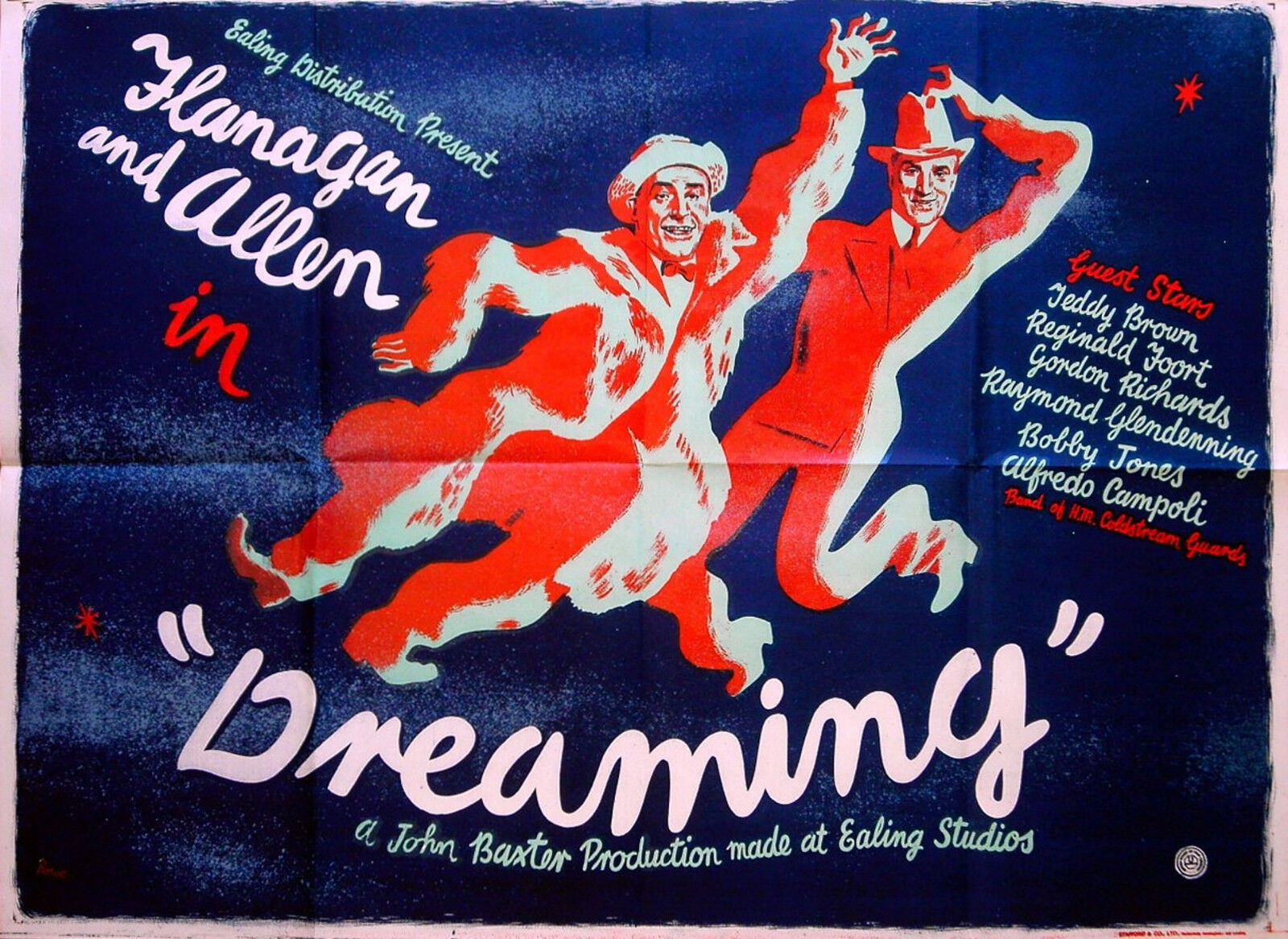
That kind of dreamy scenario was also adopted by Flanagan in his work with Chesney Allen. As Flanigan and Allen – a kind of pre-war Morecambe and Wise – they made Dreaming in 1944, a film about a soldier who dreams a series of odd dreams while out cold on an operating table. They also recorded hugely popular songs such as Underneath the Arches about two down and outs sleeping underneath railway arches who ‘dream their dreams away’ and another song called Strollin’ about a man who knows his “luck is rolling when I’m strolling with the one I love.”
Strangely, or not, given apparent coincidences are often pre-engineered by people with poetic souls, a plaque at Golders Green memorialising Bud Flanagan sits almost directly opposite the memorial for King Rat Teddy Brown. The king and his successor brought together again in one place.
One has to imagine that the vast majority of London’s vaudevillians – a generation or two of wonderful entertainers worth remembering – ended up at Golders Green. That’s a whole lot of lost jokes and songs that are now a whole lot of lost ashes. But never mind, there are still little scraps of evidence of their existence that it’s possible to stumble across on a wander through North London on a summer’s afternoon. Just keep your eyes open and you’ll spot them too.
As an added bonus click here for a playlist featuring some of the songs that inspired this article.
* I would highly recommend Ian Nairn’s ‘Nairn Across Britain’ series in which he travels across the country looking at buildings that were, at the time, under threat. Many of the structures are now sadly lost, but the series is still worth watching all the same – particularly the episode in which Nairn drives from London to Manchester. In fact, I first discovered him in a YouTube video that someone had made of Nairn driving into Manchester as The Duritti Column’s Otis plays in the background.


 Robert Leeming