The silvery spires of Canary Wharf, the spotless thoroughfares and perfectly kept squares, sit upon the buried foundations of the West India Import Dock. From its early days when the Isle of Dogs (as it is also, poetically, known) was the beating heart of an expanding trading empire, to the Night of Fire when the German Luftwaffe turned the dock and great swathes of Wapping into a fiery furnace, this area of London has never seen a particularly pretty day. Today the Wharf is pacified and gentrified and is now this country’s financial powerhouse, with not one jot of its former guise to be found anywhere. That is except for “The Hibbert Gate”, a recreation of the original entrance to the West India Dock and one of the many pieces of public art which can be found dotted throughout the Wharf, randomly scattered, around its sculpted parks and ramrod straight streets, art often missed by eyes consistently drawn skyward by the impressive high-rise scene.
Canary Wharf reeks of New York, but without the irrepressible intensity, it is strangely impotent of atmosphere, its atmosphere being only its distinct and obvious lack of one. The art adds something though, a little bit of post modern mystery in a place which has had its real genetic make-up erased and forgotten. Outside Jubilee Place lies “Testa Addormentata”, a large bandaged bronze head, Grecian in style, with a proud but losing face, created by Polish artist Igor Mitoraj. Though impressive, it seems awfully small in comparison with its surroundings, like a topped and tailed colossus from antiquity, lacking its trunk to lend it stature. It probably felt bigger in the workshop, but now it lays cheek side down, gazing towards the glitzy giant of 1 Canada Square. Antiquity bettered.
In Cabot Square sits Lyn Chadwick’s bronze “Couple on a Seat”, two figures, sat aloof from the bustling square, the king and queen of Canary Wharf gazing out towards the docks. Though not particularly regal, instead pointy and frigid and cold, they are not without grace, the gentle angles at which their legs lie and the drift of their clothes being particularly effecting. Nobody seems much to notice them though, theirs is a subdued monarchy, their rule is constant, yet forgotten.
A much more light-hearted, just as tragic figure, can be found to the right of Cabot Square on West India Avenue, a big man holding out for hugs, a rough hewn bronze figure, Giles Penny’s “Man with Arms Open.” To be taken seriously around this part of town you have to be metallic to the core, no icon of the Wharf could be anything but, yet this man’s arms are stretched backwards, in anticipation of affection. It’s such a desperately sad moment to be stuck at, near an embrace, but not quite there, the ruffles in the bronze metal work lending a crumpled look, helping to create a rather hopeless aura around him.
But where is the lady who has escaped our man’s wasted embrace? She is probably waiting beneath Konstantin Grcic’s “Six Public Clocks” for another metallic friend.The work comprises of six metal clock faces, based upon that icon of punctuality, the Swiss railway clock, the faces all sitting in Nash Court, atop six metallic lollypop sticks. It is such an excellent place to meet, in a town which runs to deadline and schedule. J.D. Salinger said “If a girllooks swell whenshemeets you, who gives a damn if she’s late? Nobody.” But stood under the clocks it would be obvious, six fold obvious, that someone was late, and the aggrieved party could stand there with a knowing smile, glance upwards, brush off those lost minutes and rush into a grateful greeting. Embrace returned. How ironic it would be though if the clocks were all stopped? Timelessness brought to a place which simply could not stand it.
In nearby Columbus Courtyard there is another Mitoraj head, “Centurione I”, a mask really, half smashed and missing a piece, this one is much more ominous looking, much more desperate, fed by a slide of water which appears to sustain it. It is quite amazing that someone can craft such a haunting face when the remaining eye is empty, but its shape alone screeches emotion. The courtyard is almost empty and the only thing which will stop lingering passers-by from imagining themselves as lost wanderers through an empty unrecognizable future city who have just ran across a mask-like fragment of a lost civilisation they used to know, is the empty Pret a Manger to the left of the sculpture, which keeps your imagination very much tied to earth.
At Westferry Circus the river can finally be seen again and all the sights of Central London upstream are welcome reminders that you haven’t left the city after all. The Circus is prim and un-British in its perfection and amid a flowerbed can be found a golden egg, a sasso cosmico, a cosmic stone. The Golden Egg of Canary Wharf, a sculpture by Do Vassilakis-König, a golden trinket not born out of the stock market or a dot com boom, but washed up from the Thames, perhaps, a mysterious link between the new and the original, the city and the river, because whatever outfit the Wharf wears, the river will always surround it.
The balloon was nothing more than an experiment to me. A ribald joke on the inhabitants of a town I never liked, nor trusted, nor felt a part of. I suppose that is what it was. It was a metaphysical something, a clichéd statement born out of amphetamine and tepid water. It was an empty folly and a hopeless gesture, loved in quarters and hated in others, held up for ridicule in Sussex and dismissed as hearsay in counties but a carriage ride away. I do not refute its ownership, I do not deny it belonged to me, but I do not speak of it with pride.
The notion came to me in the Fen Country. The night-times are truly black there and no oil lamp light or night nurses, measuring temperature and heartbeats, will convince you otherwise. Even with a bitch of a gale whistling down from some of the lesser known peaks, the evening stars are always visible. A free spectacle, a million tiny bulbs kept in order by a man with too much time on his hands. The Great Bear and Pleiades, I could see those alignments, plotted beautifully, placed with concentration and consideration, like a course plotted by a celestial commodore to the other side of here and there.
I dreamt of consistent spectacle, not spectacle dependent on the time of day or the paths of cloud, but a spectacle pinned on me and remembered through me, brief though, like an eclipse, yet unbroken in its beauty. Something better than the heavens.
Once inflated, the balloon, twenty miles across, expanded eastwards from Tetbury towards the Norfolk coast. Gently lifting off the slate rooftops on which it had rested for a good twenty-four hours, the balloon gathered in shape, taking breaths of the dewy morning air to power its ascent, diving and rising, leaping with greater confidence as its body was assumed, until, after an hour or so, it blocked out the new day’s sun. Then I ordered it stopped. And the Moroccan builders, who I had rounded up from a Calais seaport the previous Tuesday to assist with the logistics of the project, were happy to oblige. They had been paid several dinars each for their services and had been given permission to set up a small tent village near Valley Forge. Raucous frivolity and Moroccan music could be heard throughout the midnight hours, but there was nothing that could be done about it.
The balloon was kept in position by thirty iron chains, rooted in the ground at particular angles, so as to keep it tethered to the earth, but not to restrict its movements too much, or drag it downwards. From time to time I would walk around the edge of the balloon’s shadow and inspect the metalwork to ensure it was maintaining its grasp. The chains would soon become attractions in their own right, as the people’s only connection to the balloon itself. Messages would be left pinned to them, with questions or prayers, or requests for heavenly intervention. Every now and then I would see a girl, all of twenty, or less, early in the mornings, blonde and lovely, barefoot and brave, dancing around a chain in the silence, a hand outstretched towards the metalwork, links she had decorated in ribbons and wild flowers picked freshly, just minutes before, from Sudeley Dell, a chain transformed into a post holocaust maypole. I stopped for a moment, wrapped by the beautiful turns of her body. I am not too sure of her circumstances, but I think she missed the balloon after its departure.
Every now and then, a man or a woman, desperate to see the sky again unblemished, would rush towards the metal chains and attempt to hack away at them with axes and mechanical cutters. In such a case I would dispatch a gang of my Moroccan builders, still at camp in Valley Forge, to restrain the offenders and gently remind them that the spectacle they disapproved of so was done in love and nothing worse, and they were quickly returned to their senses.
2
The sun still shone through the balloon, giving a lovely grainy light, suspending the valley in a constant dusk. The street lights burned through the day and working hours were cut short by benevolent employers, so people could enjoy the refracted sunsets, the brilliant burning red, turned blue and green and vibrant turquoise by the differing shades of material sowed into the balloon’s fabric, reacting to the sunlight and the curvature of the earth.
The world went on, but the day seemed different, the clock meant as much to people as ever, if not more, but people looked up much more often and considered the mystery behind their existence a little more than usual. The sky was missed, the deep blue of a summer sky, like the ocean upturned, was missed, although shadows of clouds could still be picked out when the day was especially bright, like silhouetted figures, their cut-outs passing across the grafted skin.
Although the rain no longer fell, it still made itself heard, more so than usual, pounding upon the fabric and echoing through the helium filled chasm to the world beneath, as if some brazen farmer had taken to the roof and begun casting seeds across the cloth, in a vain attempt to sow a heavenly field. The rain would trickle down the skin to the edges and sheet off, creating vast, glassy waterfalls, curtains of water, hemming in the covered land totally and creating flat, laser-like rainbows which darted through forests and towns like colourful bars of seaside rock. Children would run through them and jump over them and stand in them and embrace all the colours and feel the coloured air and cup the colours in their hands, until the rain stopped and the rainbow bars receded to the edges agai and quietness was returned.
Bird song was constant, the one-time morning chorus stretching long into the late afternoon. Birds trailed the outline of the balloon, bristling their feathers against the material, as if to pay homage to the great lumbering creation, which had stayed so steady in the face of nature herself, and limited them, however briefly, to the lower echelons of the atmosphere.
At night-time the balloon could appear unsettling, a dark mass hanging in the sky. So between the hours of seven and twelve I ordered it flood-lit, bathed in a creamy light, a moon-like light, a gentle warm light, which people could gather under and feel settled. And people did gather, to sing and to strum acoustic guitars and to hold each other and to eat and drink with each other, under the balloon, and feel enveloped in its temporary aura. On nights when it was warm but rainy, the balloon protected them, and on nights when it was cool, the balloon insulated the heat from the homes and the factories and the places of business and kept the night time warm, despite the turning of the season from summer to autumn. Some would project pictures onto the skin, beautiful pictures of people and places that made them feel happy, and I would feel happy too.
Standing on Sudeley Hill I would look at the scene, outwards towards the shires and fells, the villages and farms which comprise this land of ours, and all the spires of England would seem to pierce it underneath and test its strength, yet still nothing broke the skin. “Oh rancid communion!” I would say to myself, “I will not tie my future grace to any one man nor to a distant kingdom, only to this green grass beneath my feet and to your sweet eyes, if ever they should return to me and if they do,” I would say, “I will free the sunshine, free the sky, to anyone or any country seat who wishes to use it for a better purpose than I.”
I was never fundamentally disconnected when the balloon was out of my eye-line. The opinions of others mattered little. I was only interested in the health of the balloon and the report I received every morning about its current structural integrity. If a tear was spotted as the balloon aged, it was fixed quickly, by inflating a second smaller balloon, with two skilled “patchers” as they were labelled, occupying a wicker basket underneath it and reaching out with needles and thread, to fix the tear when they approached.
I accompanied them once on this trip. The balloon seemed to whimper at the cut, to shake and to cry out, yet the “patchers” rectified the problem with care. I reached out with them, the three of us leaning out of the wicker basket, hundreds of feet in the air, looking from afar, no doubt, like a half hearted suicide pact. I touched it, I reached my hand out and I touched it, and the balloon felt warm and alive and real. I pushed and I pushed and my hand stayed gently pressed against the flesh, palm out stretched, fingers pointing. We were connected again, the shadowed land below, the blocked out atmosphere above and us in between. I had created it, and put it there, and it had stayed there for me, out of loyalty and love, unproven in fact or word , but physically tested and certainly resilient. I wished it luck, silently of course, and a steady and solitary few days in the heavens. I pulled the cord and the flame burned harshly and we descended, and my eyes remained skywards and fixed as we did.
3
I told her this was all for her, a subversive manifestation, something more than sky, more than a mere statement or a token, but a literal and real reflection of the effect she had had on my emotional life. If the people under the balloon woke and thought first, and only, of the balloon in the opening seconds of consciousness, then the balloon was doing its job. If they cursed it for stealing the sunshine one moment and then confessed a secret adoration for it when seen in a particular light or on a particular day, then, the balloon was doing its job. The balloon was always there, in the eye line, in the back of the mind, just as she had been in my eye line and at the back of my mind, for years. If it provoked debate and the racking of brains and the emotional exhaustion which comes only with over thinking, when words begin to lose their meaning and confusion ensues, then the balloon was doing its job.
She was ill impressed, she was difficult to impress, she didn’t get it, and struggled with the concept. I took her to Sudeley Hill, to view it from the outside in. There was a man there too, a painter, with an easel and a canvas and a jam jar full of cloudy blue water. He told me that what he saw was an oil painters dream, a principled and refined attempt at physical emotional articulation.
I remember, he wondered, “Who could it be for?” Before putting down his tools for a moment and taking in the air. I broke into a wry smile and shouted to him, “It’s for her you know!”
She didn’t even look up and the oil painter laughed, “I doubt it,” he yelled back.
The painter told me that he had rode through every town under the balloon’s shadow and had not seen a single smashed window, a single sign of unrest, only people continuing with their lives in order and tranquillity. But, he added, the words on everyone’s lips were not the talk of the week or the talk of the town, but words only concerning the balloon and how they were going to spend an evening under its watch. Then he wondered aloud again, “Was this true love, or simply novelty?”
Sooner or later, he predicted, someone was going to raise the thought of bringing it down and the talk would spread, he claimed, and swell and wagers would be taken and books opened in country taprooms on how long the balloon would continue to live. And lonely men and fathers and people with gainful skills, would gather in workshops and garages and front rooms with paper and markers and start to plot their own attempt on the balloon’s existence, a public lynching in the crafting, in all but name.
And the sorry days dawn would break, and with the rising sun would come a hundred, or more, homemade craft, crate paper airplanes and nautical vessels adapted with boosters and cranes, monstrosities of balsa wood and string, rented wings and military gliders, filled to the brim with men and boys, armed with pick axes and air rifles, lances and knifes, who would proceed to hack and pull and fight and scratch, until suddenly the balloon would give and a man would raise his arms in glee and claim he was the one who had killed the balloon. And then another, and then another, and then another would do the same in similar triumph.
The anecdotes would form and spread on the say-so of the so called tanked-up witnesses, the tales of heroism and grit, and the story would become the death and not the life, and the poetry and the beauty would dilute from the collective memory. The balloon would be hacked to pieces and people would walk around with snatches of its flesh hung around their necks on golden chains, like cherished handkerchiefs dipped in the blood of a dethroned monarch.
I went around personally, alone, to cut every cord and free the balloon from its temporary berth. With one chain left it pointed upwards, as if half weighted down to earth, in two minds as to whether stationary death and something to hold onto would far outweigh eternity in the sky. I drew my arms back and began to hack away and as the final strands and coils of silvery metal tore in two, the balloon hovered a while and then, gracefully, began to rise upwards, slowly at first and then faster and faster as it was carried away on the wind, erasing the streams of jet planes as it rose. And suddenly the sunlight poured through and retook its rightful place, as if the particles of light were bearing the balloon upwards upon their glittery shoulders, upwards towards the sun, to face the fiery giant it had tempered for so long, to look it in the eye, to face down its strength, to be pulled in by its power and then finally melted down, after inevitable submission, as punishment for dulling its heavenly majesty.
The people cheered the balloon’s departure and yelled and launched fireworks and shouted abuse and celebrated long into the night, forgetting the momentary joys it had provided for some. I stood an hour or so and watched it disappear into the sky, and wished it free and wished it safe and wished it home.
British history is certainly a dashing pageant, with its cavaliers and roundheads, its renaissance men and new romantics and its garter sashes dipped in kingfisher blue, thrown over countless brave, and some not so brave, monarchs and national heroes. But from Nelson to Victoria, from morris dancing to music hall, Britain’s chromatic tapestry of mythic figures and traditions all have one thing in common; they all fell over the side of good ship England, into the messy and crowded oblivion that is our nations past.
In a prim and pretty nutshell, that link is what lies behind Damon Albarn’s new English Opera, Dr Dee, which received its world premiere last week at the Palace Theatre, as part of Manchester’s increasingly renowned International Festival. In many ways English opera is a little like English sparkling wine, it is an acquired taste and the stuff from the continent is much better. Nonetheless Albarn’s attempt at reinvigorating our operatic lustre is accomplished and beautiful.
The story is admittedly hard to fathom and the lead character John Dee, an English mathematician, astrologer and advisor to Queen Elizabeth, is largely mute. Instead we are presented with an excellently constructed dream-like sequence of colourful scenes and sharp symbolism, the key events of Elizabeth I’s reign from coronation to armada, anchoring the plot.
The Elizabethan court is skilfully recreated. Elizabeth appears dressed in a nightgown and steps into her ready royal regalia, set up like a fairground cut-out, before being hoisted above the stage, orb and sceptre in hand, the untouchable Virgin Queen, ever-present, yet out of reach. Robert Dudley never stood a chance. The all seeing Francis Walsingham, the Queen’s spymaster in chief struts around the stage too, on stilts, little escaping his glaring eye.
Albarn plays the post-modernist minstrel, perched above the stage on a separate level, with a gang of gifted musicians playing medieval instruments, backed by the slightly under used BBC Philharmonic Orchestra. The music is traditionally English, folk filled and pretty and Albarn’s songs intermingle well with the libretto performed on the stage, offering perspective. The stand-out song “Apple Carts” is performed in the opening seconds of the opera and accompanies a parade of English characters from punk rocker to suffragette, from Horatio Nelson to city gent, as they sashay across the stage and drop backwards off a platform, shuffling into eternity, making for a particularly poignant spectacle, just one fine example of a sumptuous staging by director Rufus Norris.
The second half, which perhaps could benefit from a little more crafting, deals with Dee’s relationship with the rather roguish and incongruous Edward Kelley, who claimed he could communicate with angels, a subject which fascinated Dee. Kelley was a bit of a chancer, a bit of a slimy bastard, who told Dee that he had been in touch with “angels” and they had suggested, quite handily, that they share everything, including (wink, wink, nudge, nudge) their wives. Apparently, Dee went along with this and, in hindsight, quite rightly, quickly cottoned on to the fact that a dash of deception was at work and never spoke to Kelley again. Of course the comedic potential of this episode is not at all dwelt on in the performance. Thank God.
Many say that Dee was the first to conceive the notion of a “British Empire” with his advocacy of English expansion into the New World. This of course was during a time when our national characteristics were more swaggering than doubtful. We were a nation more sure of our importance and traditions, a cocksure attitude that would ultimately lead to the “Hurricanes, Spitfires and Tornadoes,” Albarn sings of here, darting through our skies, years of conflict, finally leading to our national collapse. However different we are now though, our roots are still traceable to an older England and Dr Dee is a fine celebration of our common heritage and a poignant reminder that we are only the latest link in a very long chain.
The opera closes with Albarn, the narrator, following the pattern of the suffragette and the Tommy before him, falling backwards into oblivion, his story complete. We are all but articles of our day, as Elizabeth I said, “All my possessions for a moment of time.”
There is a very obscure Scott Walker track, long forgotten now, except by the scant few who have fallen in love with it, called Time Operator, from the singer’s 1970 album ‘Till The Band Comes In’. It is an especially pretty song, in which the protagonist conducts a make-believe affair with the speaking clock. “You just picture Paul Newman,” Scott sings, “and girl he looks a little like me.” The telephone adds a particular sense of mystery to relationships, whether make-believe or painfully real, due to the ambiguity wished up by separation and distance. “Could she really be that nice?” One wonders. “Could she really be that funny?” And then the nerves and harsh light of reality snatches that away when meeting eye to eye. Of course this is only of note when the protagonists are beautiful, shy and lovelorn types in the Richard Burton and Elizabeth Taylor mould, eternally in love but persistently at war. Not hunched over, distasteful loners using the telephone to pester and stalk. But we are inhabiting a particularly romantic sphere here, so the former is, of course, the case.
La Voix Humaine, a one act opera by Francis Poulenc, based on a monologue penned by that inimitable genius of the French avant garde, Jean Cocteau, must have been one of the first works to consider the effects of the telephone on love. The brisk, 55 minute piece, depicts a lonely woman recovering from taking an overdose of sleeping pills, making a phone call to a former lover, on the eve of his wedding. The distance and shelter that the telephone offers lulls the woman into believing she can alter an irrevocable situation from afar, she is of course mistaken. The way the telephone cord lingers around her neck during the final minutes of the performance and seems to twist like a constricting snake, suggests that the emotional trauma inflicted by their break-up is, most likely, irrevocably fatal. “Je t’aime, je t’aime, je t’aime,” she whispers, as the music concludes. Everything rests on it, nobody is free.
A rare performance of La Voix Humaine made up the second part of Cocteau Voices, a recent double bill of new productions at The Royal Opera House Two, considering the monologues of the French genius. “The Royal Opera has never produced La Voix Humaine before,” says Aletta Collins, the choreographer extraordinaire behind this and other recent ROH productions, such as Anna Nicole Smith The Opera, “mainly because it is for a single woman, lasts for 50 minutes and has an orchestral score of almost fifty parts, so there is always the issue of what are you going to put on with it.”
This problem was solved by transporting the production to the cosy Linbury Theatre, which sits in the rather grand shadow of the Royal Opera House itself. The London Sinfonia (a much more compact 38 players) was drafted in and a new, purely dance work, for the first half, in support of La Voix, was created, choreographed by Aletta, with a completely new score composed by none other than the irrepressibly mysterious former Walker Brother himself, Scott Walker.
Scott and Aletta’s working relationship stretches back to Drifting and Tilting, a Barbican production of Walker’s songs from his experimental and almost impenetrable recent albums Tilt and The Drift, which saw British pop luminaries Damon Albarn and Jarvis Cocker performing Walker’s oeuvre. Scott, renowned for being one of pop’s great absentees, got in touch with the show’s producer and suggested that a handful of the songs feature an element of choreographed dance. Aletta was of course recommended for the job, and the partnership was so successful that she turned to Scott when she was in need of a new soundtrack.
The new work would become Duet for one Voice, based on Le Bel Indifférent, a Cocteau play written for Edith Piaf, featuring a woman pleading for the attention of her lover, only to be met with constant and complete silence. The scenario is turned on its head here and features a man pleading for the affection of his lover, only for her to sit through his protestations and pleas in silence, her face covered by a morning edition of Le Monde.
Walker’s score is intimidating, as all of his recent work has proven. The multi-layered beauty found in Tilt and The Drift can only be discovered after repeat listens, and the same is no doubt the case here. The music is varied and often jarring, the dramatic and loud stops and starts which dominate The Drift return here, as does a musical experimentalism which sees, at one point, a chorus of barking dogs dominate the recording, followed by noisy industrial drones. A solo trumpet consistently returns throughout the work, playing some wonderfully melancholic jazzy tones, which brings to mind dark street corners and sultry neon tragedy.
But it is the text, says Aletta, which was the first port of call when devising the choreography. “It started with the text because that’s what we had and we pinpointed in it certain colours and emotions or mental states, which became the genesis of different sections of the music.” From these early discussions and reactions, Scott developed the score. “I didn’t want the dancers to visualise the music,” Aletta says, “I wanted an honest response physically to the themes and ideas of the text and then married them together with the music.”
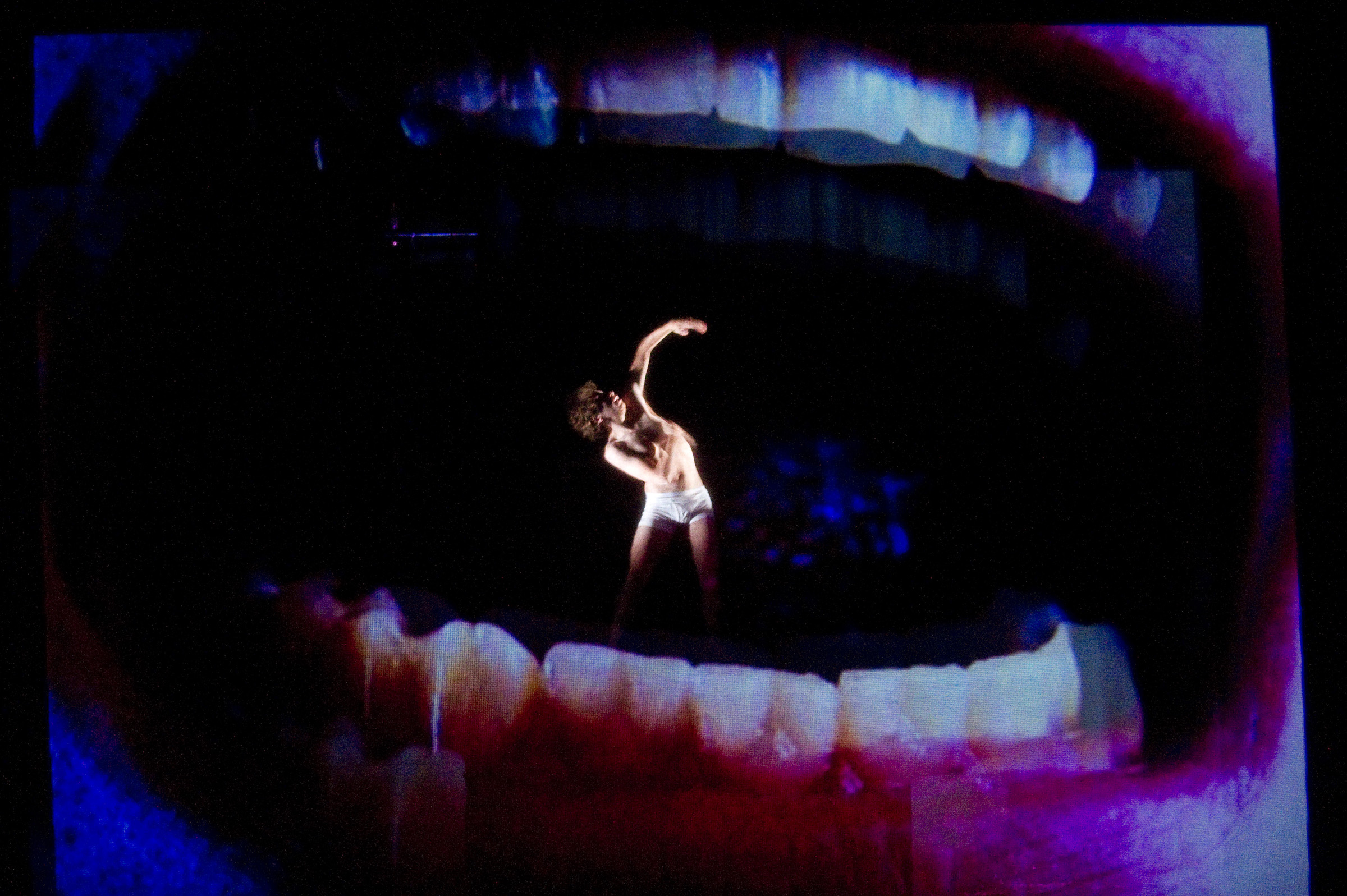
The narrative of movement on the stage, seems to play out the different clauses and stages of sexuality, from rejection to acceptance, the ecstasy and passion of carnality, from connection to disintegration. What is presented is, of course, an opposing and imagined reality, it could be reality, quite easily, it all depends on the say so of the woman, who sits deaf to the simmering sexuality, engrossed in her newspaper, her foot turning clockwise, repetitively, maddeningly, inpatient and uninterested. Other opposing realities are explored by the dancers too, what if the lover responds, what if communication springs into life, does it end blissfully, or in the kind of despairing phone call seen in La Voix Humaine? And yet, as the opening scene of the production reminds us, which depicts a half naked man maniacally gyrating inside a large red ruby lipped mouth, everything begins with desire and often ends up in trouble.
If all this seems very far removed from the traditional operatic fare that one expects of the Royal Opera House, then this is because the production was commissioned by the Royal Opera House 2. ROH2 is the contemporary arm of the ROH, or as Alison Duthie, the head of ROH2 labels it, the Opera House’s “permeable skin,” because of its ability to work with different companies and commission new works. The aim of the organisation is to push new art forms and promote and commission new and contemporary opera and dance, in an attempt to widen the mediums audience.
Cocteau famously said “an artist cannot speak about his art any more than a plant can discuss horticulture.” And yet he was very adept at describing the themes running through his prose. “Mysterious accidents and heavenly calculations,” he said were his inspiration, the invisible undercurrents which run beneath the foundations of any relationship. These undercurrents can of course be highlighted in a text, but they are made much more evident when considered through the prism of music and movement, arts which themselves hold certain invisible and mysterious powers. “All my poetry is in that,” Cocteau said, “I trace what is invisible, invisible to you.”
I must admit, I arrived at the Royal Opera House on Friday night for Cocteau Voices as a disciple of Scott Walker, and left with Jean Cocteau and Francis Poulenc entirely on my mind. The double bill of performances features a new dance piece based on Cocteau’s plays Le Bel Indifférent and Lis ton journal, interpreted musically by a brand new soundtrack by the irrepressibly mysterious former Walker Brother, and concludes with a performance of the Cocteau/Poulenc collaboration La Voix Humaine. I’m hardly a scholar when it comes to Cocteau’s work and with what knowledge I do have, I would probably have sided with Walker’s own recent assessment of Le Bel Indifférent as an “antiquated piece of misogyny.” The play, written for Edith Piaf, features a woman pleading for the attention of her lover only to be met with constant and complete silence. Both pieces are though, without doubt, excellent representations of failing relationships, caused by failing communication.
Cleverly, choreographer Aletta Collins’s Duet for One Voice, a dance interpretation of Le Bel, commissioned especially for this occasion by the Royal Opera House, turns the scenario on its head and features a man pleading for the affection of his lover, only for her to sit through his protestations and pleas in silence, her face covered by a morning edition of Le Monde.
The nearly thirty minutes of dance that ensued seemed to me to be impressive. I know little about the ins and outs of professional modern dance, but if the purpose is to showcase the beauty and contradictions of the human form, then this is exactly what I saw. The narrative of movement seemed to play out the different clauses and stages of sexuality, from rejection to acceptance, the ecstasy and passion of carnality, from connection to disintegration. It is of course an opposing and imagined reality, it could be reality, quite easily, it all depends on the say so of the woman, who sits deaf to the simmering sexuality, engrossed in her newspaper, her foot turning clockwise, repetitively, maddeningly, inpatient and uninterested. The emotion conjured on the faces of the dancers was really quite extraordinary and their energy and passion, seemingly limitless.
Scott Walker’s score is intimidating, as all of his recent work has proven. The multi-layered beauty found in Tilt and The Drift can only be discovered after repeat listens, and the same is no doubt the case here. Nevertheless the music was varied and often jarring, the dramatic and loud stops and starts that dominate The Drift return here, as does a musical experimentalism that sees, at one point, a chorus of barking dogs dominate the recording, followed by noisy industrial drones. And yet, there is much more to hang onto here, there are moments of real melody, something that has disappeared from Walker’s recent work. A solo trumpet consistently returns throughout the work, playing some wonderfully melancholic jazzy tones, which brings to mind dark street corners and sultry neon tragedy.
The second part of the evening features a performance of Francis Poulenc’s La Voix Humaine, a short opera, for one voice, which sets a woman’s telephone conversation to a departing lover to music. I’ve never seen anything quite like it and was impressed that one woman, on the phone, could hold the stage and the audience’s attention for so long.
The words sung belong to Cocteau and depict a woman who is trying to put a brave face of her emotional disintegration. She tells her partner she has just returned from a restaurant, a dinner date, dressed up to the nines, when in truth, she is in her nightgown, make-up stale, bed unmade and surrounded by plates and bottles. She puts her mind at rest by considering herself footloose and fancy free, but deep down she knows her heart is settled on a destination and failure to reach it would cause it to break. All she thinks about is him she finally admits, and when he is going to ring and what life would be like without him. The ultimate fear of course is loneliness, dying alone, isolation, her friends, she admits, are settled, organised, while she still relies on hapless affairs and momentary passions.
It must have been one of the first works to consider the effects of a technological medium on love. Whereas today a similar piece would no doubt consider the art of breaking a heart via text message, here the telephone is studied as an instrument of torture. The line continuously breaks down and wires are crossed by confused telephone exchanges, a true reflection of the rudimentary Parisian communication system of the day. She jumps when the phone rings, she panics when it cuts out, she is held to ransom by its ring.
The way the telephone cord lingers around her neck during the final minutes of the performance and seems to twist like a constricting snake, suggests that the emotional trauma inflicted by the break-up is most likely irrevocably fatal. “Je t’aime, je t’aime, je t’aime,” she whispers, as the music concludes. Everything rests on it, nobody is free.
The stage direction and designs by Tom Cairns are simple, yet effective. Deciding to conceal the Southbank Sinfonia backstage allows the set to be close to the audience, unbroken by an orchestra pit and allows for an exceptionally involving experience. Nuccia Focile, the Sicilian singer, is tasked with pulling off this one woman act and she does so with panache. Her first notes sounded slightly crushed by the weight of first night nerves and the thoughts of what she had to meander through for the next fifty minutes, but she quickly recovered and delivered an engrossing performance.
This is certainly not a night for everyone, I heard grumbles on the way out, and it may prove difficult to maintain an audience for two exceptionally different pieces of work following one after another. However, if you approach it willing to accept the “mysterious accidents and heavenly calculations,” which dominate Cocteau’s work and the invisible undercurrents which run beneath the surface of relationships, then there is a great deal to learn and revel in here.
Plastic Fairy Liquid bottles and Django Reinhardt’s finger tips are things unlikely to be associated with the birth of Heavy Metal, that brashly grinding, cherished Brummie drone which has afflicted, or violently garnished, depending on your viewpoint, our airwaves for years. Django famously burnt his hand after his caravan, (shared with Florine Bella, and stuffed to the rafters with crepe paper and celluloid flowers) caught flame after he knocked over a candle. Reinhardt’s obstinate determination to recover from his injuries and pick up his guitar again would later inspire one Tony Iommi, soon to be of Black Sabbath, then a young Brummie factory worker, to return to the guitar after slicing his fingers off in a particularly nasty industrial accident.
Yes, floors around the world are scattered with the digits of significant guitarists. So, how did Tony Iommi bounce back from his lack of sculpted cuticles, in order to form one of the great Heavy Metal groups of all time? Well, cleverly, he crafted replacement plastic finger tips from washing up liquid bottles, tanned them in leather, tuned down his guitar and loosened the strings in order to adapt to the change, thus, or so the story goes, giving birth to that fabulously dirty, grinding, heavy metal drone.
The ominous shadow of industry also played its part, which hung over the youth of Birmingham in the 1970’s like the smoggy silhouette of Richard III. It was the factory or nothing for most. And long before the repetitive grind of machinery was eclipsed by the soft crinkle of office keyboards, the noise of industrial Birmingham it seems, proved oddly inspiring.
Now, years after Black Sabbath and Judas Priest swaggered through a decade from Henry’s Blues House to the rest of the world, Capsule, a Birmingham based arts group are to launch Home of Metal, a summer-long arts festival ruminating on Metal and its legacy. “We found there was very little held in museums, libraries and archives that looked at the history of the genre,” says Lisa Meyer, Capsule’s coordinator, “and we wanted to make up for this.”
To bypass the lack of materials, Capsule organised a series of “Antiques Roadshow” fairs for Metal fans, in which rockers of all ages brought in their dark trinkets and dusty vinyl collections for judgment and appraisal. One such fan was Bill Sneyd, a forty year old accounts manager and a lifelong Metal fan since his days at Walsall College of Technology. He discovered the music through the usual channels, a loaned cassette on a Spanish holiday and a rifle through a friend’s record collection. His friend “had the lot,” Bill remembers, “Priest, Purple, Zeppelin, Sabbath, Lizzy, Magnum, the list went on. It was 1988, he played me British Steel and Led Zeppelin IV and I was hooked.”
Metal fans are famously devoted to the genre, but they are also aware that much of the music’s affiliation with doom, gloom and the fiery occult should be approached with tongue firmly in cheek. The philosophy of the music says Bill, is to “turn it up to eleven, bang your head and have a good time.” There is a sense of escapism on offer to those who love the music, the heavy sound is all enveloping and can transport you to another place, if you are willing to let it. Bill believes Metal is best labelled as “music with teeth,” with lyrics that can be quite laughable one minute yet contain the ability to “move you to tears” the next.
It is hoped that the festival will appeal to a wider audience than just Metal fans though, and Lisa and her team at Capsule have gone to great lengths to ensure there is a wide palette of shows and exhibitions on offer, “which will make people in the region feel really proud of their heritage.” One of the events they are most proud of is an exhibition planned for the Leather Museum in Walsall, which will display a number of Judas Priest’s famous leather costumes. There will also be a display at the Wolverhampton Art Gallery called “You Should be Living” which will explore the language of Heavy Metal and an American called Ben Venom will display a host of patchwork vintage metal t-shirts, “kind of patchwork quilts,” as Lisa labels them , “but with sculls on.” Obviously.
The major art show of the festival will be “Be True to Your Oblivion” presented by Turner Prize nominee Mark Titchner. “Metal is something that has cropped up in my work over the years,” Mark says, in a career that has focused on the visual potential of language. One of the newest works displayed will feature a video of Nic Bullen, one of the founding members of Napalm Death, a famous grind core band. “They are known for their extremely fast songs,” says Titchner, “but for also developing this style where the language becomes impossible to hear, the vocal becomes a grunt.” Many, like me, struggle to get past that particular element of Metal and start to sound a little like Pete Seeger standing, axe in hand, over the electrical cords powering Dylan’s amps at Newport, mumbling about how it’s impossible to hear the lyrics over the “distortion”. But I suppose you just have to get over that.
Bullen performs a work written especially for him by Mark in the video, with a very close camera shot bearing in on his mouth and throat in an attempt to “consider the actual mechanisms of sound making, separated from the background noise.” The sound of the voice is critical to other parts of the exhibition too, for example an exhibit called “Be Angry, Don’t Stop Breathing” which Mark labels as similar to group primal scream therapy, will encourage visitors to shout, scream and talk into a large microphone linked to the galleries PA system. “I’m interested in what happens when you give a person the opportunity to scream in a place where they shouldn’t,” he adds.
The power of the pithy epithet and the isolated lyric are also important to Mark. Much of his work consists of colourful banners and posters, embossed with a particular quote or lyrical line, such as “you should be living, but you only survive” or “we want answers to the questions of tomorrow.” A banner made especially for Home of Metal features the adamant “I’ll chose my own fate” taken from the lyrics of a Judas Priest song. The banners are the result of “disconnecting an idea from its original place,” says Mark, “so if you have something that is a Heavy Metal lyric or a Britney Spears lyric, it sounds like a philosophical text, when you take it away from the context of the music.”
Of course the existential can be found in anything if you are willing to look hard enough to see it, from the pages of scripture to the list of ingredients on the back of a Crème Brulee. The mysteries of life are not necessarily held and solved only within the holy or the sacred. Rather a simple isolated lyric from a Heavy Metal song penned by a bunch of Brummie rockers can, to some, offer the key to a happy life and a well anchored existence, if held up to a particular light. Answers are seen in the eyes of the beholder. Bill Sneyd’s favourite lyric is “hell bent, hell bent for leather,” from the Judas Priest song of the same name. He can see something in that, and you know, if I look hard enough, so can I.
Smokey London’s hapless night time feel and me were never one. Forty eight minutes to ten, Guinness time. Hold me up or hold me back, I’ll make it there in time for The Girl I Love.
The trams are finishing tonight. When you heard them fumbling their way through the morning, first thing, you knew you had survived another fiery night. The rattle, the clang and the sway and oh how snug it was to be on the inside, when it was raining on the outside. The trams and the rain and South London all seemed to go so well together then. And now what of these unused rails? The paths left abandoned, the streets never chosen. And what of that special section of thin air, reserved solely for those hardy souls, temporarily suspended between street and sky?
I never appreciated my position. I never gave it a second thought. The magic in the everyday, the mystery within the machine. Gliding through the kerosene strings of Christmas lights and Chinese lanterns, the filament eyes, tripped into life by the lamplighter’s touch, all the while sat side by side with the wishless old ladies who thought nothing of it.
I thought something of it though. Every single night. Like putting lighter to cigarette, I still love that sound. It’s nothing. The fizz, the sizzle, as flame meets paper and root catches light. Inhale and exhale smoke. Smoke is like a secret, the hazy wisp of a secret, breathed in for a moment, hidden inside, deep within the chest and breathed out when concealment becomes too much.
Now I’m demobbed, but I’m still feeling the Ardennes in the palms of my hands, in the soles of my feet, I’ve got its mud under my fingernails and its metal in my back. I held his hand as he melted into the dirt. I took his pictures from his top pocket, took his letters given passage by BFPO and held them in trust near his St Christopher, until I could plead my way home.
The tram driver becomes a bus driver tomorrow and for the first time in forty years he will be able to sit down, but then again, I suppose bird song always does sound louder after any storm. I’m going to open all the windows on the top deck, I’m going to let the atmosphere flood in, I’m going to jump up on a seat and peer out and see over the edge of the world, and the old ladies are going to frown and I’m going to let them. I miss my father more than anyone else in the world, and if love is the absence of anxiety, then I’m as anxious as hell.
The Summer Exhibition at the Royal Academy of Arts is by anyone’s measure the principle art event of the capital’s sultry dog days. Its pedigree is unquestionable, now in its 243rd year, the Exhibition is the largest open contemporary art show in the world, which has acted, over the years, as a launch pad for many a lusty British art career, including those of J W Turner and more recently Chantal Joffe.
This year, the Academy’s long tradition of displaying a wide range of work by both new and established artists continues, under the direction of guest co-ordinators Christopher Le Brun and Michael Craig Martin. There will be no overriding theme for the Exhibition in 2011, unlike previous years, instead says Le Brun, there will be an attempt to “dramatize and make use of the huge differences in approach and tradition,” that can be found within the Academy walls.
In room three, the grandest of all the exhibition spaces, there will be a modern version of the salon hang, which will see the walls in the historic room covered from picture rail downwards in work. The third gallery will feature “dark walls, with work hung in rich profusion from floor to ceiling,” says Christopher. In contrast, the second largest room in the Academy, the Lecture Room, will be curated solely by Michael Craig Martin, famous for his 1973 iconic conceptual piece of art work “An Oak Tree” and will contain work by artists inducted into the Royal Academy only. This gallery will be lighter in nature than the third room, sparser, and will be arranged in classic contemporary style.
The layout of the exhibition will also be very different this year. Visitors will enter first into the Central Octagon Hall, which will display photography for the first time, before progressing onto sculpture, a display curated by Piers Gough and Alan Stanton and then moving onto the bigger rooms.
The Exhibition is of course open to entries from anyone, not just Royal Academicians, which makes sifting through nearly 12,000 submitted entries an engrossing and time consuming task for the organisers. “It’s not that the choosing process is difficult,” says Le Brun, “it’s more that it needs care, attending to one’s intuitions for hour upon hour.” Instead of a theme, this year the tone of the Exhibition will be set by the choice of work on display and their collective feel and tone. “I particularly didn’t want a theme this year, I sometimes find them unnecessary and too general to be relevant,” adds Christopher. “We just want the best work.”
Of the 11,000 submitted pieces for consideration, the majority of works chosen and featured in the final Exhibition line-up will be available for sale, as in any other gallery up and down the country, giving visitors the opportunity to purchase art work from up and coming artists, and giving creatives an unrivalled opportunity for sales. As well as the chosen work, there will also be a salute to the creations of Ben Levene (1938-2010) this year’s memorial artist. Levene exhibited in every exhibition at Burlington House from 1974 until his death last year and was considered to be an artist on the cutting edge of his craft. A small selection of his work will feature on the walls of the Academy this year in tribute to his life.
“There are some really fine things to look out for this year,” says Le Brun, including a “huge war memorial,” which will be created by James Butler for the Academy Courtyard,this will be presented alongside a “big new Jeff Koons colouring book sculpture.” Visitors should also expect to see a “magnificent large painting” by distinguished Danish painter Per Kirkeby, for the west wall of the third gallery. A major work by Mimmo Paladino, the Italian born sculptor, painter, print maker and creator of the excellent bronze 1986 sculpture “Il rumore della notte” or “The Sound of the Night”, will also be featured. As well as equally major pieces by Keith Tyson and Anselm Kiefer. “Quieter works,” says Christopher, “will be provided by Celia Paul, Mick Moon, James Hugonin and Edmund De Waal, who are all on top form.” Photography will also play a large part in the Exhibition with Cindy Sherman, Darren Almond and Gary Fabian Miller all providing strong signature pieces this year.
As for unknown artists we will have to wait and see if this year’s exhibition will yield a sizable crop of new talent, the Academy hangs and chooses pieces by work not name, “I don’t yet know who they are,” says Le Brun teasingly. Nevertheless, if a new artist succeeds in standing out from the crowd on the walls of one of the toughest rooms in the art world, then you can be sure their name will not remain a mystery for too much longer.
The 2011 Royal Academy Summer Exhibition will run from the 7th of June untill the 15th of August at Burlington House, London.
I’m not the kind of guy who generally appreciates secrets or surprises. I’m the kind of guy who likes to know just what the hell is going on. I appreciate planned surprises and I appreciate secrets when I’m in on the gossip. If someone organises a surprise party for me and gives me a guest list specifying date and time, then I’m down with that, pull a real surprise party and I’ll most likely panic and hide under the sofa until everyone has gone home. I like to plan ahead, have a stash of anecdotes at the ready and have the prepared air about me of the refined bon viveur. Ha! As I said, I like to know just what the hell is going on.
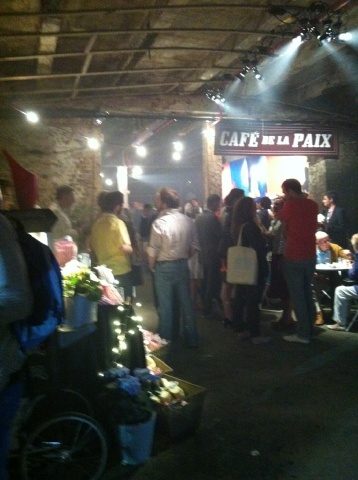
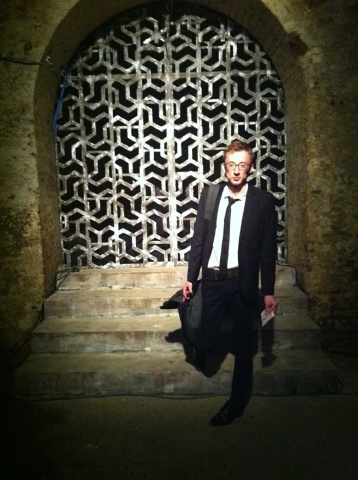
But every now and then I’m willing to make an exception. Well, frankly I’m always making exceptions, I’m a lover of predictability who is living an erroneously unpredictable life, thus I always have a headache and a creeping like for the music of Vanilla Ice (I don’t really, that was an unpredictable comment, designed to catch you off guard, oh how I love the art of being unpredictably unpredictable.) Anyway, the point I’m trying to make is that while queuing up to enter the latest Secret Cinema presentation, the bi-monthly showing of a secret film, shown in a site-specific location, held this month in the cavernous arches under Waterloo Station, the scene bringing to mind a cold war-espionage flick, my unpredictable nature made me predictably nervous.
We had been ordered to assemble at the location dressed in 1950’s style clothes, smart, elegant suits and sunglasses, graphic patterned dresses, washed out colours, scarfs and foulards. I opted against the patterned dress and foulard and instead when for the smart, elegant suit. I looked good. Many people looked good. Very good. Others looked like they had assembled their outfit at the Elephant and Castle Oxfam and others hadn’t bothered at all. No, they didn’t have cuffed hem carrot jeans in the 1950’s, they weren’t that silly.
The dark arches had been transformed into what appeared to be a North African souq, patrolled by French soldiers and women in white robes, complete with market stalls and smoky bars, which brought to mind Bogart and Bergman and a kiss is still a kiss. Could the film be Casablanca? I wondered to myself. No, the obvious lack of Nazis ruled that one out, that would be like the Sound of Music without nuns. Or is that Nazis? Actually I think the Sound of Music has nuns and Nazis. The motherload. Anyway. I digress. The attention to detail was really quite impressive. A band played La Marseillaise, while armed soldiers patrolled gantries above us. There were people sleeping and living in houses, which made up streets and squares. “As-Salamu Alaykum,” one of them yelled out to me, “hiya,” I called back, sheepishly, in my northern accent.
There was a milk bar too; we had been given a milk token at the gate, which could be cashed in for a plastic cup of milk. It’s what I imagine school before Mrs Thatcher to be like, only this milk had a shot of something lovely in the bottom, which made the whole thing much more worthwhile. They were playing Jacques Dutronc. I love Jacques Dutronc. We danced. And then it dawned on me. Milk Bar! Bomb! French soldiers! The windy, claustrophobic streets of the North African market! The film was the Battle of Algiers, the French New Wave classic from 1966.
Things began to make much more sense from that moment on. The excellent acted pieces of drama that were going on in the tunnels were creative recreations of scenes from the film. There was a torture chamber at one end, with one poor soul, an Algerian fighter, behind a mesh fence, being berated and bruised, beaten and drenched in cold water by a French interrogator. It was really quite a compelling scene, contrasted with the frivolous atmosphere of a nearby bar room. One woman, drink in hand, sidled up to the fence and declared “Oh, I do love a bit of torture!” I had a feeling that one was coming. Little smatterings of theatre were being played out elsewhere too. Every now and then a cocky fellow would crack a joke to one of the French troops and get dragged off kicking and screaming and some kids would pester a tramp, at one point pushing him down some stairs. Bit much to stomach really, when you’re tucking into your second ham and cheese crepe of the evening, from the crepe stall, but I’m English, so my upper lip was stiff.
We were herded into a side area to watch a rather engrossing theatrical scene, depicting four young girls being prepared to plant bombs, the terrorist outrage portrayed in the film, while four drummers beat a military reveille, as the scene played itself out. There was then a brief lull in proceedings while the bombers fanned out into the crowd. Milling around, I saw one of the terrorists and shouted something that would have got me shot, had I said it in an airport or in front of Buckingham Palace. “Careful” I yelled, “she’s got a bomb!” And she gave me a look which could have killed a panda bear. But it serves me right for not staying in character. And indeed, for being so predictable.
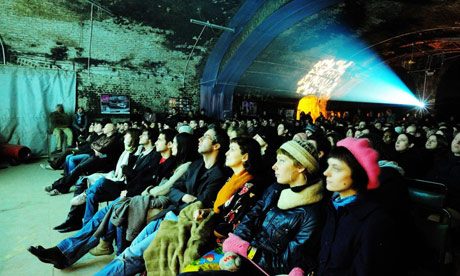
The theatrical part of the evening was brought to a close by the bombs exploding in the central square. It was done effectively, with smoke billowing and soldiers screaming, creating a real sense of confusion. Amid the commotion we were evacuated into where we would watch the film. My only complaint about the entire Secret Cinema set-up was that there was not enough room for everyone to fit into the make-shift cinema, with its antique picture-house seats and its cranky old projector. I just missed the cut and had to sit on a cushion, on the floor, in the overflow room, which was dressed up as a mosque. Not particularly comfortable for two hours, but having said that it was one of the most bizarre places I’ve ever watched a film, in a dirty tunnel, deep underneath Waterloo Station, surrounded by people in 1950’s dress, shoes left at the door to “observe religious practice”, or basically to prevent the “mosque” carpet from getting muddy.
I did, I must confess, sometimes get distracted away from the thrilling, if sometimes cold action of the film, distracted by my surroundings. Particularly by the guy sat directly in front of me whose shoulder I could see over, for whom it took nine attempts to spell the word “mosque” in a text message to his mother. In the end he had to ask his friend, who spelt it wrong too. Nothing distracts me more than bad spelling and birds of paradise, as Phil Silvers used to say. Nevertheless, I enjoyed Secret Cinema, it turned going to see a film into an experience again, a communal experience. If cinema is to survive as a communal activity and not be replaced solely by sofas and DVD players, then it will have to adapt and diversify its offering. Most of all, I enjoyed the unpredictability of it all, and for a self-confessed lover of the predictable, that is really something.
Sylvia? I can’t honestly remember your name. Sylvia sounds about right, the shivering essence, the sheet glass sounds of your name out of time, seem about right.
I had been there for longer than I should have and everything had gone wrong. Your live-in maid, your adopted mother in her eyes only, stared at me coldly as I tapped my suitcase down those ancient staircase steps, tip toeing homeward.
I remember you telling me that happiness was just the art of self-delusion, “I was born lying to myself,” you had said “so what difference does it make?”
I knew you were lying then, I knew in that moment. I had seen you smile far too many times before.
“Are you going to stand there, or are you going to come in?” I glanced to the left and then looked straight into your eyes. “The shadows fall differently do they?”
“Have I ever lied to you,” she replied.
“I’ve lied to you,” I called back.
“Then we’re both liars.”
I thought of your jettisoned relationships, all those long extinguished flames, love affairs alive in mind, but lacking true carnality in reality. Renegade memories aimed at wrecking the backcloth.
Before stepping warily into the morning cold, into those rainy fields of frost and magic, I took a pen and scrawled a final note goodbye “Good night, lady; good night, sweet lady; good night, good night.”
 The silvery spires of Canary Wharf, the spotless thoroughfares and perfectly kept squares, sit upon the buried foundations of the West India Import Dock. From its early days when the Isle of Dogs (as it is also, poetically, known) was the beating heart of an expanding trading empire, to the Night of Fire when the German Luftwaffe turned the dock and great swathes of Wapping into a fiery furnace, this area of London has never seen a particularly pretty day. Today the Wharf is pacified and gentrified and is now this country’s financial powerhouse, with not one jot of its former guise to be found anywhere. That is except for “The Hibbert Gate”, a recreation of the original entrance to the West India Dock and one of the many pieces of public art which can be found dotted throughout the Wharf, randomly scattered, around its sculpted parks and ramrod straight streets, art often missed by eyes consistently drawn skyward by the impressive high-rise scene.
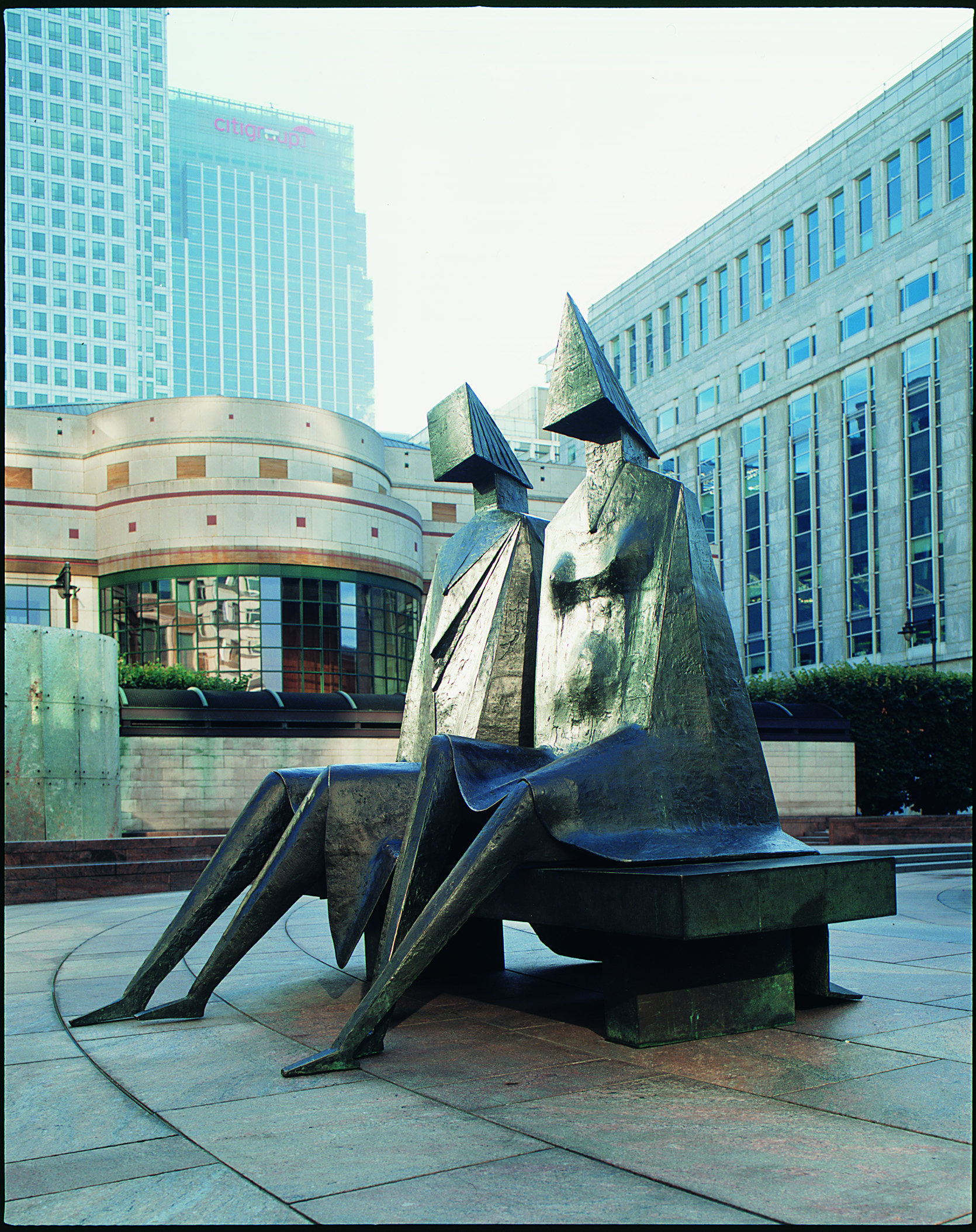 Canary Wharf gazing out towards the docks. Though not particularly regal, instead pointy and frigid and cold, they are not without grace, the gentle angles at which their legs lie and the drift of their clothes being particularly effecting. Nobody seems much to notice them though, theirs is a subdued monarchy, their rule is constant, yet forgotten.
 ply could not stand it.







 Robert Leeming