Whimsy in Adversity

Sometimes there are stories in newspapers of armchair archaeologists who spot hidden earthworks on Google Maps. They zoom in and see the outlines of long buried Viking longhouses or Saxon burial mounds or ditched flying saucers, and they head out with spades and buckets to dig them up.

Years later, the sparkly Saxon results of these digging sessions turn up in glass cases in the British Museum, while the spaceships are quietly hidden away, if they don’t take off moments after discovery and fly home with dirt and clumps of grass tumbling from their wings as they gain altitude.

I’ve never been an online archaeologist. My peregrinations through the towns and villages of Google Maps before holidays offer the perfect antidote to working for a living, but I’ve never found anything strange. Until recently, when I spotted the outline of a balloon cut out of grass in the middle of an industrial estate in my hometown of Oldham.

I briefly wondered if I’d discovered the compressed remains of a lost zeppelin, one of Stanley Spencer’s prototypes perhaps, the man who flew a rudimentary airship from Crystal Palace into central London in 1902, while throwing little muti-coloured rubber balls down from his basket high above the city to demonstrate what some nefarious force could do with bombs, if world affairs ever developed in that direction.
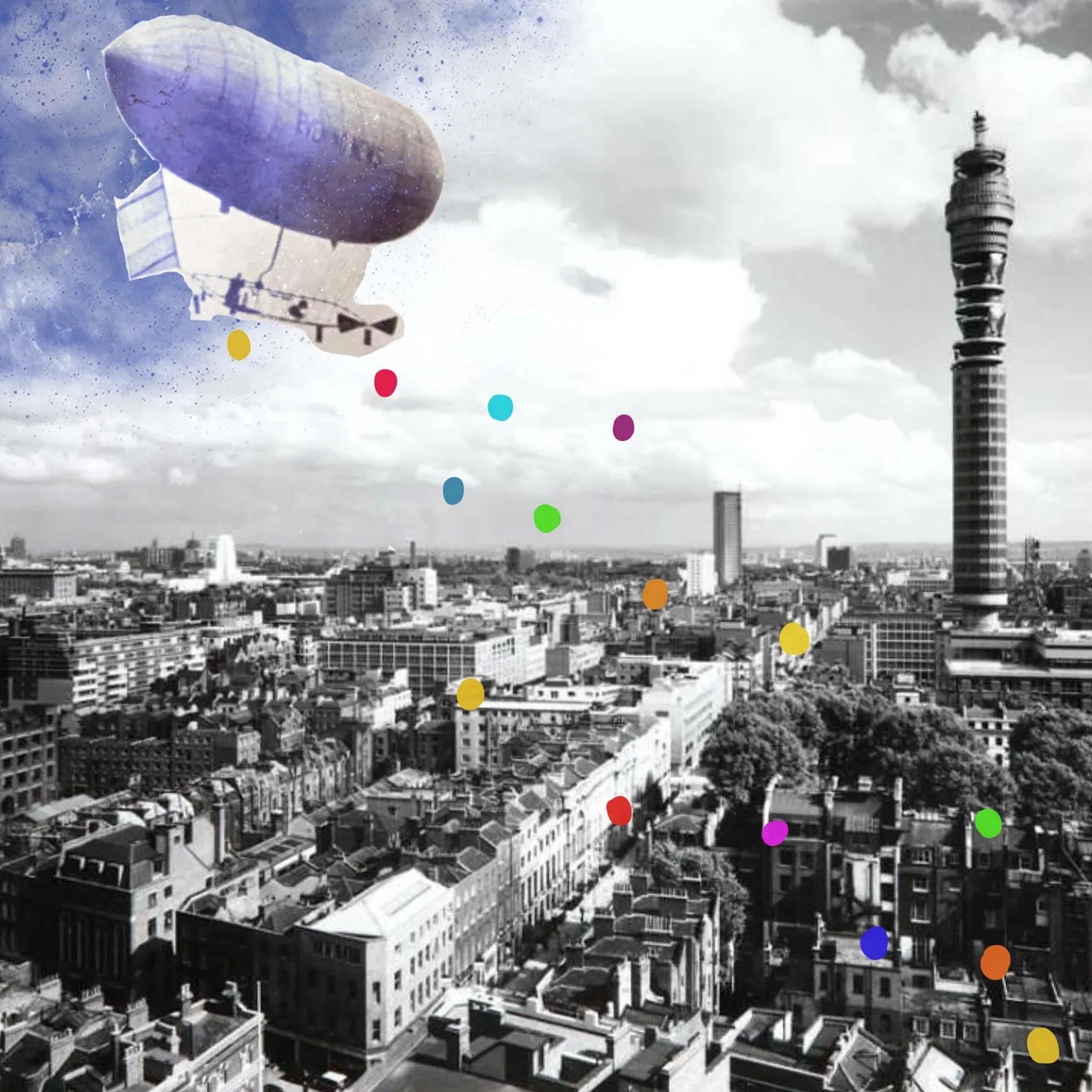
That was not what I had found though. The little grass airship was in fact a memorial to the Bowlee Barrage Balloon Centre, the Second World War-era headquarters of the 925, 926 and 931 Balloon Barrage Squadrons, which apparently stood next to the Jolly Butcher pub, in Middleton, near Oldham.

I’m not entirely sure of the purpose of a barrage balloon, but if you look at a picture of wartime London, or Manchester, you will probably see them hovering in the sky, silvery-grey spherical shapes, about as big as a helicopter but with tail fins and tethered to the buildings below.

They were there to deter low flying bombers and they were deployed in cities across the UK, nosing out from hangers and launched from airstrips like the one at Bowlee. Sometimes, they had netting strung between them to create a massive cartoonish net that could ensnare bombers like something out of Wacky Races, but the physics and the mechanics behind that you will have to look up for yourself.

War or no war though, there is something whimsical about balloons. Who doesn’t smile when they see one? With this in mind, I began a quick online trawl through the online newspaper archives to see if I could dig out any stories that painted a picture of the balloons’ whimsical nature rather their tactical contribution to the war effort.

The poetry dripped off the yellowing scanned newspaper pages almost from the moment I started looking. 

One article from the early 40s in the Manchester Evening News described the balloons as “strange grey..silver creatures, like fish in the untroubled blue swimming above the coral reefs of dirty London chimney pots.”

Another story, in the Liverpool Echo, told the tale of an American soldier who while walking across Hyde Park, was “induced by a mysterious stranger” to part with £45 in return for a barrage balloon to take home as a souvenir. According to the Echo of Tuesday 8th of June 1943, when, an hour later, the gullible soldier returned to the Peter Pan statue in Kensington Gardens, where he had “expected to find the balloon deflated, packed up and ready to go”, he instead found the mysterious stranger had disappeared into the night.

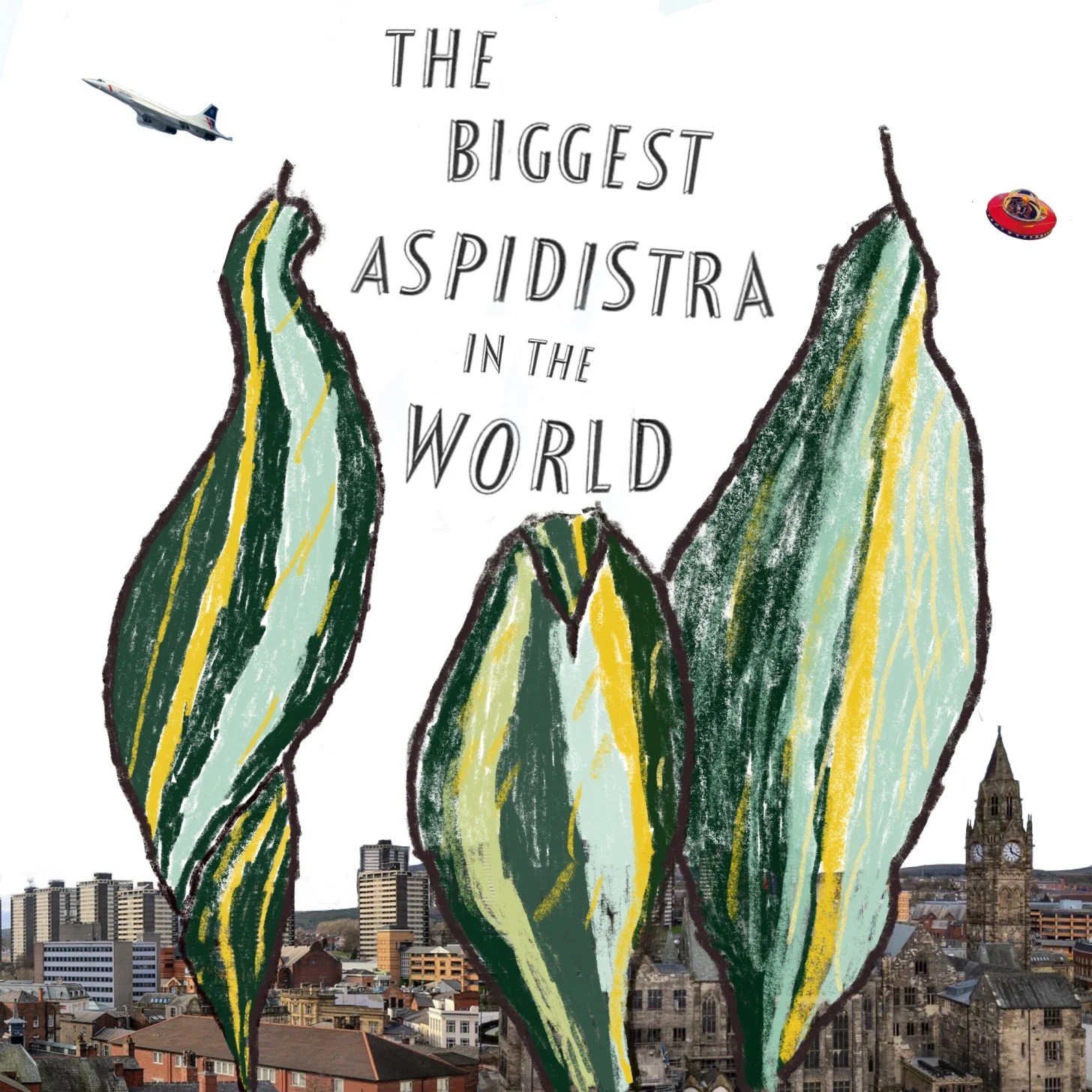
“A barrage balloon,” the Liverpool Echo article goes on to say, “is not the sort of thing you can bring home and hang on the chandelier or put beside the aspidistra,” and on reading that I couldn’t help but think of the Biggest Aspidistra In The World in the song made famous by Gracie Fields, which grows so tall it has to be watered by the local fire brigade, “while its roots stuff up the drains, and grow along the country lanes.” An aspidistra with that kind of girth almost certainly would be able to host a barrage balloon on one of its humongous green leaves without much stress.

It is perhaps crucial to add in trying to bring some closure to this tale, that the article does note that the whole affair happened as the soldier was “returning from a party and whatever might have been his mood of the moment these occasions have been known to inspire elevated aspirations.” And the report goes on to paraphrase the Victorian historian, Thomas Caryle, who once wrote of French statesman going home from scandalous parties and “striking the stars with their sublime heads.” 

Other reports from the time suggest the balloons often prompted a series of light-hearted cartoonish episodes that one imagines Walt Disney could have depicted in Bedknobs and Broomsticks. On Saturday the 16th of March 1940, for example, a headline in The Guardian yells “Men carried up by barrage balloon” and the article goes on to paint a picture of two members of the RAF being carried “over twenty feet into the air by a balloon” in an unnamed north east costal town after the tempestuous thing “got out of hand as it was being launched,” and caused the two men to be carried into the air on the mooring ropes. The rip cord was pulled, and the balloon was brought to the ground, but one can image them floating up into the clouds regardless, their shiny boots striking tottering chimney pots as they advanced higher and higher, off over the North Sea, before being deposited in a field of tulips in Holland.

The stories go on. In Greenwich, during a lightning storm, a barrage balloon dropped onto Woodland Terrace on a house occupied by a Mrs W. B Edwards. “The balloon deflated as it fell and struck the gable of the house bringing down the telephone wires and Mrs Edward’s washing line,” the story reads, while another balloon in Crystal Palace came down on a garden allotment and got caught in some apple trees.

The London Evening Standard of spring 1939, shows a picture of a crowd standing outside J. Salter’s, a dentist at No.178 Kilburn High Road. Everyone is looking upwards, and it must have been a windy day because the people in the photograph are all holding on to their hats.

Another picture shows what they are staring at, a barrage balloon being launched from the top of the Gaumont Cinema, with long multi-coloured shimmery streamers tied to its tail. These beautiful skyborne ornaments were flown above cinemas across Kilburn to advertise the George Formby film “It’s In The Air”, which came out in 1938, and is a gentle farce about a hapless rejected air raid warden who tries to join the RAF just before the war starts.

Those cinema topping balloons must have been quite mesmerizing dancing in the air as grey London geared up for the Blitz. A bit of whimsy to blow the cares and woes away, or as George Formby sings with his Gibson banjolele in the film:

Do I seem a little loony? Well, I am a little loony

For I’ve not been feeling myself all day.

Its… in… the… air … this funny feeling everywhere

That makes me sing without a care today

As I go on my way it’s in the air.

It’s… in… the… air… there’s great excitement here and there

The sun is shining everywhere and spring

Makes everybody sing, it’s in the air!
How did London become the first metropolis to disappear?

1593elizabeth

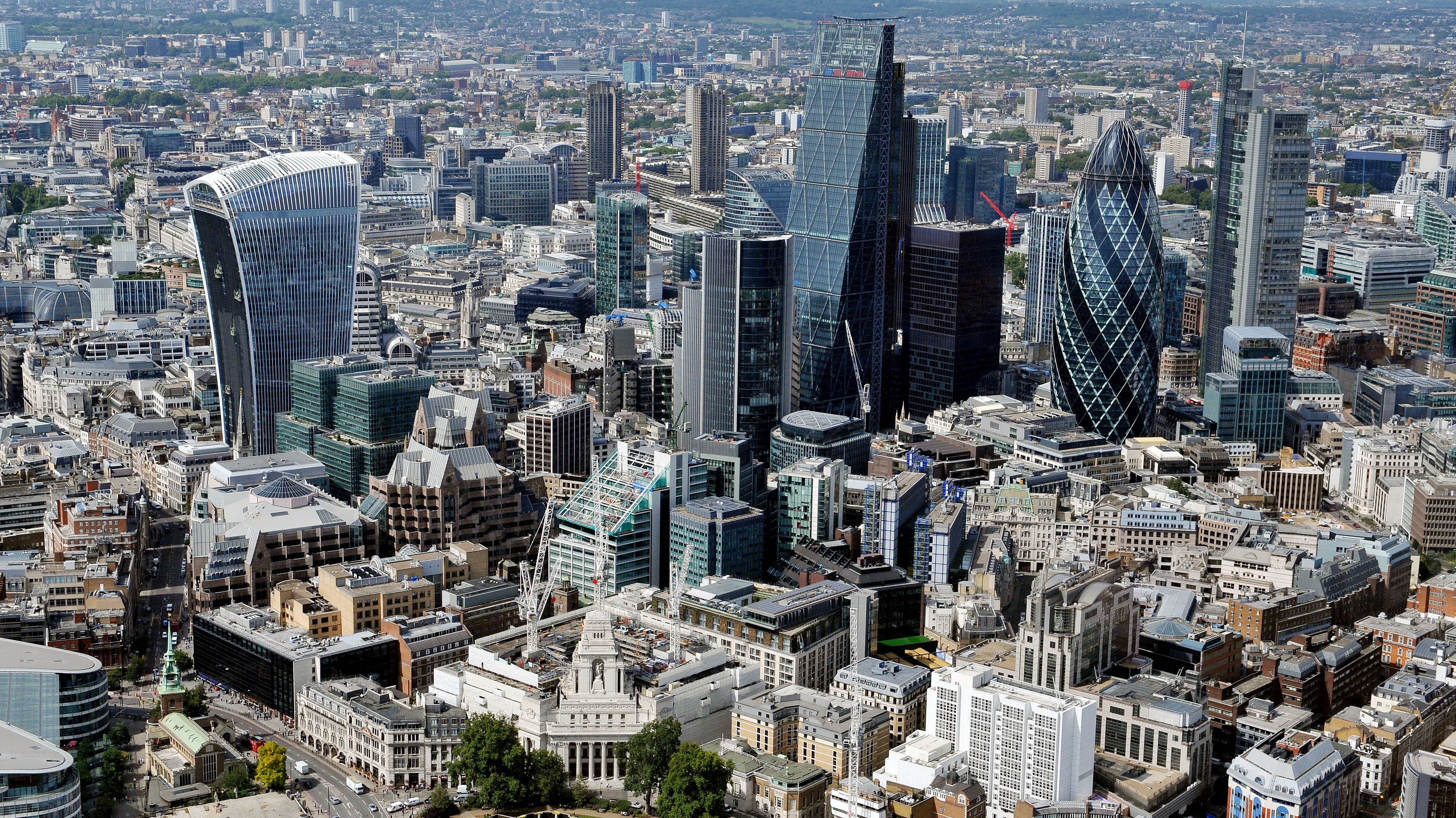
Go to the City of London on a Sunday afternoon and you will find emptiness. Street after street of emptiness. Nobody comes to the City, London’s financial district, on a Sunday.

The irony of this is that the City IS London. The boundries of the City are the same that marked the Roman settlement of Londinium, established nearly 2000 years ago. The City is where London first started to breathe and grow and develop into the teaming metropolis that it has since become.

Under the modernist, brutalist layers of the Barbican Centre, lie not only Roman foundations, but Tudor foundations too. It was here, in the bustling Barbican of Tudor times, that Shakespeare lived, in Cripplegate, and wrote Hamlet.

The City is where Londoner’s endured the greatest calamities of the metropolis’s history. The Church of St-Giles-without-Cripplegate, which sits, preserved, within the concrete womb of the Barbican, survived not only the Great Fire of London in 1666, but also the Nazi bombs of the 1940’s, which obliterated the rest of the area.

london-barbican018big

This church’s canny skill of self-preservation allowed not only Oliver Cromwell to marry at its altar, but also allowed Rick Wakeman to record The Six Wives of Henry VIII, in the church’s nave, a century later.

Today the population of London’s historic heart is just 8,000, out of an overall population of nearly nine million, a number that has stayed static for decades.

It is surprising that anyone still lives there at all, in this cavernous mass of offices and sandwich shops.

There are over forty Eats and Pret a Mangers within the Square Mile and there are probably more on the way. That is one to serve every 200 of the City’s population, which is quite a good ratio of sandwich coverage.

But, civilisation does cling on and people do live there in the penthouses that sit at the top of the ever taller office blocks and in the beautifully appointed apartments of the Barbican.

I once even met someone who lived in a converted flat in the spire of Christ Church Greyfriars, the bombed-out church at the top of Cheapside, which was left partly in ruins as a memorial to those who died in the Blitz.

This is, to say the least, one of the City’s more unusual desirable residences, sitting as it does above the grave of Isabella of France, the so called ‘She-Wolf’ and original femme fatal, who was married to Edward II.

The rise of global finance and the power of the City of London Corporation and Parliament’s reliance on it as the economic engine room of the country, led to the sanitisation of this very crucial slice of London’s history.

sky

The very centre of wider London, sits not in the City though, but under the statue of Charles I in front of Trafalgar Square. The statue of the beheaded King was torn down in the wake of the Civil War and the Roundheads ordered that it be melted down. The canny merchant who bought it though, buried the statue in his back garden and returned it to Charles II on his restoration in 1660.

It is from this spot that the accession of future Kings and Queens of England will be announced, but the monarch too, just like the workers in the City, is a commuter. For long periods of time Buckingham Palace is empty, turned over to millions of tourists, while the Queen reigns from Windsor or Balmoral or Sandringham.

Go to Chelsea or Kensington, or any of the more well healed inner suburbs of London and you will find emptiness too. Street after street of houses bought up by millionaires and billionaires, who use them once in a blue moon whenever they are in the city.

img

Go to County Hall, the imposing building that sits opposite Parliament, the former home of the powerful and independent Greater London Council and you will find only fish. Tank after tank of tropical fish. It was converted by Margaret Thatcher into an aquarium in the 1980s.

Pretty soon you won’t even find Parliament in Parliament. The Commons and Lords are all set to move to allow a multi-billion pound restoration to take place.

The centre of London has been hollowed out and turned into a playground for bankers and tourists, while the real people, the lifeblood of the city, have been pushed further and further out into the endless outer suburbs.

The pulse of the city can now be found in its extremities rather than at its heart.

As Patrick Keiller, in his excellent 1994 documentary film, ‘London’ writes, ‘for Londoners, the City is obscured. Too thinly spread, too private for anyone to know. Its social life invisible, its government abolished, its institutions  at the discretion of either monarchy or state or the City, where at the historic centre there is nothing but a civic void, which fills and empties daily with armies of clerks and dealers, mostly citizens of other towns.

The true identity of London is in its absence. As a city it no longer exists. In this alone it is truly modern. London was the first metropolis to disappear.’

Listen to Marylebone!
Screen Shot 2017-04-03 at 21.34.45

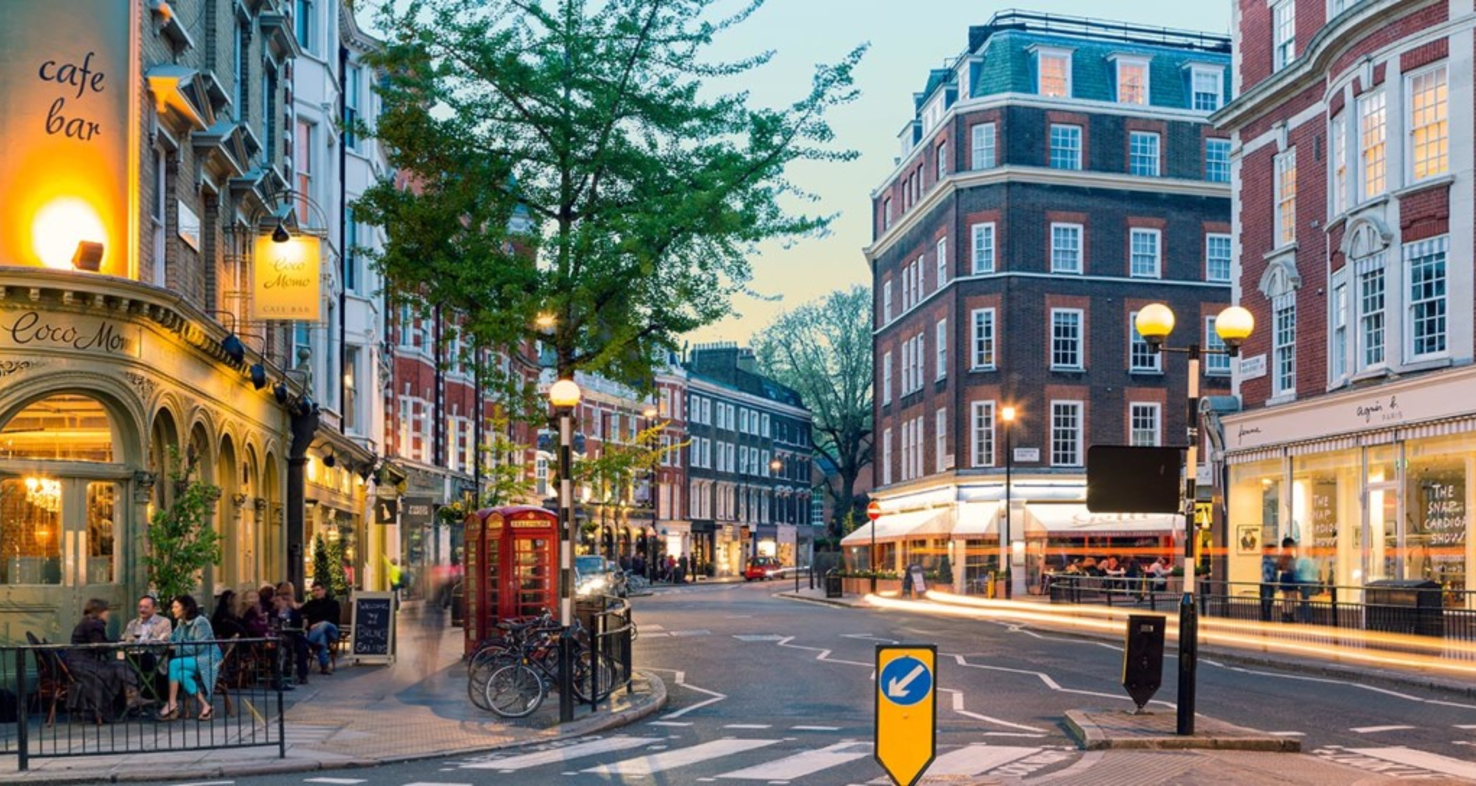
I recently moved from the near suburbs to the city centre and the change has been louder than I expected. I used to think the idea that the city never slept was a cliché. That if you went to Piccadilly Circus at 4am on a Monday morning then you would find something approaching emptiness.

After two months living in a top floor flat at the upper end of Wimpole Street in Marylebone, I can confirm that the city does indeed never sleep and for a while, until I got used to it, neither did I.

Perhaps the most surprising noises come from the sports cars and motorbikes that seemingly peep their noses out of subterranean garages at midnight and fly down the street at ferocious speeds, seemingly for no other reason that it is easier to get away with that kind of thing late at night.

Then there are the sirens from the ambulances making their way to University College Hospital or even to the mysterious London Clinic at the end of my road, England’s biggest private hospital, where hooded figures limp out of limousines and Range Rovers and into waiting wheelchairs.

There are helicopters, drunks, parties, delivery wagons, late-night road works and a reverberating dial tone from some unknown telephone that projects into the street and echoes down it when someone tries to make a call.

The bells of the St Marylebone Church, two streets away, toll the hour, as well as every half and quarter. They also toll to mark the start of the Sunday service.

There are 63 sets of bells in Westminster, including those in the Royal Courts of Justice, the eighteen bells at Fortnum and Mason and the Swiss glockenspiel in Leicester Square.

In fact, it is nearly impossible to live anywhere in Westminster without hearing bells, especially when Big Ben can be heard all the way to Pimlico.

Imagine living across from a large Swiss glockenspiel that bursts into song every fifteen minutes though. The one in Leicester Square is wirelessly controlled from Derby too, so going at it with a pair of wire cutters isn’t going to get you anywhere fast.

The strange thing is, that after a rocky start, I think all the Marylebone noise is helping me to sleep better. Once all the noises are settled in your mind, they become a kind of scored symphony, a familiar tune, that is able to lull you into sleep.

If a note is missing then the melody is broken and London certainly has many notes to play, with its ‘pulse like a cannon’ as Ralph Waldo Emerson wrote. London is certainly a city that never goes to sleep.

The Desert Song – The Barjeel Art Foundation Collection at the Whitechapel Gallery

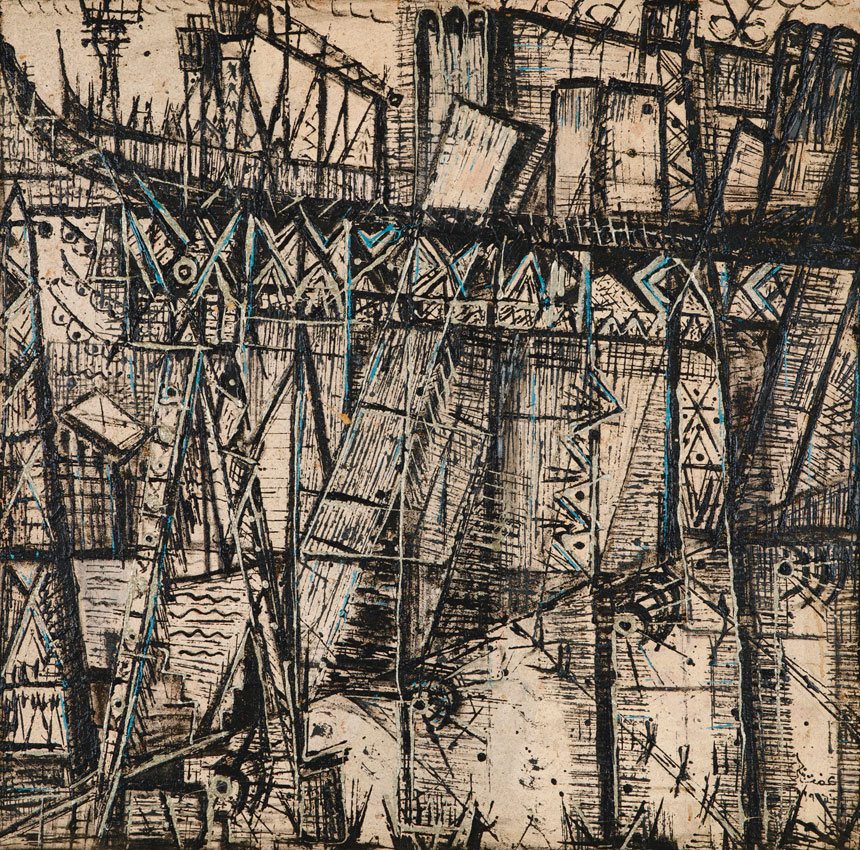
Efatt Nagy's The High Dam
Efatt Nagy’s The High Dam

The construction of the Aswan Dam in the 1960s was, like seemingly everything in that era, a Cold War altercation between East and West. America and Britain refused to pay for the building of Aswan, which fans out into the blue Nile like the Art Deco proscenium arch of the Hollywood Bowl, its desert shades matching its parched surroundings. Nikita Khrushchev was willing to aide Egypt with the building costs though and the Soviet premier, performing some first rate Cold War posturing, appeared with President Nasser, cutting the red ribbon to open the first stage of construction with ceremonial aplomb.

Effat Nagy’s The High Dam is a depiction of the construction of Aswan and is featured in the first part of a showing of the Barjeel Art Foundation’s collection at the Whitechapel Gallery in London. The painting has a slight Soviet overtone, the scaffolding, which covers a steely industrial backdrop, bringing to mind the spiky edges of Kazimir Malevich. The initial impression is one of great might and muscle being employed in the name of an impressive undertaking, a symbol of the construction of a new Egypt, but look a little closer and the scaffolding appears frail, suggesting that this solidly built future may turn out to be flimsy.

Nagy and her husband Saad al-Khadem, were both pioneers of folk art in Egypt and she was invited by the Egyptian Ministry of Culture to visit the gargantuan construction site at Aswan. The poor labour conditions and the forced relocation of entire villages played on her mind and the minds of others who painted the scene. The poor conditions are echoed in Ragheb Ayad’s Aswan, which depicts skeleton figures doubled over in toil, working in a seemingly endless chasm.

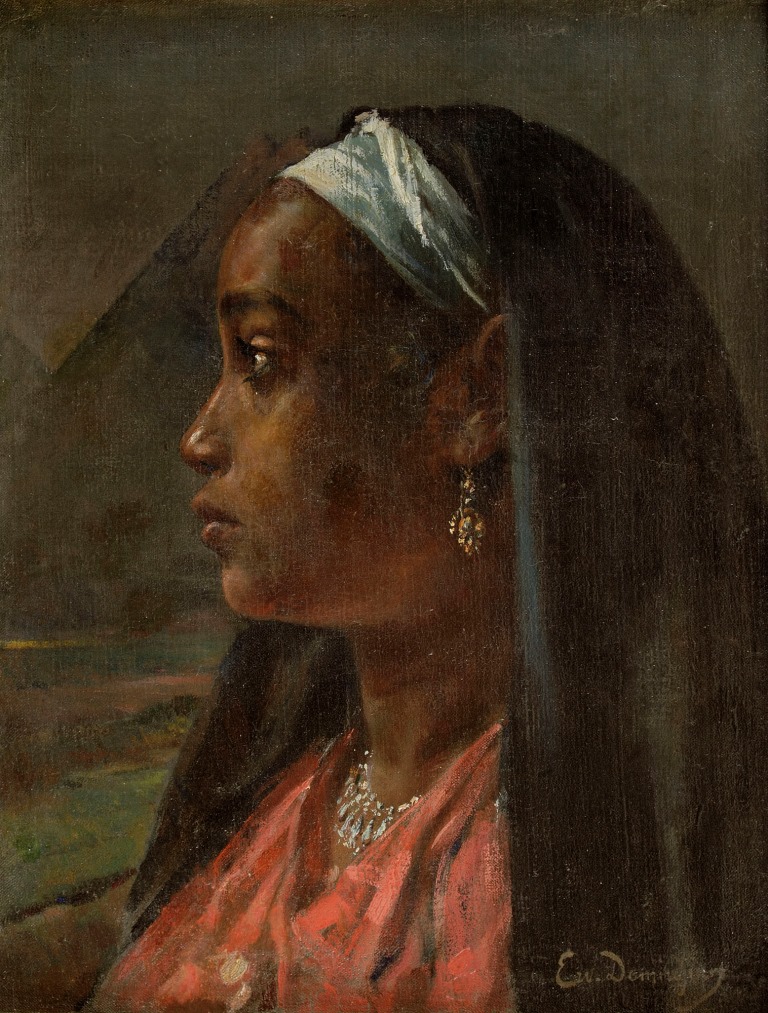
Ervand Demirdjian's Nubian Girl
Ervand Demirdjian’s Nubian Girl

The Barjeel Art Foundation is a United Arab Emirates-based initiative established to manage, preserve and exhibit the personal art collection of Sultan Sooud Al Qassemi. Thirty eight pieces of art will ultimately feature in the four part Whitechapel show, which will run in instalments into next year, charting the development of Middle Eastern art from Modern to Contemporary.

The seed that gives birth to this freewheeling collection is the Armenian artist Ervand Demirdjian’s Nubian Girl. Painted between 1900 and 1910, the canvas is beautiful and traditional, with the evident influence of Modern western and, in particular, Dutch and French portraiture. The painting bears a passing resemblance to Vermeer’s Girl with a Pearl Earring and is, perhaps, more mystical, her enchanting eyes seemingly outshining her jewels to become the brightest thing on the canvas.

Traditionalism is swept away when the exhibition considers art from another, more contemporary cause célèbre of western interference in the Middle East, Iraq. Kadhim Hayder uses the country’s rich library of myth and symbolism to critique more recent events, such as the toppling of the monarchy by what would become Saddam Hussein’s Ba’ath party.

Kadhim Hayder's Fatigued Ten Horses Converse with Nothing
Kadhim Hayder’s Fatigued Ten Horses Converse with Nothing

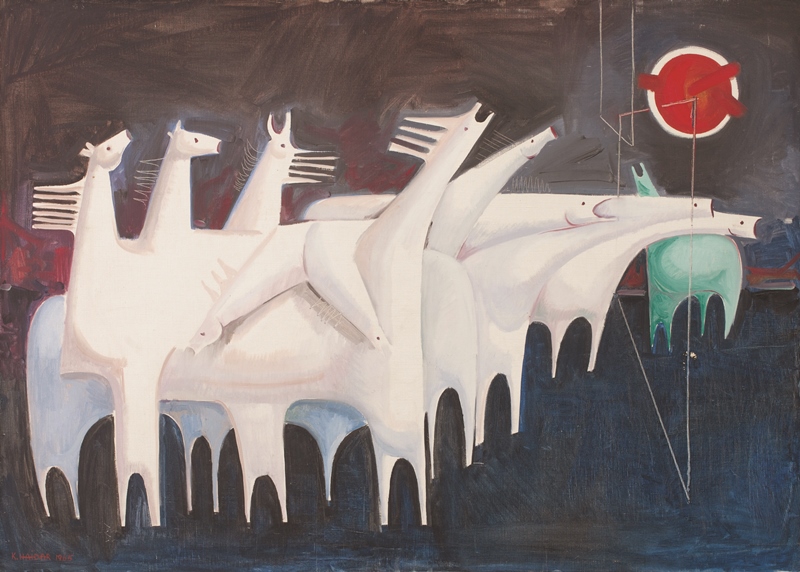
The Hayder painting featured in this exhibition is Fatigued Ten Horses Converse with Nothing (The Martyrs Epic) a ghostly image of several white desert horses howling at a fiery sun. Though painted in 1965, the image is still searingly modern. The horses are in fact weeping, perhaps the first of millions of tears to fall on Iraq’s bloodstained sand, for Al Husayn, an important Islamic figure who was killed at the Battle of Karbala. He is still mourned on the Day of Ashura by Shia society, when it is said that a tear only as little as the wing of a fly will have the power to put out the fire of hell.

Hamed Ewais's Le Gardien de la Vie
Hamed Ewais’s Le Gardien de la Vie

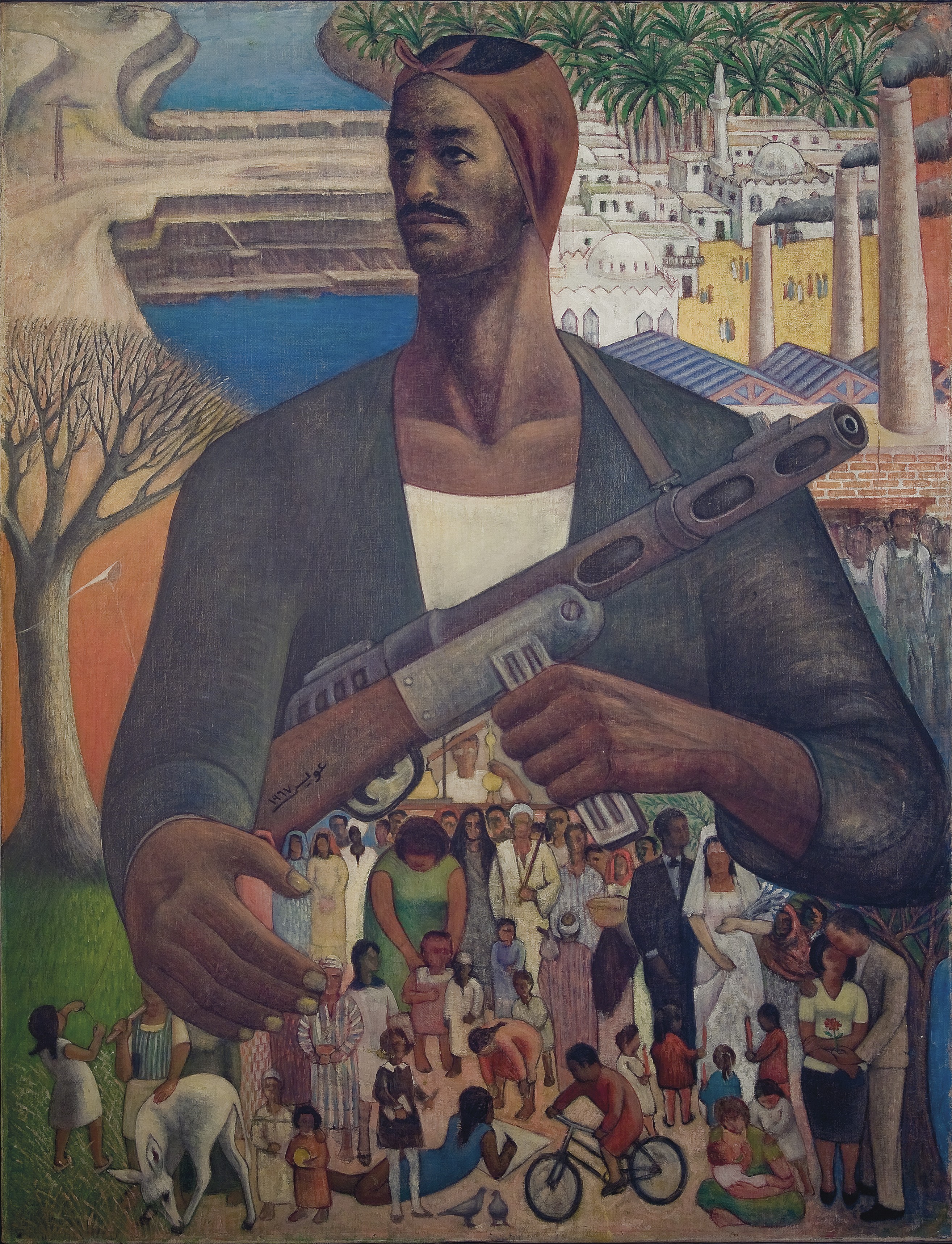
Hamed Ewais is another Egyptian artist present in the Whitechapel show. Le Gardien de la Vie (The Protector of Life) depicts a machine gun-toting fighter as almost a fatherly figure, protecting civilian lives by force of arms. It is again a modern image belying its fifty years and could easily be passed off as a 21st century example of propaganda. But the work instead elucidates the desire of a nation to look after and nurture its own citizenry, free of the interference of foreign colonialism. It depicts another desire too, a hope given voice by this entire collection, the artistic desire for unfettered self expression.

Barjeel Art Foundation Collection: Imperfect Chronology – Debating Modernism I runs until November 6th 2015. Images courtesy of the Whitechapel Gallery.