Whimsy in Adversity

Sometimes there are stories in newspapers of armchair archaeologists who spot hidden earthworks on Google Maps. They zoom in and see the outlines of long buried Viking longhouses or Saxon burial mounds or ditched flying saucers, and they head out with spades and buckets to dig them up.

Years later, the sparkly Saxon results of these digging sessions turn up in glass cases in the British Museum, while the spaceships are quietly hidden away, if they don’t take off moments after discovery and fly home with dirt and clumps of grass tumbling from their wings as they gain altitude.

I’ve never been an online archaeologist. My peregrinations through the towns and villages of Google Maps before holidays offer the perfect antidote to working for a living, but I’ve never found anything strange. Until recently, when I spotted the outline of a balloon cut out of grass in the middle of an industrial estate in my hometown of Oldham.

I briefly wondered if I’d discovered the compressed remains of a lost zeppelin, one of Stanley Spencer’s prototypes perhaps, the man who flew a rudimentary airship from Crystal Palace into central London in 1902, while throwing little muti-coloured rubber balls down from his basket high above the city to demonstrate what some nefarious force could do with bombs, if world affairs ever developed in that direction.
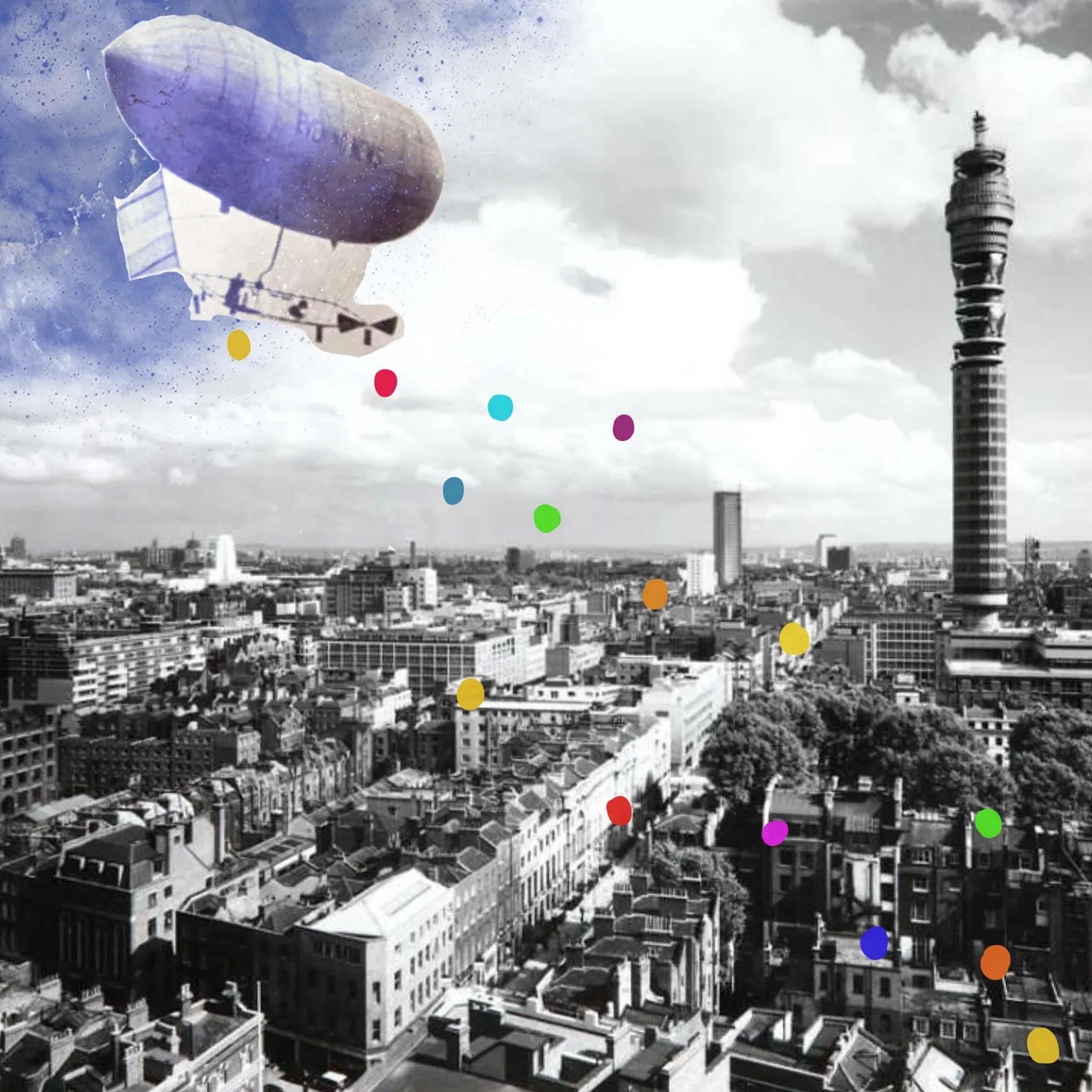
That was not what I had found though. The little grass airship was in fact a memorial to the Bowlee Barrage Balloon Centre, the Second World War-era headquarters of the 925, 926 and 931 Balloon Barrage Squadrons, which apparently stood next to the Jolly Butcher pub, in Middleton, near Oldham.

I’m not entirely sure of the purpose of a barrage balloon, but if you look at a picture of wartime London, or Manchester, you will probably see them hovering in the sky, silvery-grey spherical shapes, about as big as a helicopter but with tail fins and tethered to the buildings below.

They were there to deter low flying bombers and they were deployed in cities across the UK, nosing out from hangers and launched from airstrips like the one at Bowlee. Sometimes, they had netting strung between them to create a massive cartoonish net that could ensnare bombers like something out of Wacky Races, but the physics and the mechanics behind that you will have to look up for yourself.

War or no war though, there is something whimsical about balloons. Who doesn’t smile when they see one? With this in mind, I began a quick online trawl through the online newspaper archives to see if I could dig out any stories that painted a picture of the balloons’ whimsical nature rather their tactical contribution to the war effort.

The poetry dripped off the yellowing scanned newspaper pages almost from the moment I started looking. 

One article from the early 40s in the Manchester Evening News described the balloons as “strange grey..silver creatures, like fish in the untroubled blue swimming above the coral reefs of dirty London chimney pots.”

Another story, in the Liverpool Echo, told the tale of an American soldier who while walking across Hyde Park, was “induced by a mysterious stranger” to part with £45 in return for a barrage balloon to take home as a souvenir. According to the Echo of Tuesday 8th of June 1943, when, an hour later, the gullible soldier returned to the Peter Pan statue in Kensington Gardens, where he had “expected to find the balloon deflated, packed up and ready to go”, he instead found the mysterious stranger had disappeared into the night.

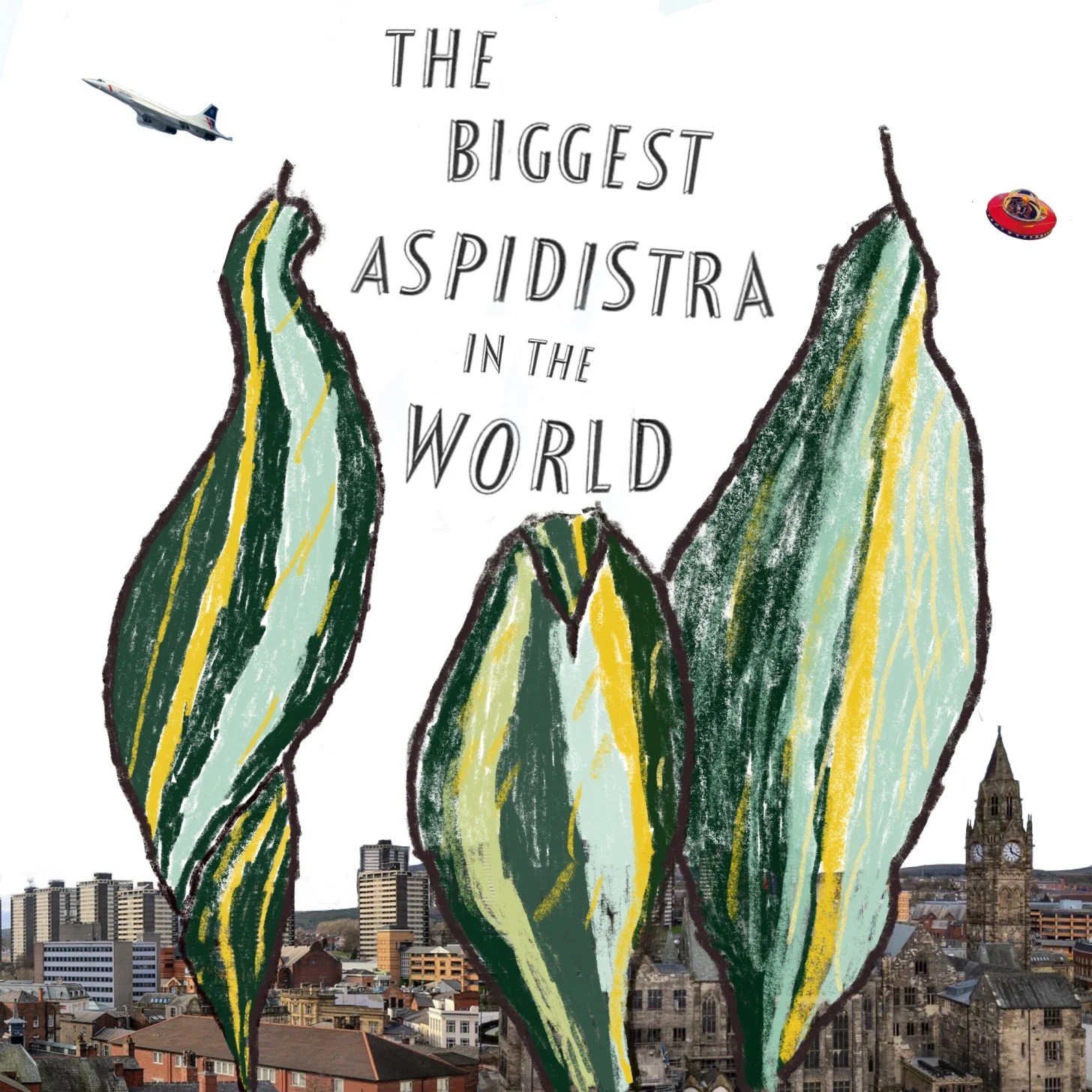
“A barrage balloon,” the Liverpool Echo article goes on to say, “is not the sort of thing you can bring home and hang on the chandelier or put beside the aspidistra,” and on reading that I couldn’t help but think of the Biggest Aspidistra In The World in the song made famous by Gracie Fields, which grows so tall it has to be watered by the local fire brigade, “while its roots stuff up the drains, and grow along the country lanes.” An aspidistra with that kind of girth almost certainly would be able to host a barrage balloon on one of its humongous green leaves without much stress.

It is perhaps crucial to add in trying to bring some closure to this tale, that the article does note that the whole affair happened as the soldier was “returning from a party and whatever might have been his mood of the moment these occasions have been known to inspire elevated aspirations.” And the report goes on to paraphrase the Victorian historian, Thomas Caryle, who once wrote of French statesman going home from scandalous parties and “striking the stars with their sublime heads.” 

Other reports from the time suggest the balloons often prompted a series of light-hearted cartoonish episodes that one imagines Walt Disney could have depicted in Bedknobs and Broomsticks. On Saturday the 16th of March 1940, for example, a headline in The Guardian yells “Men carried up by barrage balloon” and the article goes on to paint a picture of two members of the RAF being carried “over twenty feet into the air by a balloon” in an unnamed north east costal town after the tempestuous thing “got out of hand as it was being launched,” and caused the two men to be carried into the air on the mooring ropes. The rip cord was pulled, and the balloon was brought to the ground, but one can image them floating up into the clouds regardless, their shiny boots striking tottering chimney pots as they advanced higher and higher, off over the North Sea, before being deposited in a field of tulips in Holland.

The stories go on. In Greenwich, during a lightning storm, a barrage balloon dropped onto Woodland Terrace on a house occupied by a Mrs W. B Edwards. “The balloon deflated as it fell and struck the gable of the house bringing down the telephone wires and Mrs Edward’s washing line,” the story reads, while another balloon in Crystal Palace came down on a garden allotment and got caught in some apple trees.

The London Evening Standard of spring 1939, shows a picture of a crowd standing outside J. Salter’s, a dentist at No.178 Kilburn High Road. Everyone is looking upwards, and it must have been a windy day because the people in the photograph are all holding on to their hats.

Another picture shows what they are staring at, a barrage balloon being launched from the top of the Gaumont Cinema, with long multi-coloured shimmery streamers tied to its tail. These beautiful skyborne ornaments were flown above cinemas across Kilburn to advertise the George Formby film “It’s In The Air”, which came out in 1938, and is a gentle farce about a hapless rejected air raid warden who tries to join the RAF just before the war starts.

Those cinema topping balloons must have been quite mesmerizing dancing in the air as grey London geared up for the Blitz. A bit of whimsy to blow the cares and woes away, or as George Formby sings with his Gibson banjolele in the film:

Do I seem a little loony? Well, I am a little loony

For I’ve not been feeling myself all day.

Its… in… the… air … this funny feeling everywhere

That makes me sing without a care today

As I go on my way it’s in the air.

It’s… in… the… air… there’s great excitement here and there

The sun is shining everywhere and spring

Makes everybody sing, it’s in the air!
City Lights

Do certain people leave behind a little of their aura in places that mean a lot to them? I don’t know. I have no idea. But recently, when walking across the grassy Crissy Field, a one-time airfield in San Francisco, on a clear blue day with the Golden Gate Bridge sitting all orangey between the deep blue of the bay and milky blue of the sky, the thought came into my mind that Amelia Earhart had walked there. I could see, in my mind’s eye, an image of her kicking out the chocks from underneath her Lockheed Model 10-E Electra on the very same grass on which I was walking.

Some Googling later in the day proved my hunch correct. Earhart did indeed fly out Crissy Field in the early 1930s, in the days before she became the first person to fly solo from Hawaii to California, and before the construction of the Golden Gate, twined with the Bay’s propensity to be shrouded in a thick fog, made Oakland Municipal Airport a more attractive alternative launch pad for some dare devil flying.

San Francisco is like that. It’s full of ghosts, be they real of fictional. When you see the undulating ski-slope streets of the city, it’s impossible not to see Steve McQueen speeding over them in his Highland Green 1968 Ford Mustang GT during the car chase at the end of Bullitt. Or Ryan O’ Neil and Barbara Streisand doing the same but on a bicycle in What’s Up Doc, before careering into a jingly-jangly parade in Chinatown and getting trapped in a multicoloured paper mâché dragon. And then you think of Captain Kirk and Spock looking for a humpback whale in The Voyage Home, or Jimmy Stewart and Kim Novak looking for each other in Vertigo, or Amelia Earhart standing by her plane on Crissy Field.

Such were the visions I was having as I wandered San Francisco and they were exacerbated by the fact that the city appeared, to me at least, to be a bit of a ghost town itself. Parts of the central business district, a one-time home to countless tech companies, are still to spring back into life after the pandemic, while in the down-at-heel Tenderloin district which borders it, homelessness, fentanyl addiction and petty crime make for a worrying hallmark.

The hotel workers union, during my visit, were on strike, with bored employees sat outside empty lobbies banging on upturned paint tins, the noise echoing through the empty streets like the soundtrack to impending action in some dystopian sci-fi film. I should say at this point that I was in the city at Thanksgiving, which may have been a reason for its emptiness. In fact, one union had laid on a thanksgiving dinner on a sidewalk near Union Square for its striking workers and had set a long table with a white cloth with fifty or more folding chairs pulled to it. The expectant table made for quite an edifying scene, belying the fact, if just for the morning, that this was a city with some problems.

On my first afternoon, still spaced out form the jet lag, I climbed up the steep Telegraph Hill to Coit Tower, a monument to the be-shrubbed mind of Lillie Hitchcock Coit and immortalised by the writer and founder of San Francisco’s City Lights book shop, Laurence Ferlinghetti, in his poem Dog.

The dog trots freely in the street

and sees reality

and the things he sees

are bigger than himself

and the things he sees

are his reality

And he goes past the Romeo Ravioli Factory

and past Coit’s Tower

and past Congressman Doyle

He’s afraid of Coit’s Tower

but he’s not afraid of Congressman Doyle

I was slightly perplexed by Coit Tower, if a little afraid. It seemed slightly ominous sticking up out of Telegraph Hill like an Art-Deco ivory finger. It was even more eery because nobody seemed to be around, except for electric cars, empty electric cars, which would seemingly float down the street towards the Pacific every now and again.

These were the famous driverless cars belonging to Waymo, an even more futuristic version of Uber, which are being trialled in the city. After some hesitation, both of the political and cowardly kind, I decided to try a ride and found it, after the initial thrill of watching the wheel spin autonomously on sharp corners, to be quite an empty experience. It seemed to me to be just another removal of a simple human interaction from everyday life, like the disappearance of the person working the checkout in a supermarket, they’ve all been beamed up to be with Kirk, Spock and the humpback whales, only to be replaced with silence.

In contrast, on one sun-streaked afternoon later in my trip, when I had walked the length of Golden Gate Park to the ocean, legs exhausted, I opted for an Uber over a Waymo and was quickly rewarded with a gas-bagging alternative. The driver, an elderly man, seemed new in town and asked me if I knew where I was going and could offer up a better route than the sat-nav. Naturally, despite being clueless, I was charmed by this request and the thought that I might be so easily assimilated into a place 12,000 miles away from home as to be taken for a local after just two days.

I apologised and said I’d only been around for a few hours, which prompted a long conversation about roots. He was from Hawaii and he seemed to think that given I had come so far, from London to the edge of the Pacific, not going on to see the islands was a bit of a dunderheaded choice.

Did I know, he asked, that it was the Royal Navy’s Captain Cook that discovered Hawaii and that he had named them the Sandwich Islands after the Earl famed for putting cooked meat between pieces of bread? I did not, I said. Did I know, he added, that the union flag still makes up part of Hawaii’s state flag? I did not know that either. Now, this was the kind of high-quality conversation that I couldn’t get from a Waymo, which only seemed to get vocal to scream at me when I didn’t have my seat belt on.

No, the Hawaiian didn’t care about seatbelts, he was more interested in debating the make-up of the English breakfast, and reminiscing about the time he saw Harvey Milk and Dianne Feinstein talking on the steps of San Francisco City Hall. He said he knew then that they would both go far. She went on to become the longest serving female senator in US history. He got shot in the head. Oh, America!

With the likes of Waymo coming to a city near you, one can only imagine that the notion of having a freewheeling conversation with a taxi driver is heading to the same place as Feinstein and Milk: a museum. But I suppose error could still set the technology back a bit. Just the sight of pedestrians waving manically when they walk out in front of the moving vehicles at crossings suggested that the public’s faith is not yet high in the new technology. To begin with I thought they were waving at me, then I realised they were waving manically to ensure that the car’s internal gizmos clocked them and didn’t mow them down.

And what’s to stop these cars going all dystopian, sealing the doors, locking you in and taking off at full pelt over the humps and bumps of San Francisco. Before you know it you’d be racing off into the Pacific and not stopping until you got to the Sandwich Islands to spend the rest of your life eating BLTs.

See, I let my imagination run riot there, while I still can, before I’m replaced by something that can write much more levelled prose than I can, more normal prose, and hopefully, something much more readable.