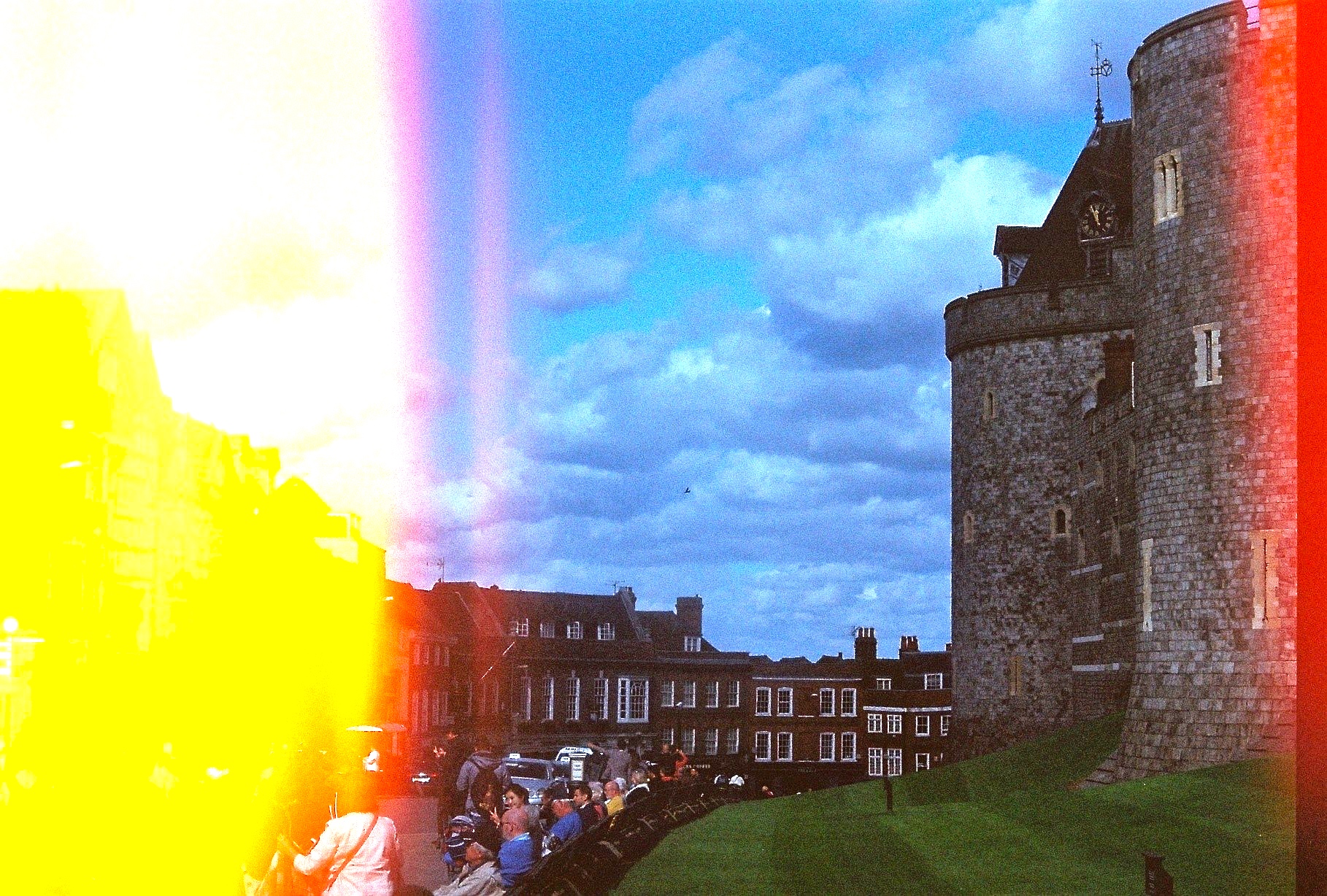


Collected Journalism and Short Fiction

Bill Henson is the maker of modern myth cast in available light. The distinctive Australian artist has a long history of creating dramatic images in the twilight, images that, although serious, are never harsh, but instead are always beautifully, if not glossily presented.
A collection of Henson’s photographs ‘1985’ has recently been released by Stanley/Barker, a fledgling independent publishing company based in London. Taken when the photographer was 33, the pictures present alternative images of human civilisation, shot at dusk in the suburbs of Melbourne and in the deserts of Egypt.
The jump between images of modern day suburban Australia and ruins from antiquity may sound jarring, but like remembrances from a vivid dream, they fall together on the page to create a fluid landscape of changing epochs.
The images were taken in the seconds before the light disappears, a time of day that can appear, to the more poetic observer, as particularly otherworldly, a time when sleeping senses are reawakened, reintroducing, Henson says, the disconnected with the “deep mystery of the world”.

While social commentary is purposely avoided, the photographs instead offer a glimpse into an imaginary past. Henson grew up in the suburbs and he can trace his earliest memories to the innocuous streets of Greater Melbourne. The images that we remember from our infancy are images that continue to influence our dreams for the rest of our lives and it is these dreams, the dreams of our earliest days and the imaginary landscape they unfold in, which Henson tries to recreate in this collection.
Our early interests also continue to influence both our real life and our dreamscapes as we age. Ancient Egypt, the Pyramids, the Sphinx and the golden masks and ancient trinkets discovered by Howard Carter, were all things that formed part of Henson’s imaginary world as he grew up. His ‘1985’ photographs combine the two, his imaginary world with the physical world he grew up in.
Like dreams, these pictures are only partial. Sometimes a great deal of their detail is engulfed in shadow and it is up to the viewer to use imagination to complete the picture. Dreams rarely follow a narrative pattern, rather they are tapestries containing some images that inter link and inspire the next, while others are unusual, sometimes unsettling images from deep within the subconscious, images that appear to jar the pictorial pattern and push it in another direction.

When one considers the photographs separately from the personal stories that inspired them, it is possible to picture the brevity of human civilization in the grand sweep of time. It has been noted in the past that Henson’s work is somewhat inspired by the Romantic school of art and, in particular, the writings of the nineteenth century and their examination of the sense of awe, terror and melancholy that is prompted by the power of nature.
It is possible, in the comparison created by placing images of our complete and functioning civilization next to the defunct and crumbling civilisation of Ancient Egypt, to see the lines of Shelley’s Ozymandias reimagined, when, in the poem, the traveler chances across the broken statue of a fallen despot from ancient times and remarks:
“Nothing beside remains. Round the decay
Of that colossal wreck, boundless and bare,
The lone and level sands stretch far away”.
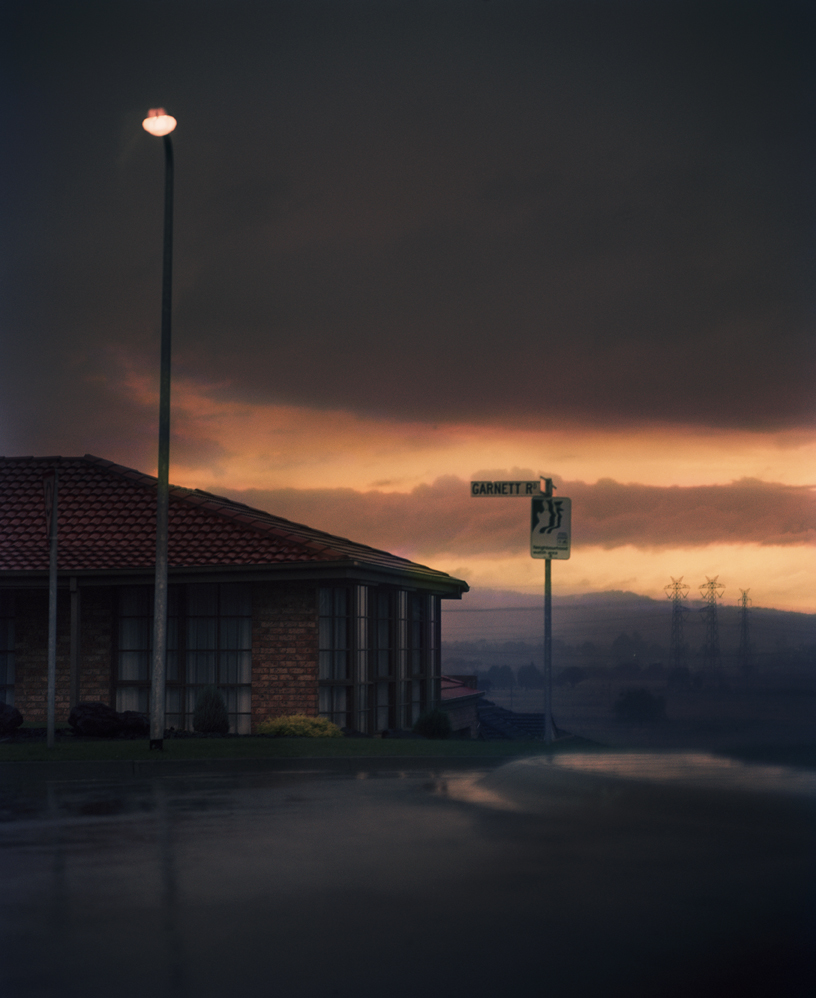
The Melbourne suburbs will, perhaps, a very long time from now, be the new Pyramids of another age. Civilisations come and go, not even the Earth herself is eternal.
Another Romantic writer Henson has sometimes quoted is Georg Philipp Friedrich Freiherr von Hardenberg the German mystic and poet who also went by the name Novalis. When just 27 he wrote ‘Hymns to the Night’, a book of poems and verse created in response to the death of his fiancee Sophie von Kühn. The book is a celebration of night as the entry point into a higher life. “Aside I turn to the holy, unspeakable, mysterious Night,” he writes in the opening stanzas. “The distances of memory, the wishes of youth, the dreams of childhood, the brief joys and vain hopes of a whole long life, arise in gray garments, like an evening vapor after the sunset.” Night is not the time to answer questions. It is the time to ask more.
All pictures by Bill Henson, courtesy of Stanley/Barker. 1985 is available now. http://www.stanleybarker.co.uk
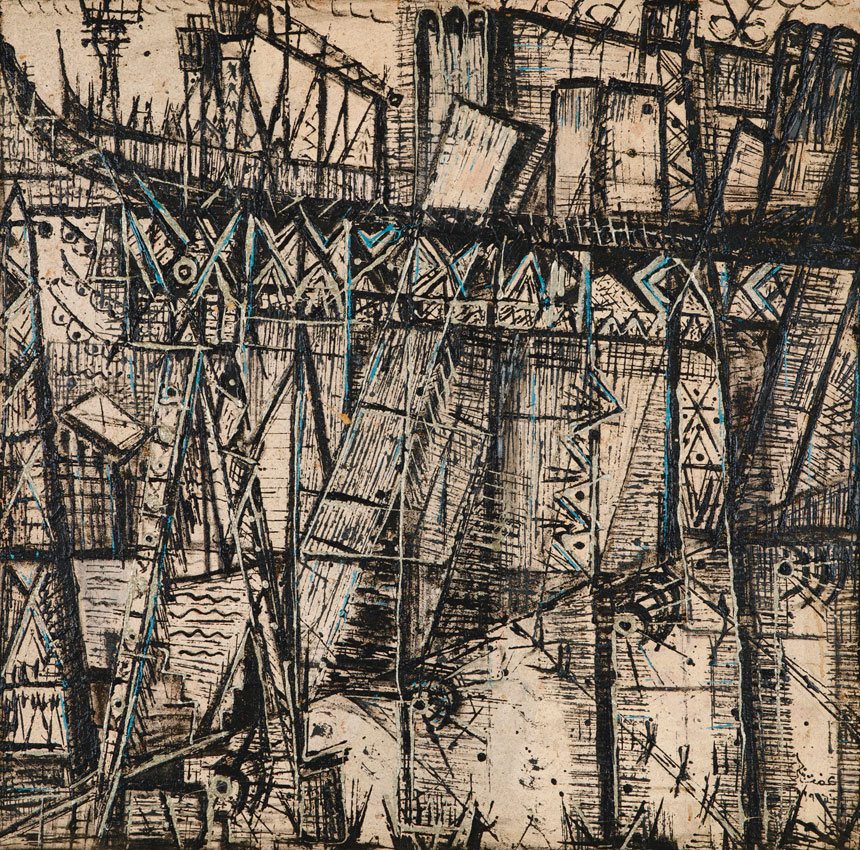
The construction of the Aswan Dam in the 1960s was, like seemingly everything in that era, a Cold War altercation between East and West. America and Britain refused to pay for the building of Aswan, which fans out into the blue Nile like the Art Deco proscenium arch of the Hollywood Bowl, its desert shades matching its parched surroundings. Nikita Khrushchev was willing to aide Egypt with the building costs though and the Soviet premier, performing some first rate Cold War posturing, appeared with President Nasser, cutting the red ribbon to open the first stage of construction with ceremonial aplomb.
Effat Nagy’s The High Dam is a depiction of the construction of Aswan and is featured in the first part of a showing of the Barjeel Art Foundation’s collection at the Whitechapel Gallery in London. The painting has a slight Soviet overtone, the scaffolding, which covers a steely industrial backdrop, bringing to mind the spiky edges of Kazimir Malevich. The initial impression is one of great might and muscle being employed in the name of an impressive undertaking, a symbol of the construction of a new Egypt, but look a little closer and the scaffolding appears frail, suggesting that this solidly built future may turn out to be flimsy.
Nagy and her husband Saad al-Khadem, were both pioneers of folk art in Egypt and she was invited by the Egyptian Ministry of Culture to visit the gargantuan construction site at Aswan. The poor labour conditions and the forced relocation of entire villages played on her mind and the minds of others who painted the scene. The poor conditions are echoed in Ragheb Ayad’s Aswan, which depicts skeleton figures doubled over in toil, working in a seemingly endless chasm.
The Barjeel Art Foundation is a United Arab Emirates-based initiative established to manage, preserve and exhibit the personal art collection of Sultan Sooud Al Qassemi. Thirty eight pieces of art will ultimately feature in the four part Whitechapel show, which will run in instalments into next year, charting the development of Middle Eastern art from Modern to Contemporary.
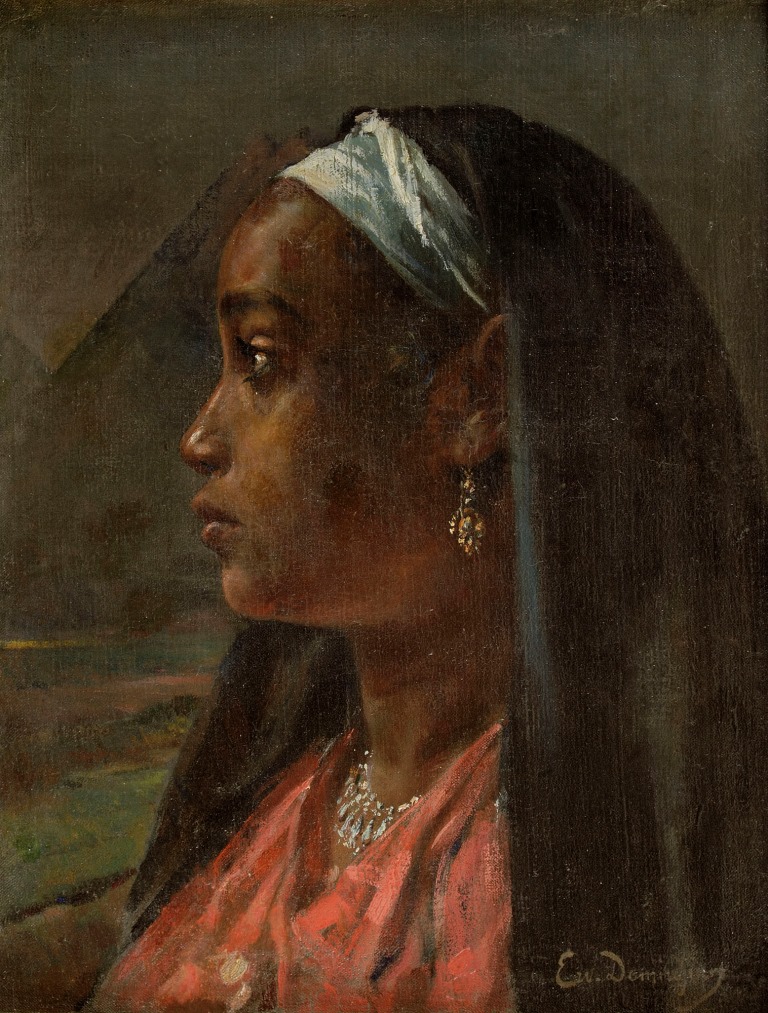
The seed that gives birth to this freewheeling collection is the Armenian artist Ervand Demirdjian’s Nubian Girl. Painted between 1900 and 1910, the canvas is beautiful and traditional, with the evident influence of Modern western and, in particular, Dutch and French portraiture. The painting bears a passing resemblance to Vermeer’s Girl with a Pearl Earring and is, perhaps, more mystical, her enchanting eyes seemingly outshining her jewels to become the brightest thing on the canvas.
Traditionalism is swept away when the exhibition considers art from another, more contemporary cause célèbre of western interference in the Middle East, Iraq. Kadhim Hayder uses the country’s rich library of myth and symbolism to critique more recent events, such as the toppling of the monarchy by what would become Saddam Hussein’s Ba’ath party.
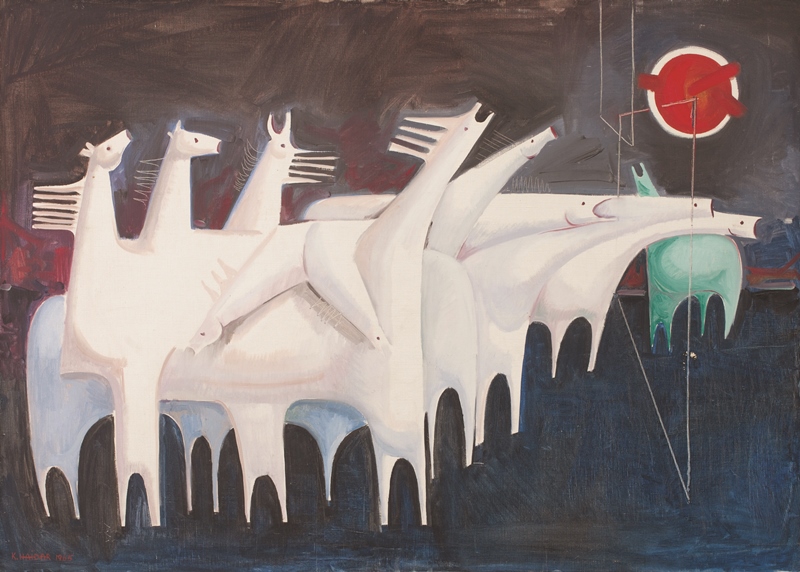
The Hayder painting featured in this exhibition is Fatigued Ten Horses Converse with Nothing (The Martyrs Epic) a ghostly image of several white desert horses howling at a fiery sun. Though painted in 1965, the image is still searingly modern. The horses are in fact weeping, perhaps the first of millions of tears to fall on Iraq’s bloodstained sand, for Al Husayn, an important Islamic figure who was killed at the Battle of Karbala. He is still mourned on the Day of Ashura by Shia society, when it is said that a tear only as little as the wing of a fly will have the power to put out the fire of hell.
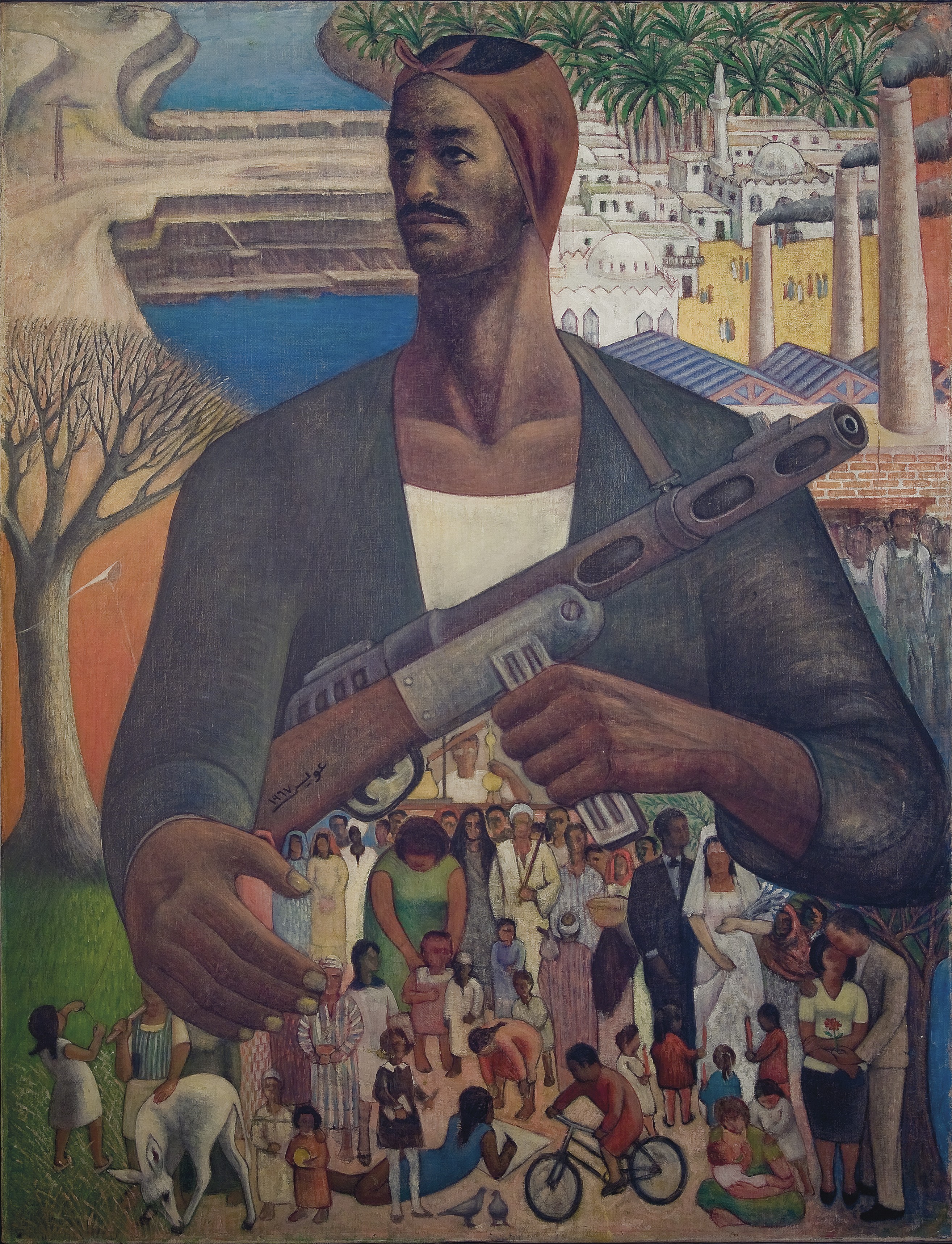
Hamed Ewais is another Egyptian artist present in the Whitechapel show. Le Gardien de la Vie (The Protector of Life) depicts a machine gun-toting fighter as almost a fatherly figure, protecting civilian lives by force of arms. It is again a modern image belying its fifty years and could easily be passed off as a 21st century example of propaganda. But the work instead elucidates the desire of a nation to look after and nurture its own citizenry, free of the interference of foreign colonialism. It depicts another desire too, a hope given voice by this entire collection, the artistic desire for unfettered self expression.
Barjeel Art Foundation Collection: Imperfect Chronology – Debating Modernism I runs until November 6th 2015. Images courtesy of the Whitechapel Gallery.





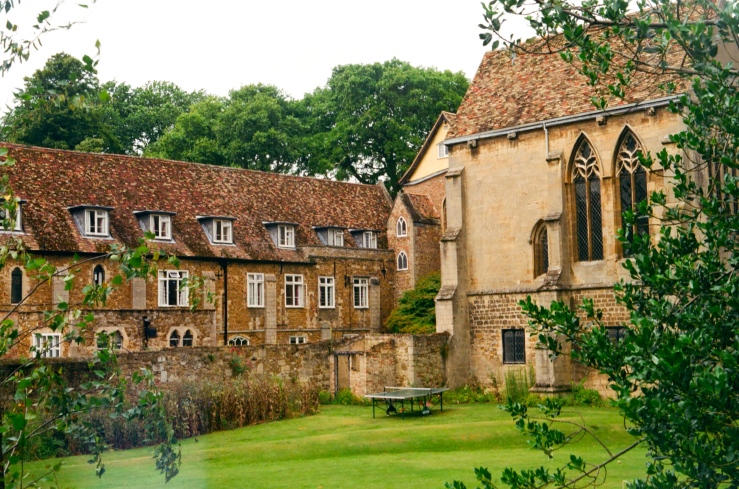
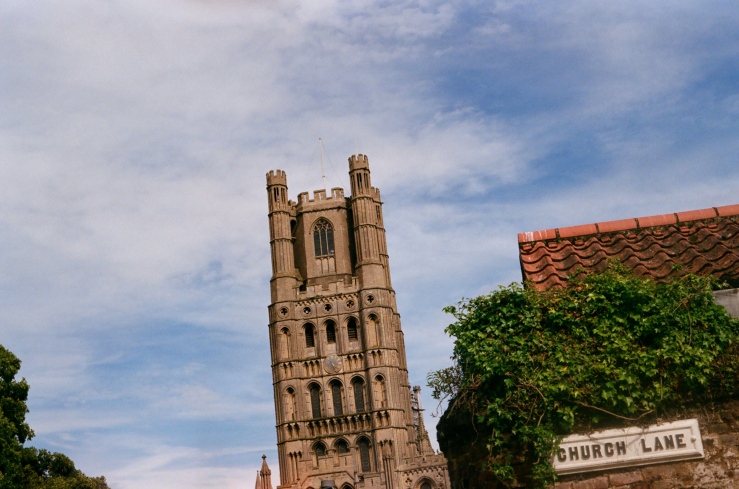
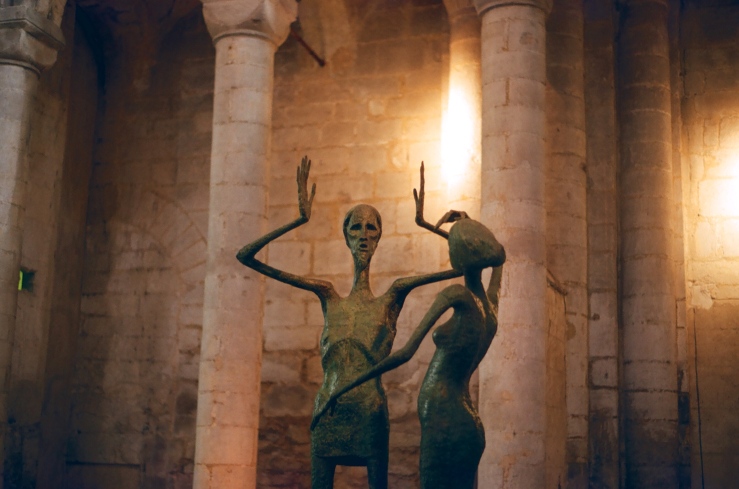
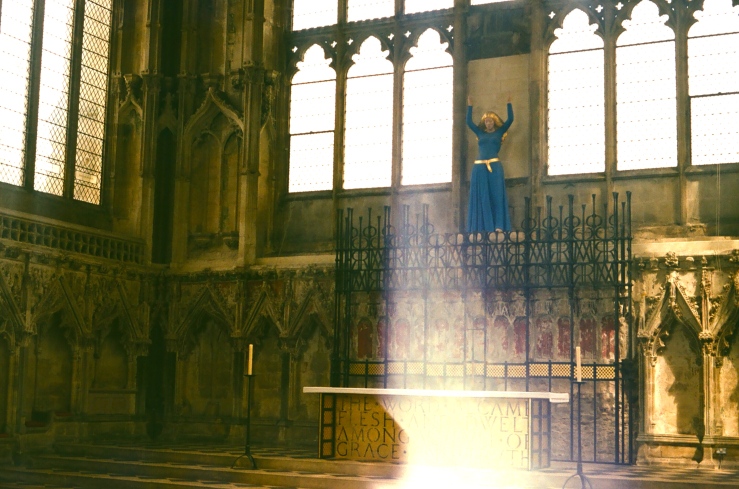
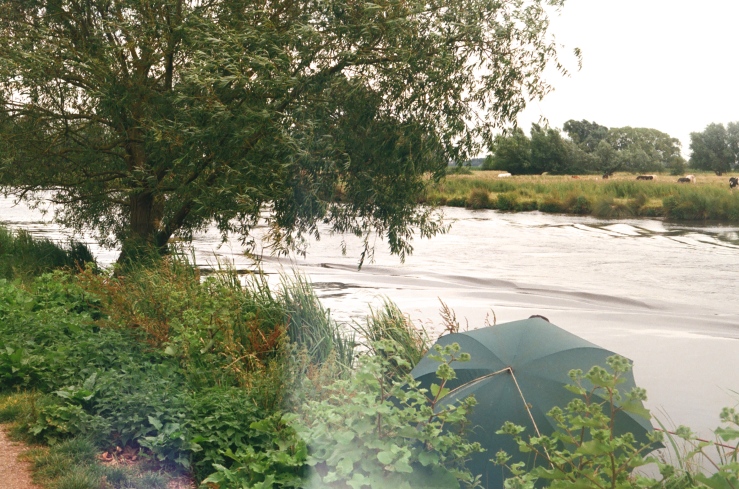
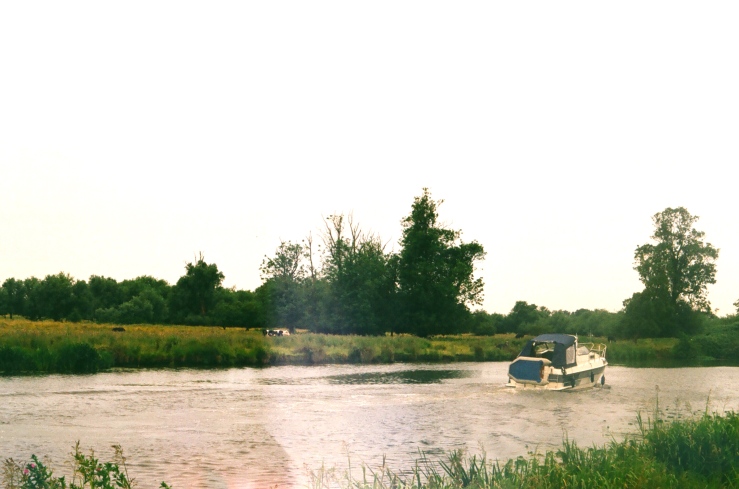
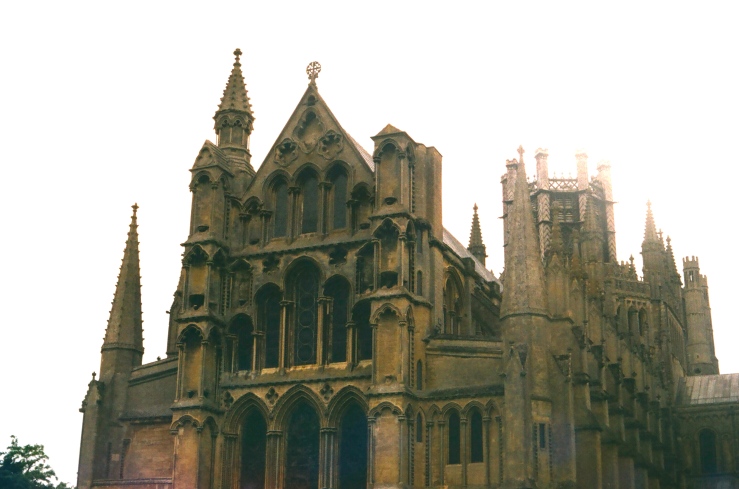




The flickering outdoor light cast a milky pattern across the back yard pond Oonagh had dug on her forty fifth birthday. Michael stared at the water and remembered the dirt piling up beside the wooden deckchair he had sat in while she worked.
Oonagh had the habit of making household rearrangements to mark milestones. On her fortieth birthday she had smashed through a partition wall to open up the dining and sitting rooms and on her fiftieth she had uprooted several conifer trees that had grown so tall they blocked out the sun for the majority of the day.
He’d objected to the pond, he’d objected to chopping the trees down. He’d become unforgivably objectionable after he stopped working at the military installation down by Cogley Wood, and he had mercilessly dragged his feet as she hacked away at the tree trunks.
“Why don’t you go a little easy,” Michael had shouted at her, “you’re fifty now, you’re not as young as you used to be.”
“If it wasn’t for me,” she said breaking to breathe after each swing, “nothing would change around here.”
The fact that he could gaze out across the square to the Robinson place, the fact that he could sit and watch people come and go from the Horse and Jockey pub, the fact that he could make note of the changing seasons, the maypole in the summer, the lighting of the tree in winter, this was her gift of openness to him, chopping those trees down had kept him connected to the world when he most wanted to be out of it.
“To accept the immediacy of death is the only way to overcome anxiety,” she would say, and, “To grow nightingale roses on the eastern side of a garden is to open up your life to a host of secrets,” among other such maxims that were deemed not so serviceable for reality, but certainly were worth bearing in mind for the next world.
Micheal still hated it when people sang ‘Jerusalem’ at weddings, everybody likes the tune but the words are hardly fitting and although they had really belted it out on that summer’s day in 1952, he couldn’t help but cringe at the memory. Although her countenance was divine, the holy city paled in comparison to the passion she would bring forth every Sunday night, in the old place, down by the beach, with the leaky roof and the jet planes from the military installation at Cogley Wood roaring overhead as they did it.
Miraculous moments come and go in the blink of an eye and then, the miracle done, you are left to wonder if it was all just a predetermined certainty you were made to wait a little longer for than you were entirely comfortable with.
Oonagh saw the world in Micheal and the generational back and forth continued until probability conspired that they chop down the trees together and she looked back at him from amongst the fallen wood, the world opening up before him again, as time proved his heart faithful and she told him about the changes.

A century has passed since Kazimir Malevich’s Black Quadrilateral was unveiled in Russia and the painting forms the starting point of the Whitechapel Gallery’s Adventures of the Black Square, which examines the influence the painting has had on abstract art in the years that have followed.
Malevich developed his artistic style to the point of pure abstraction using geometric shapes in his work to express ideas and sensations. The Black Quadrilateral and the 39 paintings that premiered with it were the first paintings that were not depictions of something else, constituting one of art’s first steps outside of a physical reality. “I am trying desperately,” Malevich wrote, “to free art from the dead weight of the real world.”
The artists featured certainly took Malevich’s aspiration to heart and those present do not only represent nations one would immediately associate with abstract art, but are from countries ranging from Argentina, to Israel and Iran.

The exhibition, which meanders over two floors, begins in Russia with images of the Shukhov Radio Tower, the winding conical steel structure that was saved from demolition just last year. Placed next to these images is a depiction of a megaphone, something of a motif throughout the exhibition. Design for Loundspeaker No. 5 by Gustav Klutis, is a Constructivist take on what was then a brand new means of mass communication and is in itself an attempt to use bright colour and brash form to communicate with people in a manner that transcends language and social rank. The megaphone theme is picked up later by Zvi Goldstein, an artist from Romania, who reminds the viewer that megaphones can be used to both rally people to social revolution and to suppress them with propaganda, something that can equally be said of art.
Malevich’s immediate influence can be seen more readily in Lyubov Popova’s Painterly Architectonic. Created just a year after Malevich’s Quadrilateral, shape is used to represent the encroaching modernity that was taking hold in the early years of the twentieth century, with the square being used to represent skyscrapers and cars.
![El Lissitzky -1o Kestnermappe Proun [Proun. 1st Kestner Portfolio] Published 1923 Scottish National Gallery of Modern Art, Edinburgh © the Artist. All rights reserved.](https://robertleeming.com/wp-content/uploads/2015/01/el-lissitzky-1o-kestnermappe-proun-proun-1st-kestner-portfolio-published-19231.jpg)
The notion is progressed with the conjoining of abstract art and architecture seen in the selection of Proun lithographs created by El Lissitzky, which he created to represent “the interchange station between painting and architecture.” Proun is an abbreviation for the Russian ‘Project for the affirmation of the new’ and was formulated to encourage the creation of a new society in the wake of the Russian Revolution. The lithographs are otherworldly to look at, but there are practical considerations at their core.
Theo van Doesburg’s ‘Colour design for ceiling and three walls, small ballroom, conversion of Cafe Aubette interior, Strasbourg’ continues the consideration of how geometric abstraction was developed into a three dimensional form to slot within our built environment. Van Doesburg was a Dutch poet, painter and architect, who worked on the redevelopment of the Aubette building in Strasbourg into a cafe, restaurant, ballroom and cinema complex. Doesburg was a perfectionist and took control of all aspects of the project right down to the style of the ashtrays in the ballroom. Underlying his complex designs was a new aesthetic he termed Elementarism, a school of thought that reduced art to its fundamentals of form, colour and line with only vertical or horizontal lines being used and only paint being applied in primary colours, something that is visible in the carefully positioned rectangles, squares and colours found in van Doesburg’s plan for the Cafe Aubette. “The point is to situate man within a painting, rather than in front of it”, van Doesburg said. “Man does not live in the construction but in the atmosphere generated by the surfaces.”

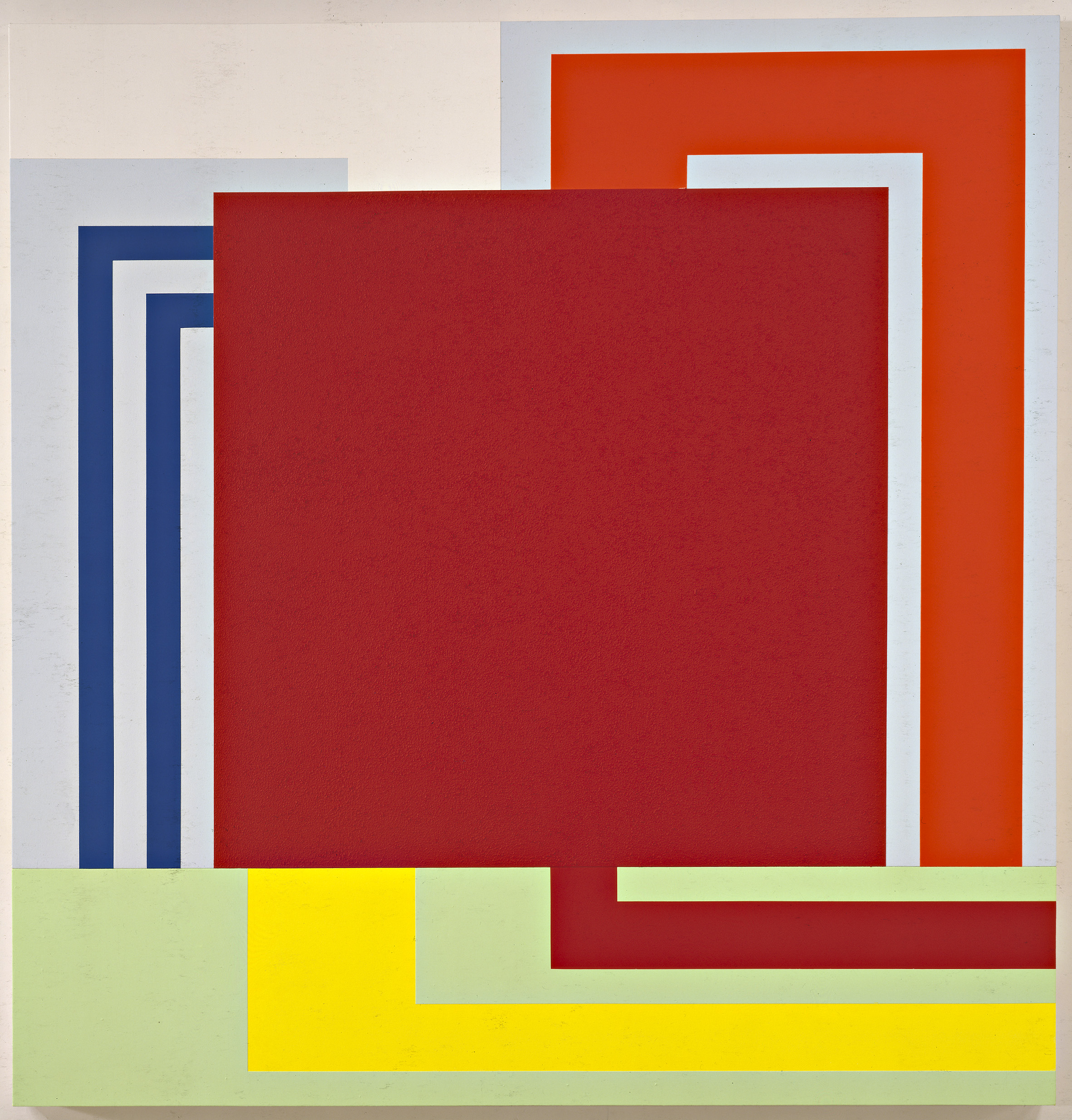
Squares and geometric shapes, like the blocks of sound found in a Beethoven symphony, are, when collated together, always the building blocks of a greater whole and as the exhibition progresses towards the present day, the theme continues. In Peter Halley’s Auto Zone, one of a series of cell paintings he created, the artist uses colourful squares, intersecting and eye-catching, to depict a prison as a prime example of modern thinking and, in a broader sense, the ability of modern society to manage space, people and activity through surveillance.
The theme of space management is also confronted in Keith Coventry’s Sceaux Gardens Estate from 1995. Coventry’s Estate Series manages to create a language from the layout of London housing estates, the footprints of tower blocks replaced by colourful oblongs. The image exposes the dystopian nature of modern cities and in doing so creates an image that is in itself dystopian, a diagram beyond understanding, but something that has to be accepted and lived in nonetheless.
The exhibition concludes in the near present with Spirit Above All by Zhao Yao from 2012, the abstraction, the squares of dark colour still evident, a century after Malevich put paint to canvas on his own black square.
“Shouldn’t it give us pause,” Malevich said, “that the oldest works of art are as impressive today in their beauty and spontaneity as they were many thousands of years ago?” This enthralling exhibition proves that spontaneity and simplicity in art is long lasting, and that out of a fundamentally abstract form can come a very physical rendering of our everyday life.
Adventures of the Black Square continues at the Whitechapel Gallery until 6 April 2015. All photographs courtesy of the Whitechapel Gallery.



From the lingering drone that opens Wagner’s ‘Das Rheingold’ to the riotous satire of Kurt Weill and Bertolt Brecht’s ‘Three Penny Opera’, German culture is nothing but consistently stirring and the work of Anselm Kiefer stands at the forefront of the Germanic cultural panorama. But in the years since the Second World War, this stack or artistic riches has not always been fully acknowledged by Germany’s own people, a fact Kiefer has been instrumental in correcting.
Like many who have visited the current Royal Academy retrospective of his work, I was acquainted with Kiefer’s art, but perhaps was not aware of the breadth of his practice or the scope of his influences. Over a forty five year career he has embraced painting, sculpture, photography, drawing, woodcuts and architecture, examining universal questions of belief and meaning as he progressed with each of these disciplines.
Addressing the Nazi tyranny is another considerable plank of his work something every German artist emerging in the immediate postwar years had little choice but to consider. At the same time as producing an examination though, Kiefer has also participated in an act of reclamation, retaking the iconic fields and forests and mythological heroes of his homeland for use in his work, freeing them from the Nazi propagandists who had twisted their meaning.

The best examples of this attempt at reclamation can be seen in his ‘Occupations’ and ‘Heroic Symbols’ collections. ‘Occupations’, created for an exhibition in the late 1960s features self portraits of the artist in his father’s World War II uniform performing the banned Nazi salute in front of historic European sites. Naturally the paintings caused outrage, but they were not devised to shock, rather to make the point that the Nazi legacy could not be cloaked in a veil of silence and forgotten about, rather it had to be approached. Kiefer made plain that his generation owned their nation’s past whether they liked it or not and willful ignorance would not be the best foundation on which to construct a new Germany.
Kiefer again slips into the guise of a Nazi in ‘Heroic Symbols’, depicting himself standing in front of statues of Roman warriors while performing a Nazi salute. As well as raising a subject that had been cloaked in a grim public silence, Kiefer also dons the uniform in order to try and reenact what his forebears did in an attempt to understand them and to try and conclude if, in their position, he would have participated in the horror.
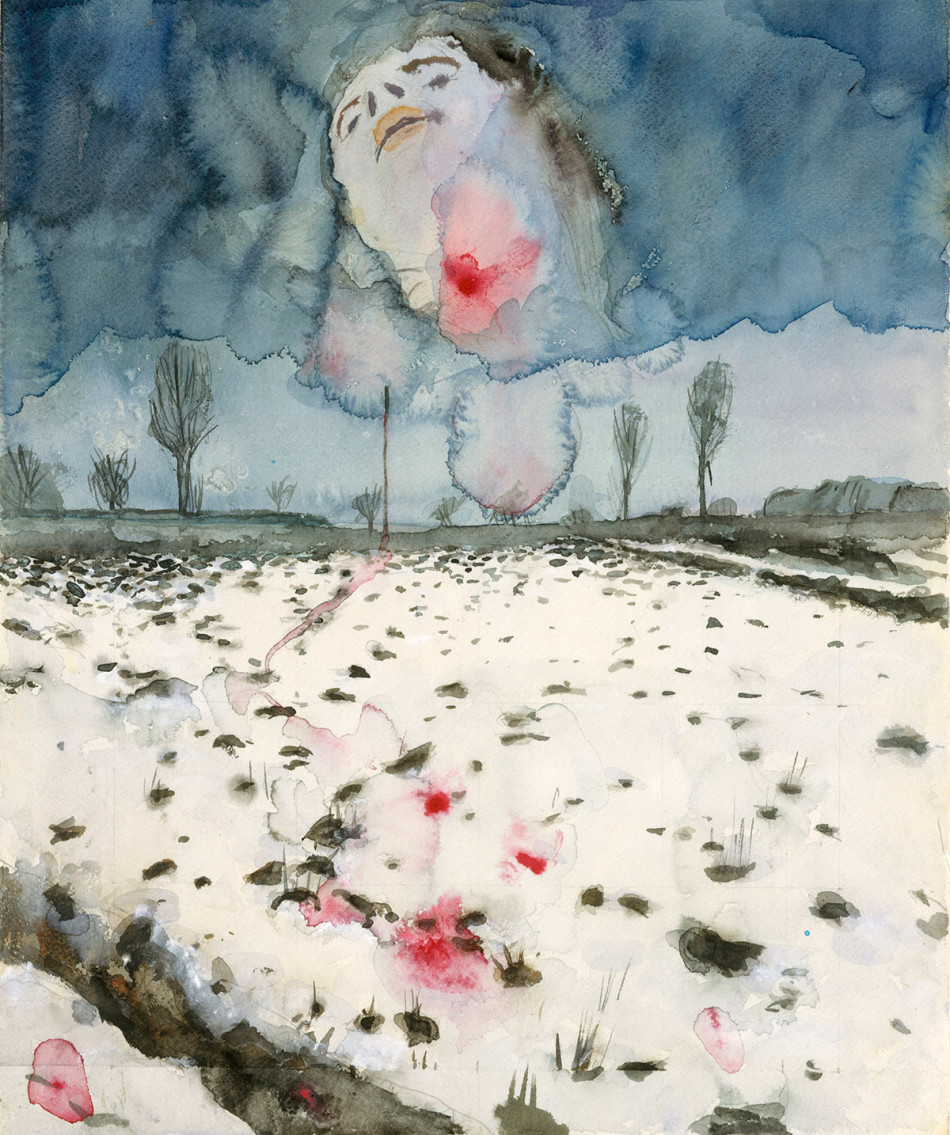
Some have tried to label Kiefer’s work as ‘Neo-Romantic’ a title that has been challenged, but does bear some credence when one considers his often barren landscapes. In ‘Winter Landscapes’, Kiefer depicts a snowy scene, the white stained with blood that drips down from the severed head of a woman that floats ethereally over the forests and fields.
Trees figure in many of Kiefer’s landscapes, Germany being a nation where the forest is as important to its national identity as the sea is to Britain. Kiefer’s trees reference ‘Yggdrasil’ the Norse myth that depicts an immense tree of life linking all the worlds of the universe.
This mythological, almost alchemistic element, is a theme that is consistent throughout Kiefer’s practice and in the 1970s he began to examine the link between the earthly and celestial more closely. In ‘The Orders of the Night’ the artist portrays himself lying beneath huge sunflowers which embody the connection between the Earth and the sky as the flowers follow the sun. “When I look at ripe, heavy sunflowers, bending to the ground with blackened seeds,” Kiefer says, “I see the firmament and the stars.”
Kiefer was particularly inspired during this period by Robert Fludd, the Elizabethan astrologer who believed that for every plant on Earth there was a corresponding star in the sky. Fludd famously published his ‘Diagram of the Spheres’ in ‘Utriusque Cosmi’, one of the most famous occult symbols ever created. The diagram is constructed from a series of concentric spirals, each representing angels, stars and elements, which stretch downwards from God to our own terra firma. The document resembles the rings of a tree trunk, a Kiefer influence already discussed, but half circles, arcs and crescents are also recurring in his work.
The artist shows himself lying beneath an arc in one painting representing the progression of life, while in another painting Kiefer draws inspiration from the Fertile Crescent of Mesopotamia, noting that clay writing tablets in the area were created from the same material as bricks, questioning if building bricks, like tablets, can contain the notes and memories of a lifetime. In ‘The Ages of the World’, a piece of sculpture created by Kiefer especially for this exhibition the artist presents a funeral pyre representing geological time and the history of art and culture, a totem pot-marked by meteorites and fuel, suggesting the cyclical nature of our planet’s birth, death and rebirth.
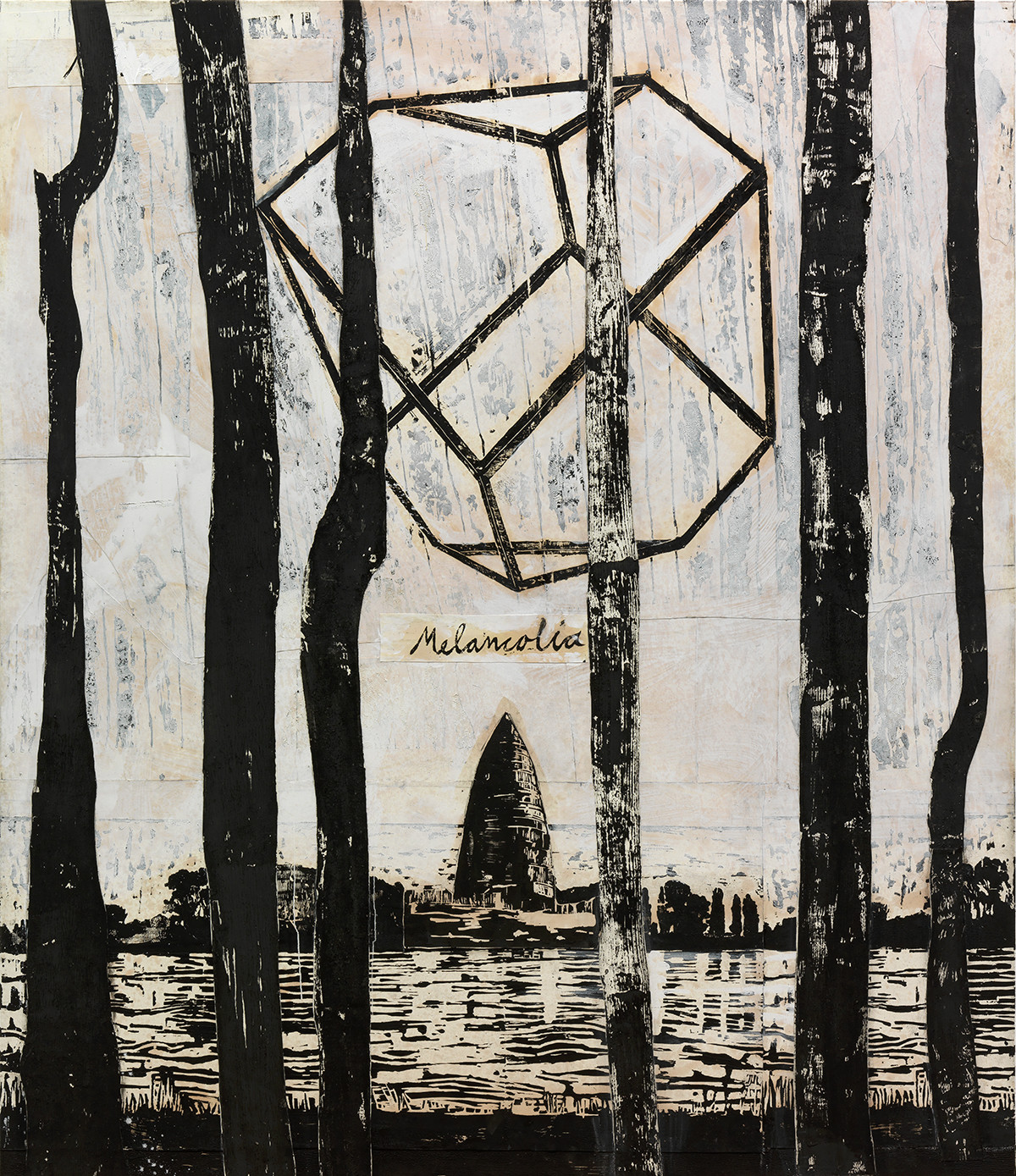
In the final gallery of the exhibition the artist turns to the primary inspiration of many German artists throughout history and the lifeblood of the country, the River Rhine. He presents the river in woodcut form and in doing so remembers the role it played in his youth when the Rhine would regularly flood the basement of his childhood home near the French border and he would wonder if the neighbouring nation had invaded his house in liquid form.
One of the most impressive elements of Kiefer’s work is that it exists at all. The German philosopher Theodor Adorno wrote in the wake of the Holocaust: ‘To write poetry after Auschwitz is barbaric,’ and the quote bears testament to the challenge Kiefer faced, as a young German born just two months after Hitler’s death, when he chose self expression as his life’s work.
In his 1981 works ‘Margarethe’ and ‘Sulamith’, Kiefer attempted what Adorno had deemed impossible and approached the Holocaust in two paintings. On the two canvases of oil, acrylic and straw he depicted the mythic ideal of German womanhood Margarethe on one and Sulamith representing Jewish womanhood on the other. Margarethe and Sulamith were both referenced in Paul Celan’s poem ‘Death Fugue’, which he composed in Czernowitz, a German labour camp after his parents had been murdered by the Nazis. The poem depicts Jewish prisoners referring to the two women in a song as they dig their own graves under the watch of a blue-eyed German commandant holding a serpent in his hands. The words of the song note that the women’s hair, once beautiful, was now streaked with ash from years of war.
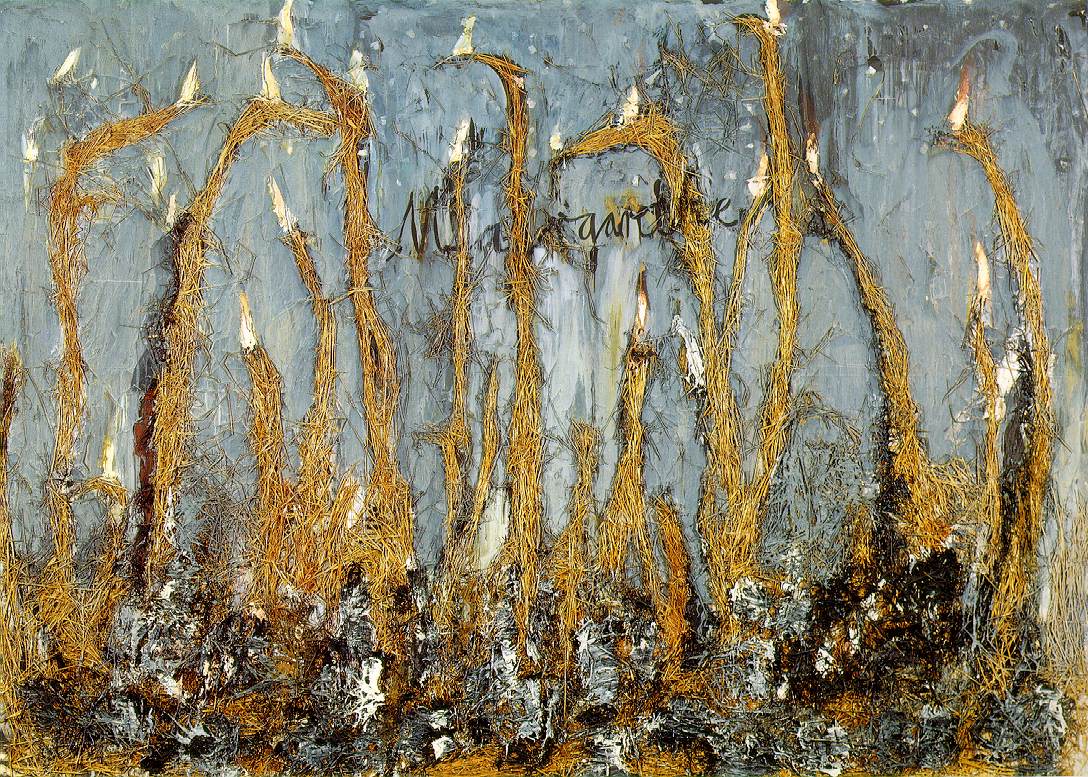
Kiefer unites the two in the artworks. He does not depict the women themselves but instead the Margarethe canvas references the once black hair of Sulamith with shadow curving and worming its way through the painting, while the Sulamith canvas is streaked with golden straw, a reference to the lost lustre of Margarethe’s blonde hair, the two paintings together reunifying the Germany the Nazis tore apart.
“The Germans have cut themselves off from half of their culture,” Kiefer said in response to his work, “they have disabled themselves. One thing is the Holocaust, the other this amputation of oneself. All the culture of the 1920s and thirties, in all its fields, theatre, philosophy, cinema, science etc, disappeared.” It is not too much of an overstatement to say that Anselm Kiefer began the German people’s reacquaintance with their artistic soul.
All photographs courtesy of the Royal Academy of Arts.
 Robert Leeming