Jesco White – The Dancing Outlaw of Bandytown

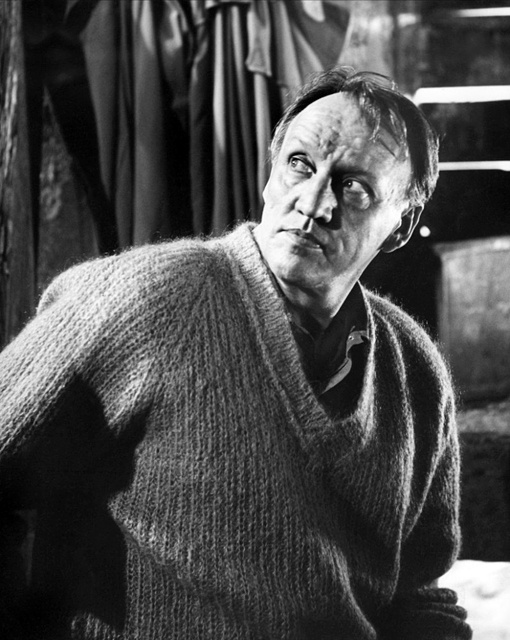
Sanity, it seems benefits from the mundane. A happy medium is healthy for ones mental mechanics. But sometimes the mundane isn’t always an option. Dominic Murphy’s new film “White Lightnin” examines the collapsing male mind and uses the rip-roaring, gas-sniffing life of Appalachian trailer dweller, Jesco White, the dancing folk legend and inspiration for many an alt-country song, to do so. It is a re-imagining of his sordid, tragedy ridden existence, with a  fictional ending which shows Jesco (played by Edward Hogg in his first lead role) descend into madness and murder, events that could have occurred had his demons got the better of him. A “dark fairy story that considers a mind totally out of control” is what it’s creator calls it, with hillbilly dancing, hells angels, the raucousness of trailer life and Carrie Fisher all thrown in for good measure.

Parts of the American south have always seemed to have a collective screw loose, Jesco “The Dancing Outlaw” White being a case in point. His mind was fractured early by sniffing gas and injecting heroin and worn down by tortured years in jails and asylums. He had numerous shootouts with the police and faced the kidnap of his son and murder of his father ( an event the films Jesco never recovers from). The golden thread running through his life though is Appalachian mountain dancing, a skill passed from father to son. It involves the ability to look cool while generally flailing ones limbs around to hillbilly music. He still performs today, touring sporadically, and sporting his own My Space, which showcases some of his favourite videos from years past, including one of country heroine and songstress Cousin Emmy, who plays “You Are My Sunshine” via the whistles and squeaks of a deflating balloon. Backed by Pete Seeger on guitar of course. Eccentricity at its purest.

Jesco the dancer is a wonderfully original character, who Ed says “ seems to burn brighter than those around him when you meet him in the flesh.” In his calmer moments he is a southern gentleman, God fearing and father to his numerous children. He has alter egos to, that he drifts in and out of. He is Elvis. He dresses up like him and re-records his songs in his “home studio”, a tape recorder hanging from a string in his living room. From time to time he even channels Marilyn Monroe.

When his temper does catch fire it’s not in the same way as Dominic’s film character. His temperament is more sarcastic and gloriously irreverent compared to his doppelgangers violent rage. When the County authorities refused to bury the body of one of his countless Uncles in the local cemetery, he bought a sit-on lawn mower, poured petrol over it, drove the contraption  into the morgue and set it ablaze. It caused apparently, quite a stir.

But whereas the real Jesco has held onto the light, the films Jesco walks the same thin line, but falls over the fiery side. He struggles with and fails to contain his anger at his fathers murder by two hicks who lash the old man to the back of their pick-up and then hit the gas. His anger and need for revenge wars with an intense jealousy, that destroys his marriage to comfortable Southern Belle, Cilia (Carrie Fisher.) “We just took Jeso’s temper in real life to its logical extreme” says Dominic, the extreme being the graphic murders of his father’s killers and a policeman who gets in the way of his rage.

Ed Hoggs, Jesco is a cross between Charles Manson and the demon brother of Neil Diamond, resplendent in sparkly black shirt, his manic dancing charms his audiences in red-neck watering holes. But temper and jealousy are two fatal gashes in his unstable character, at one point he jumps from the stage, charges a hillbilly Lothario who is chatting up his wife and almost does the poor fellow in. It is a wonderful performance, full of outrageous effrontery, as he switches from softly spoken southern charmer, to blood curdling psychotic screamer with perfectly timed ease. “I felt some sympathy for Dominic’s Jesco” says Ed “ he’s a guy who just can’t get away from trouble, it dogs him.”

“White Lightnin” is Ed Hogg’s first role in a feature and enters the film world after serving his apprenticeship at the National Theatre. “He’s a highly technical and well trained actor” says Dominic, who had to ease away Ed’s need to know exactly what would happen in a scene that was about to be shot. Of course such knowledge does not lend itself to the kind of spontaneity required for a part that would naturally lend itself to the very un-British “method” school of acting: “ Method acting is  training yourself to be able to put the self in an emotional state, whereas British actors tend to represent emotion. I didn’t let him rehearse a scene physically, so this gave him the anxiety which helped arouse the rage in his performance.”

It is a grim landscape that is presented here, probably very colourful to the outsider, but presented by Dominic in a grey rusty tone. A colour that suggests malaise, like when a person realises their in an irretrievable situation and the colour drains from their face. From everything. The film has that kind of feel. That hell is just over the mountains and its embers are dulling your vision.

Amid the grim colours and violence the film offers a religious puzzle, and seems torn between devout belief and dismissive nonchalance . At one point Jesco asks Cilia where she is going as she heads out of the trailer, “to church”,  she replies in a voice that suggests she would rather go and watch wood warp than do anything of the sort. But at the same time after the murders, Jesco flees to an old wooden shack in the Appalachian forest to seek, fight for and to punish himself physically in order to gain redemption. The last shot of the film sees him lying in a field in a crucifixion style pose as Amazing Grace plays in the background.

Ed describes the final scenes as “A man trying to put himself on a level playing field with his God” in many ways its self-flagellation, trying to suffer the pain he has inflicted on others. It suggests that sooner or later one has to level with oneself. A person can put themselves through total hell without seeing the inside of a jail cell, that’s punishment in the eyes of the state, not the self. The films harrowing conclusion tries to prove that a warring conscious can be Calgary itself. Jesco see’s this through in a mountain cabin alone as bloody solitude cleanses his mind.

Of course beneath Jesco, Appalachian dancing, religion and the myth of the American south, there is a story of a man on the brink of his own sanity, not angry at his existence but at the constant barrage of unlucky circumstance. The typical male depressive of literature haunted by the need for revenge, jealousy lost love and the unstoppable passage of time, pushed to fall into mania until the Earth becomes as Hamlet said “nothing but a stale promontory, a foul and pestilent congregation of vapours.” And if you get to that sorry point you can either pull a Jescoesque bloody vent at the world (not advisable). Or like the real one you can sit down, take a deep breath, throw on your Elvis suit and watch Cousin Emmy play “You Are My Sunshine” on a gradually deflating balloon.
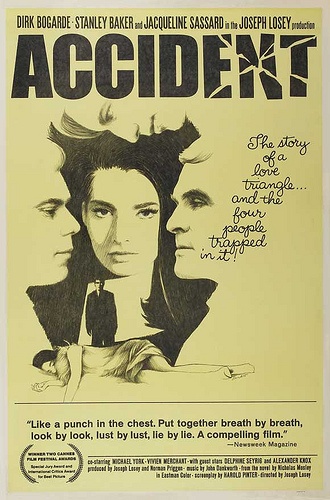
Joesph Losey, Dirk Bogarde and Stanley Baker – Patron Saints of Britain’s New Wave

Joseph Losey was one of America’s greatest gifts to British Cinema. Forced to abandon Hollywood for London with Joe McCarthy’s communist witch hunt baying for his creative blood, his British residency, for the rest of his working life, ensured that such art house cinema classics as The Servant, Accident and The Go Between, were forever enshrined in the British pantheon of film classics. Now in the year in which he would have celebrated his 100th birthday, the famously prickly director’s work is being re-appraised and re-released by the British Film Institute.

Losey is often referred to as a director’s director, but he produced his fair share of B movie curios too, including 1948’s The Boy with Green Hair. For some time, B movies were seen as his area of expertise, so much so that he was considered to direct the first Hammer Horror films.

Three projects he completed in the 1960’s though, Eva (1962), The Servant (1963) and Accident (1969) are hailed as masterpieces that helped kick start a New Wave cinema movement in Britain, similar to the celluloid revolution in France which brought Goddard, Truffaut and Demy to the fore. Not only this but his casting of Dirk Bogarde and Stanley Baker in these films helped two actors, who up until that point had been stars of the British studio system, making films such as Doctor In The House and Hells Drivers, begin a new chapter of their careers.

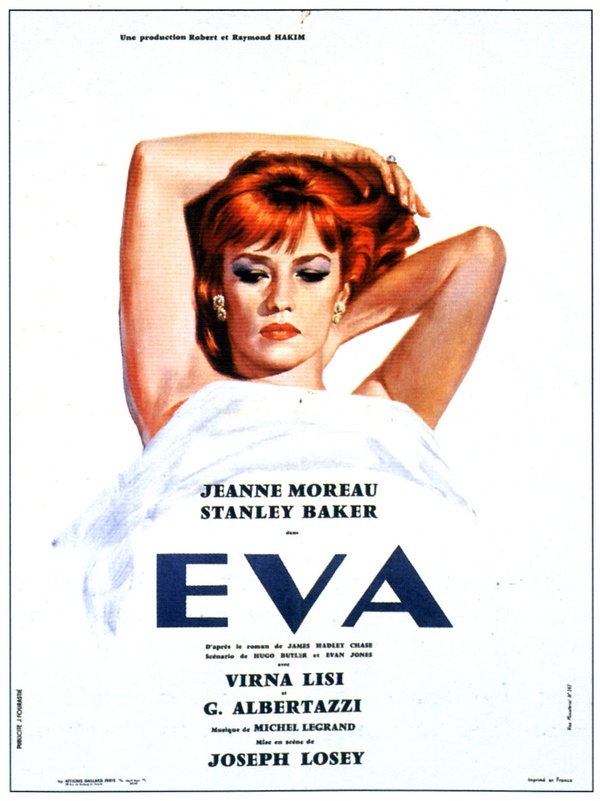
Eva, Losey’s first real stab at sophisticated film making has early hallmarks of brilliance, but it is let down by a rather sultry self indulgence. The Billie Holiday score gels wonderfully with Jeanne Moreau’s faded chic, juxtaposed against an equally fading Venice, before it became the tourist rat run that it is today.

Moreau plays an especially deadly femme fatal ( a constant Losey character in his films), and in one scene she is seen lying in a steaming Jacuzzi, listening to Billie Holiday records. Stanley Baker plays a Tyvian, a rather too stereotypical Welshman, an author whose garb on the back of the book he is supposed to have written is that of the coal miner. Tyvian has a lover already, the honest innocent who is always cast aside by the protagonist in Losey films.

Eva is darkness personified, like Hugo Barrett in The Servant, she has no redeeming qualities, but Baker falls for her non-the less, perusing her across Europe, only to be met with a hail of abuse, flung ash trays and at one point the end of a riding crop. But his love, or rather lust persist, masochistically, and he throws his life away almost on a whim for her.

The film is an interesting attempt at cool,  a rather slapdash stab by Losey to try and raise himself above the B pictures that had been the tradition of his career up until that point. There’s some laughable moments, particularly at the beginning when a biblical style voice over akin to a Charlton Heston film announces over shots of sculptures of Adam and Eve “And the man and the woman were naked together, and they were unashamed.”

It was Losey’s 20 year working relationship with Dirk Bogarde though which helped prompt the blossoming of Losey’s career. The quartet of films the two made together in the 1960’s, The Servant, King and Country, Modesty Blaise and Accident  are in many ways the cornerstones of British film making in that decade. The Servant  and Accident  in particular, both starring Bogarde and both scripted by Harold Pinter, created for the first time British intellectual film, utterly cool, utterly sophisticated and stylistically European.

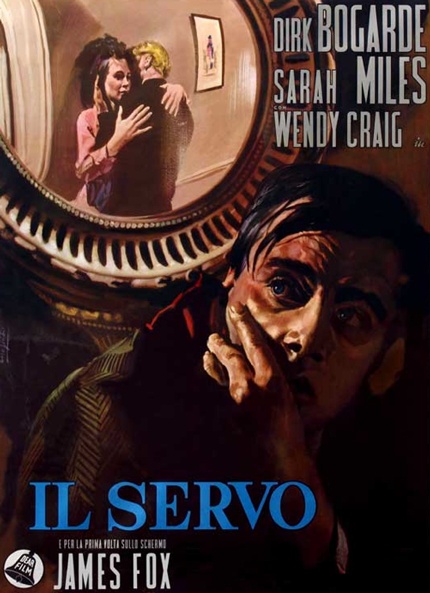
It is The Servant which most consider to be the prime Losey cut and one of the most enigmatic films ever to be produced in the UK. It is, rather predictably, slated as a kitchen sink drama of the kind Alan Bates was making at the time. The valet arriving in a fit of stutters and blushes and ultimately betraying his dominatory tendencies, plying the young aristocratic Tony (Edward Fox) with ever stronger spirits until he is a broken mess, his fiancé heading towards the door, and the house very much belonging to Barrett. Servitude reversed. This is however not before Barrett has endured the full force of the British upper classes’ sense of superiority, basically being treated as a second class citizen by Tony, before the tables slowly turn.

Losey throughout his career is unremitting towards the upper classes, both here, in Accident and in The Go Between for which he won the Plame d’or in 1971 at the Cannes Film Festival. But this is much more than a class war parable, it is, which marks it out among its 1960’s peers a very gay film, with obvious homosexual overtones. The film made in 1963, four years before homosexuality was made legal in England in Wales, sees Bogarde camping up his performance, becoming a creepily obsessive dominator who tells Tony “My only ambition is to serve you, you know that don’t you?” Before handing him a mysterious vial of liquid that he’s got from “A little man in Jermyn Street” that pushes him ever deeper into his virtually comatose state. Tony becomes ever more reliant on Barrett and can barely function without him as the movie reaches its climax, which see’s Bogarde throwing Tony’s fiancée out of what is now Barrett’s house, Tony lying fractured out of his mind in the hallway.

Many people say that The Servant is a very simple class allegory akin to Animal Farm, Barrett the manservant and Tony the upper class cad simply swap places. But look more closely and you realise that Barrett replaces Susan (Tony’s fiancée), who begs Tony to sack Barrett, but ends up being removed from the house herself. Does Barrett replace Susan in Tony’s affections? That door is left very much open. One must remember that in the same year Bogarde made Doctor in Distress, a further instalment in the Rank Organisation’s Carry On style comedies, a million miles away from the subjects broached in The Servant, which fell away unnoticed on its original release, but set the critics raving.

Accident is a film which has been written off as upper class nonsense too,  focusing on a long Sunday afternoon in a Buckinghamshire house, as two aging Oxford dons fight it out over a Spanish heiress. There is cricket, there is the Eton wall game and there is plenty of intellectual posturing and flimflamery, but thank heavens there is not one attempt by Losey to make one of these moneyed intellectuals heroic. They are all being sunk by their own desires, they are being dragged from the dreamy spires into a sexual mire that will end with a mêlée of rape and death.

It is a film of excellently sculptured images and metaphors. Bogarde and Baker play middle age academics, both in marriages teetering on the edge of collapse, when Anna (Jacqueline Sassard) comes into their lives as a pupil, setting their desires racing once more. There is a wonderful scene when at a Sunday afternoon dinner party at Stephen’s country home the camera watches Stephen (Bogarde), Charlie (Baker), Anna and her “boyfriend” William (played by a very young Michael York) compete in a game of badminton. Stephens’s wife is seen sitting in a chair watching, as the camera pans back to the game. As it heads back again towards Rosalind (played by Viviane Merchant) she has gone, nobody has noticed, the game continues, all the male eyes on Anna, and just like Tyvian and Tony’s loves, another innocent is cast aside.

On another level we have the obvious tension between Stanley Baker and Dirk Bogarde. Their relationship was just as tense off-screen for the same reasons as it was tense on. Baker was the masculine Welshman who could probably drink even Richard Burton under the table and he was strong and he was manly, and he was everything that Bogarde obviously wasn’t. They’re the same on-screen. Stephen lusts for Anna constantly, Baker actually has her, again and again, even at one point using Bogarde’s house, without his permission, for their sexual trysts. The only time Bogarde gets anywhere near her hallowed blue blooded flesh is when it is suggested that he takes advantage of her after the accident that kills her hapless boyfriend.

There is a scene in the middle of the film, when Sassard (the one bum note in the film’s acting score) is walking through a forest with Bogarde. He, ever the gentleman, is leading the way, holding back branches and testing the ground (mentally as well as testing the firmament below). He warns her of a spider’s web weaved between two saplings. You expect her to dodge it, she looks the type, but instead she drags it down with her hand destroying the life’s work of the blessed insect that created it. The perfect Losey metaphor for Anna, the wrecker, who appears and drags down the well ordered web of five lives, without much real care for those involved.

Losey films always feature webs of complicated relationships and to make his cauldron of depravity bubble he always drops a wrecker. Be it the poisonous almost Iagoesque Barrett in The Servant or the unwittingly fatal Anna in Accident or Eva in his Venetian passion play of the same name.

The classy sensuousness of a Losey film is something that doesn’t exist anymore, they are enigmatic, everything is implied but very often nothing is confirmed. Are Tony and Barrett in love in The Servant? Does the Oxford don rape his pupil? One can only guess. It would be quite right to consider if a Losey film ever portrayed a person actually in love and not a victim of lust, if he ever portrays a working relationship on screen well, or indeed if there is ever a realistic portrayal of a woman in his work. Instead of love though, one turns to Losey for a critique of the darker side of the human psyche, for studies in the callousness of lust and domination, where characters are often destroyed by their own desire. An age old subject coated in a poisons bitchy, subtext that Losey was the master of. Or as Dirk Bogarde described him in a letter to his widow, Patricia, written in the wake of Losey’s death in 1984: “He has at least four great movies to his credit. Clever sod! Shitty bugger! Goodness how I shall miss him.”

Cosmo Jarvis/She’s Got You

CosmoPic.jpg.displayRemember when it’s revealed on Seinfeld that Kramer’s real name is Cosmo and hilarity ensues? Well this guy’s name is Cosmo for real, Harrison Cosmo Krikoryan Jarvis to be precise, and he looks like a six-inch nail if it had human features. I have the feeling though that Cosmo’s name is potentially made-up, to attract attention and produce a flamboyant go-getter aura, much in the same vein as “Elton John” and “Gordon Brown” have lent a new lease of life to Reg Dwight and Andre Chorlton. It’s very likely too that Cosmo has modelled his marvellous moniker on Sir Cosmo-Duff Gordon, a silver medal winning fencer from the early 1900’s, who survived the sinking of the Titanic and married a genteel lay-dee whose sister wrote porn. All true, believe it or not, not a figment of my imagination on a rainy Monday afternoon.

“She’s Got You” is the New Jersey born, Devon raised troubadour’s first single from his upcoming album “HumAsYouHitch”. He’s a multi-instrumentalist, who, before contracts and audiences came calling, wrote 250 songs in the space of five years. He plays the ukulele too and has apparently penned quite a few poisonous ditties about ghastly celebrity irritants Jessica Alba and Britney Spears.

Cosmo sounds a bit like Billy Bragg, but he isn’t an insufferable nerd and doesn’t drone on about the tax man, the private lives of milkmen and cups of tea. No, it appears that Mr Cosmo has dived into the “world music” cannon, picked up a handful of influences, thrown them up into the air and this gem has fallen down from above. There’s some Hawaiian ukuleles, there’s some African pan-pipes ala Paul Simon’s Graceland, there’s some reggae influences and a wonderful Beatle-esque bridge that has echoes of old British music hall. The song, a tongue-in cheek plea to a friend who has fallen into the clutches of a devious girlfriend, has the hallmarks of bubblegum folk, an intelligent, light hearted acoustic sound. The lyrics aren’t half bad too: “When will you learn, she’s got you wrapped around her little finger” goes the fetching chorus.

It’s wonderful really, shockingly catchy with a rollickingly good tune. Think Sufjan Stevens and his brand of turquoise blue, clean pop, powered by school recorders and you’re just about there. He’s only nineteen too and obviously has ladlefuls of potential. One to watch and that’s for sure. An eccentric wonder who looks set to live up to his amazing name.

The Boxer Rebellion/Union

theboxerrebellionIt’s been five years since The Boxer Rebellion’s last and only album “Exits“, not the amount of a time an up and coming band ideally wait before launching their sophomore effort. But their’s has been a rocky half decade, full of injury, financial turmoil and record contract foibles. Yet still they’ve managed to make it out the other side and have made a number of gutsy moves during their second run up to the “big time”. Firstly they cast aside any need for record deals and launched “Union” in January on Itunes only, scoring a no1 on their alternative music chart, beating such lusty competitors as Coldplay and The Kings of Leon. Secondly, they’ve struck a mighty deal, with the even mightier HMV to be the sole proprietor of the new record, but given HMV is the only high street record store these days, that really isn’t much of a big deal. Although between me and you I saw a copy in Vinyl Exchange the other day going for a sprightly two quid, how they got hold of it? Nobody knows.
Two pounds is selling the Boxers short a little, they are a fairly good band, unfairly boxed together with “The Killers” a band that make “An Evening with Billy Joel“ sound palatable,God I hate Billy Joel, he looks like a shelled errant walnut which let itself go. The Rebellion are unabashedly “indie”, which is a slight problem given the “indie” cannon is so disgustingly bloated these days, that only a pinnacle of extra-special talent will see long-term success, the rest being condemned to ultimately disappear without a trace. To avoid that fate will be a difficult task, but The Boxer Rebellion do demonstrate here that they have some good material with which to work.

The album opener “Flashing Red Light Means Go” opens with a barrage of drums and you expect it to roll off into electric guitar anthem territory, but instead it veers into the acoustic, followed with almost shoegaze-like sound effects which echo Radiohead, it’s a nice surprise, and a lovely song.

There’s some quite wonderful song to song contrasts to, from the excellent single “Evacuate”, with its thrashing guitars and exasperated, “on the run” melody complete with drum rolls that bring to mind latter-day Morrissey. This gives way to the softly, lilting acoustic ballad “Soviets” “ Oh how can your innocence sway that easily” Nathan Nicholson sings in one of the albums better lyrical moments.

Nathan has the unnecessary want to reach for falsetto notes though from time to time, as if a man with the a loaded pistol has just walked into the studio, holding up a sign that reads, “sing higher or else I’ll shoot.” it sounds a little forced, comes out of nowhere and happens far to often, someone needs to sit him down and have a quiet word before he turns into Liberace, candelabras and all.

“The Gospel of Goro Adachi” is another highlight, that drifts into the realm of electro. There is some hints of an almost oriental sound that mirrors the origin of the bands name, “The Boxer Rebellion”, referring to the “Righteous Fists of Harmony” a group that challenged the power of the Chinese state and laid siege to Beijing. The whole episode ended bloodily and not in The Boxers favour, as you would expect if you tried to lay siege to Beijing.

The tail end of the album (much like this review) begins to drag though, as the same sound repeats itself to often. The multilayer, fuzzy guitars harmonizing with Nathans increasingly grating vocals come and go to often and on songs such as the six minute plus “Misplaced”, seem to go on for an age. There are some wonderful chestnuts on this record, but you have to wade through a few to many fuzzy guitar riffs and generic melodies to find them. The problem is that there is simply to much of this stuff about, piles and piles of it packing the shelves of your local record shop. Is there enough originality on this record to make it stand out from the crowd? I’m not to sure. But it is non the less a good listen, with a few genuinely excellent songs, that might help afford it “lost classic” status many years down the line.

And if that does happen, the hardy soul who hangs on to their original copy will in 50 years or so turn up on Antiques Roadshow 2059, hosted by a decomposing Fearne Cotton, present their rare CD copy of “Union” to the expert (a bespectacled Paul Morley) who will say “gosh what happened to them” and “didn’t we all look a bit silly in those skinny jeans….£2000 for this indie relic at auction” “what this old thing”, the hardy soul will reply “haha never”.

Red Light Company/Meccano

52a9340ee58e70b601fa1b025bbca766Meccano was such a shitty toy, I really didn’t get it, bolting together bits of metal and plastic to make some creaking 1960’s bakery van or a crappy crane. What self-respecting 5 year old would waste his time doing that. I did once, I made a truck and it was one of the major achievements of my formative years, the rest of the time I spent playing in dirt and falling over.

Nonetheless Red Light Company loved the stuff, and have used the metal madness nimbly as a metaphor to inspire a shiny new indie melody, the third single of the London groups first album Fine Fascination. And a nice enough song it is too, full of thrashing guitars and driving rhythm.

Having said that, the first few seconds of the song are dire, soul crushingly awful, an artistic mistake that ranks alongside Neil Diamond (as a human being) and Bob Dylan’s upcoming Christmas album. Well it’s not that bad, the song launches with the ringing of baby lullaby bells, the kind of thing that is sprinkled forth by mobiles dangled over cots countrywide, accompanied by what seems like a robot monkey continuously banging a tin drum. It sounds kind of like the first strains of Dr Spock’s “The Common Sense Book of Baby” if it was launched as an all singing all dancing musical on Broadway. It ruins the song.

But if you put it out of your mind and with mental training and hypnotism it is possible, then you can enjoy the electric whirlwind that follows. It’s got echoes of Editors, Bloc Party and a whole host of other current favourites. It does have the genuine feel of a hit in many regards, it has a “feel-good” melody, the kind of sound that always makes money. The chorus has the necessary sing-along factor and it laments the lurking end of the weekend, a feeling we can all associate with.

But those blessed bells keep lingering in the background and do, purposely or not, give the song a Christmassy edge. Which frankly causes you to reach for your calendar and realise it’s almost the end of August and then it’s September, the start of the slide into winter and cold and darkness and right at the end of all that… bloody Christmas…all over again. Thanks Red Light Company.

Oh and Jo Whiley apparently loves it, the woman now to old for Radio 1, so read into that what you will. Overall there are worse ways to spend three minutes of your life, like trying to build a shitty Meccano truck.

School of The Seven Bells

New bands today are always labelled as the new somebody else; School of Seven Bells are no different and have been compared to My Bloody Valentine and The Cocteau Twins. News of these comparisons no doubt helped sell out the Night and Day Café last Friday night for the inaugural appearance of the band in Manchester.

They are often compared to the great shoegazers and after spending an hour or so with them I came to the conclusion that they sound a little bit like My Bloody Valentine fused with a disorientated Neil Sedaka. No that’s not true, they sound a little like My Bloody Valentine, but with a bit less blood and more stick on sparkles. Although frankly my hopes of discovering the saviours of shoegaze sustained a major blow, when after the gig started a bald man in his late 40s, with a shockingly visible beer belly started to robot dance.

The Night and Day is quite an intimate rustic venue and is always dimly lit even in the daytime. The café is a long thin hall with a stage at one end, however parts of the room always seem weirdly absent from the main event. I’m pretty sure I saw a married couple hidden in a corner playing battleships and Sydney Greenstreet talking to some hoodlums amid the gloom. Its old fashioned that way.

The Bells are part of the Brooklyn indie scene which is currently going through a golden age inspired by the new great American bogeyman George W Bush and the new found “hard times”. The trio is led by Benjamin Curtis formally of the Secret Machines and backed up by the vocals of identical twins Alejandra and Claudia Deheza and while one twin seems charmingly beguiling the other looks like she would probably go for your throat.

When Curtis announced that Manchester was the date of the tour they were most looking forward to; I kind of believed it, with the same sort of wide eyed innocence that I often adopt when anyone compliments my home town. This was quickly dashed when half way through the set one of the twins asked the crowd: “is there anywhere to go after the show” with a look on her face that suggested she expected to walk out the door to find stark emptiness, bar flaming wicker men, communal Morris dancing and a toothless blind man marauding around rattling pennies in a pewter cup, with a lame monkey perched on his shoulder. She had derision in her eyes for poor old Manchester, derision, of that I am sure.

However leaving aside their doubtful Manchester loving credentials, this is a band with a lot of promise. The electronic niceties that compliment the bands new album are missing live, leaving a sound much rougher around the edges, yet still full of electronic vibrancy. This is complimented by an all female vocal, a great soft juxtaposition to a thrashing, stabbing, background fuzz. Some of the songs sound overly similar but there are standouts. Not least the song ‘Prince of Peace’ with its arabesque melody.

The distant drone of their shoegaze forbearer’s is ever constant during most songs and this is exacerbated more live, than it is on the album and is paired with almost dance-like beats. The band turned out a energetic eleven song set, which could have benefited with a bit more banter with the audience, however their work does blend together well and perhaps benefits from no interruptions, except of course for the odd high pitched whistle from the Night and Day’s creaky sound system. A vocally strong performance was delivered nonetheless and the forty something beer belly man left half way through. Thank god, it appears it just wasn’t for him.

Meeting The New Juilliard Ensemble

ToniMarie Marchoni, Paul Nemeth and Jennifer Chu play the oboe, double bass and piano respectively in the New Juilliard Ensemble, a group based at New York‘s Juilliard School. They are a jet setting bunch who have just returned from a Japanese tour and numerous trips across the US and Europe individually. Robert Leeming caught up with them in one of their rare free moments.

Muso: Speaking as someone who used to dread auditions to get in ensembles and orchestras, I would imagine there was a particularly daunting audition to get into an ensemble as prestigious as yours?

ToniMarie: There is an official audition process that you have to go through I believe, it is probably very daunting but I don’t think any of us here went through one!

Paul: I substituted for a friend in one of the fall concerts and I’ve played with them ever-since, the thing with the NJE is that there is no permanent members. The musicians rotate all the time.

Jennifer: A lot of people get the chance to be involved, you are usually fished out of other Julliard groups. I played a solo in another ensemble that is run by Joel Sachs, the leader of the NJE and he invited me to join after that.

Muso: The NJE is a chamber ensemble in the traditional sense isn’t it? How many instruments are involved and what individual roles do your instruments play within the fabric of the group?

Jennifer: The ensemble is based on the London Sinfonietta, so it is usually made up of around 13 musicians, violin, viola, cello, double bass, woodwind, brass and piano of course.

Paul: The number varies depending on what the composition requires. The double bass has tended to play a backing role to other instruments in pieces written for ensembles in the past . Composers have tended to be stingy when it comes to handing out solos. But that’s changing, more and more modern composers are showcasing the double bass, so I’m getting more and more things to do.

ToniMarie: Joel is a master programmer though. He has such an amazing knowledge of modern and classical composers, he can pretty much dig out the most unheard of pieces that feature an instrument he wants to showcase solo. So there’s nobody that gets just “back-up”. Everyone get their moment.

Muso: It’s very much based on playing new commissions isn’t it? Can you give me an idea of the kinds of things you play?

Jennifer: Yes its pretty much brand new music that we play, always written within say the last ten years. I was recently involved with NJE’s premiere of Robert Rodriguez’s Musica Por un Tempo at the Metropolitan Museum of Modern Art. It was a piece based on the works of Henry Purcell and we played that over a pre-recorded rumba dance rhythm. It was pretty original.

Paul: I’m involved in a premier of a new work in September to mark the completion of a huge renovation and extension at Julliard. It’s a piece called Paths To Parables II by Dmitri Yanov-Yanovsky, I think he’s from Uzbekistan. The music is based on rabbinical tales, Jewish religious stories and there is a narration that goes along with the musical interpretations, that is supposed to be Woody Allen offering a commentary on the stories.

Muso: That sounds amazing….haha….I love Woody Allen.

Paul: It is funny, I believe the person who is playing Woody Allen is going to dress up as a Rabbi and the narration is actually things Woody Allen has written, so as you know its hilarious. The humour is also set in the sound of the music as well I feel.

Muso: How was the tour of Japan that you recently returned from, what did the ensemble get up to on that?

Jennifer: Well I wasn’t involved with that one!

ToniMarie: It was an amazing week, we were all welcomed heartily where ever we went. We did four concerts at  Suntory Hall, which is a huge concert hall in the middle of Tokyo. We also did a concert at the Tokyo American Centre, which is part of the American Embassy. They try to improve relations between the two countries through culture.

Muso: Sounds all very exiting. What kind of things did you play at the Embassy?

Paul: It was all modern repertoire again. But we focused on the diversity of American culture, playing pieces by for example Japanese-American composers and Hispanic-American composers.

Muso: What has been your favourite concert that you have played with the ensemble or indeed during your time at Julliard?

Jennifer: Uhm tough one!

Muso: Oh very……you didn’t think this was going to be easy did you?

Jennifer: Haha, I think for me it was the concert at the Metropolitan Museum of Modern Art that I mentioned before. We performed in the Sculpture Garden there, which is a really refreshing place. It’s kind of boxed in by the museum on one side and the city on the other, which does some wonderful things to sound. That was part of the Summergarden festival they have, were the museum is filled with music through the summer evenings.

Paul: I think for me it was probably the Suntory Hall concert. We played a piece called “The Daring Young Man on the Flying Trapeze” by Jack Beeson. Joel used to be a student of his at Colombia University, and he got Jack, who used to be a major player of the New York music scene to compose this piece for us. Its totally contemporary, but not avant-garde.

Muso: Who are you inspired by musically?

Paul: Definitely my string teacher Orin O’ Brien she was the first woman ever  to play with the New York Philharmonic, so she worked under Leonard Bernstein, Pierre Boulez, Zubin Mehta, all the greats that have led the New York Phil. To be taught by someone who has such lineage as that is amazing…..I mean she’s worked with people when she was younger who worked with Gustav Mahler.

Muso: Ok last question, a bit lighter. What is the most listened to track on your Ipod? ( A frenzied few minutes of Ipod clinking and giggling ensue)

Jennifer: Well I love Chinese pop at the moment, my top 25 is full of that.

ToniMarie: My favourite song I would say is “In My Life” by The Beatles. I love that song. Listening to The Beatles records when I was little was one of the things that got me into music. I really love Brahms too particularly his first symphony and Opus 118 No2 in A Major. Which was one of the first things I learnt to play on the piano and I still do today because it is so amazingly cathartic.

Paul: I’m constantly hunting out different Classical works really, its such a wide genre and there is so much variety to seek out.

Muso: You cultured lot! Well thank you for talking to me and good look with all your upcoming travels and ventures.

Run Silent Run Deep – Dialog

I’m not sure about dance music, I don’t really understand it and I’m not sure how to. But I do like ambient/techno post dance outfit Dialog. Their work is for the hazy moments in life, the post-drink, post-club, post-party moments, when one’s head feels a bit syrupy, tiny noises seem like nuclear explosions and your eye-lids start to droop.

Here Dialog aim to transport your fractured countenance to an underwater world. The beginning of the album launches with the sound of electronic bubbles, as you trip backwards, fall and sink below the waves. You open your eyes, you can breathe of course and you see a Beatle-esque cartoon landscape, were octopi doff their top-hats to you, killer whales wink in your direction and yellow submarines float on by.
It’s a little trippy.

Water is the theme of the album, which by the way is named after the 1958 submarine flop “Run Silent Run Deep” starring Burt Reynolds and Don Rickles. It’s the kind of film you see on Channel 4 in the afternoon before Countdown, made on the cheep, you don’t even see any sea. Anyway……water is the theme of the album, a metaphor for the unconscious mind. It’s warm and pleasant front-crawling on the surface, snorkeling over the reef, but monsters lurk deep below ready to drag you down to much more unpleasant places.

That is the album’s pattern, submerged, caught and dragged to the ugly depths and then released to the surface gasping for breath. Musically parts of “Run Silent Run Deep” reminded me of Sven Libeck’s “Inner Space” an album I heartily recommended, although it is quite hard to track down. Libeck was a Norwegian jazzster who spent most of his life sunning himself on Australian beaches instead of scowling at sheep amid the hilly melancholy of Norge. His music is so unbelievably evocative of the Australian Coral Reef, particularly the track “Dark World” which conjures up images of drifting through shoal’s of dazzlingly coloured tropical fish amid the wondrous blue of the Great Barrier Reef, a tame reef at any rate, were nothing bites and nothing stings, like Stingray without the strings. Fans of The Life Aquatic with Steve Zissou will recognise the music as the backing to the films underwater scenes.

The music here is perhaps a little less entertaining, but no less effective. Like Libeck there is use of shimmery electronic piano tones and echoy chords as the music bounces around the empty chasm of the sea. Dialog’s ocean gets increasingly darker as the album progresses with strings playing Morricone minor chords against dance beats.

“Absent” the longest track on the record is wonderfully catchy. Electronic gales and crashing waves can be heard growing in the background, but the centre of the track remains elegantly calm with an Arabesque sounding electric guitar melody. The tripped out beats continue as the tracks become more and more dark and the ocean floor is reached. On the track “Lament Configuration”, it is almost as if a wreck is studied on the ocean floor, and a sample of what sounds like Peter Lorre can be heard saying “what will be your pleasure sir” in a long lost bar.

The penultimate cut “Taking the Easy Way Out” returns us to the surface and the fictional seascape from earlier in the record. It is co-written with The Beaufort Scale, the London based ambient group and is one of the most exciting pieces on the record, with a wonderful drum line as the surface nears. Echoing Sven Libeck there is great use of flute in this, to advance the melody and guide the swirling strings. In the final track “Gothic Monks”, your nose touches the shore and nothing now stands between you and home. This is the most overtly upbeat dance track on the CD and brings the curtain down on a liltingly relaxing record.

I don’t suppose serious fans of electronica/dance music and those knowledgeable of its history will find anything new or revolutionary here and like any piece of wordless music, there will be those that find it boring. But for someone who wants to try and consider dance music as an art form for once, then they can do no better than to start that task here.

Rev Peyton’s Big Damn Band

Where: Night and Day Café Manchester

When: 5th May 2009

I suppose when you go to see a group called Rev Peyton’s Big Damn Band, you don’t go expecting an evening of introspective loveliness, and there was most certainly none of that. Nothing deep. There was though plenty of strut, plenty of gumption, a song about tomatoes and a portly woman playing the washboard.

Just like I doubt Seasick Steve is a queasy mariner, I doubt the Rev Peyton is an ordained minister, him dishing out the sacrament in some church built to the blues, would however be a scene to behold. The Seasick Steve comparison is apt though, they are both in the same line of grizzled blues, with the true dust-bowl misery of their forefathers squeezed out of their work for the benefit of people who shop at Tesco.

In fact really their songs are a hodgepodge of country and blues, the Reverend’s voice is not as damaged or pitted as many of the traditional blues singers though he looks considerably older than his 27 years but sometimes his voice is more country crooner than Robert Johnson. More Gram Parsons then latter day Dylan.

The washboard player is called apparently “Washboard Breezy“, and is the Revs real wife, just as the drummer Jayme Peyton is the Revs real brother. I would certainly not describe her as breezy though, she had a face like thunder and a very un-ladylike like gait. I guess they used to share a trailer on the outskirts of Nashville watching Jerry Springer (90’s reference dear dear, showing my age) and frying green tomatoes. Not anymore though, now they’ve hit the big time, singing about, well frying green tomatoes. Talking of 90’s TV shows, one of the songs “Your Cousin’s On Cops” was inspired by one of Breezy’s relatives appearing on American reality dross show Cops. You know the one, some guy is arrested for loitering with intent or drunk driving, there’s always a chase, there’s always some nut sounding off. TV made for the kind of people who just sit in a dark room and swat flies. Take a breath. Anyway, there’s a song about that and I kid you not a song about how to make a potato machine gun out of some PVC nd a hairspray canister. You don’t learn that kind of thing at a Coldplay gig do you. Although I would frankly enjoy turning a potato machine gun on dear old Chris Martin. Pompous sod.

Like Robert Johnson, who famously sold his soul to the devil at the crossroads in exchange for guitar playing prowess, the Rev is an outstanding acoustic guitar player. As he said at one point during the gig to his gathered congregation in a wonderful southern American drawl: “I don’t need a bass player, I can play bass fine on my own”, as he struck the bass strings of his acoustic geetar in a masterful manner. A stunning riposte to the humble bass player though I suppose, which he apparently delivers at each gig, he’s obviously got something against them and I think its got something to do with Breezy, envy, sex and tomatoes.

The music is the epitome of toe tapping, I wouldn’t want to be locked in a room with it for a long period of time, but that’s just me, I wouldn’t want to be locked in a room for a long period of time with Mick Jagger either, but I respect his talent, and the music of the Reverend provides a good hour of entertainment, brash character and humour. Another obvious musical comparison would be to recent Tom Waits. The “assembled in the back garden” sound of the music is very similar, just as Waits creates instruments from back yard junk, the Rev rehabilitates washboards and battered guitars. The sound is antique, in many ways, passed down through the ages and electrified today. There is even the odd wistful Waitsesque song, that laments the passing of time.

Their set was a little to short though I felt, this is obviously due to their lack of repertoire at the moment and this is understandable as they are a new group. What would be interesting is if the Rev dived into the bottomless archive of old American classics created by his heroes such as Charlie Patton, Mississippi John Hurt, Leadbelly and Furry Lewis and offered his take, Breezy’s washboard and all. However I do recommend that next time they grace our shores, you spend an hour with this big damn band with a big damn sound, a gorgeous washboard player and bags full of personality, who keep it all very much in the family.

Cheshire Life

Good art it seems is often born out of pain and such is the case with Malcom Croft’s work, a Stockport based artist who was forced to give up a successful career as a press photographer after an accident left him seriously injured.

As a photojournalist for the Press Association and the Manchester Evening News, Malcom had the great knack of being in the right place at the right time. He was on hand to capture the iconic image of Margaret Thatcher being battered with daffodils by a woman in Stockport in 1992. He snapped the scene in a sun swept Spanish square during Euro 1994, as English football fans ran riot and a bride and groom arrived in the middle of the mêlée, expecting wedding photographs by the fountain. He also won a slew of awards, including Photographer of the Year, for his coverage of the IRA bomb that exploded in Manchester city centre in 1996.

Both images featured in newspaper pages around the globe, but his career would ultimately be cut short. In 1994 he was hit by a car while cycling in Derbyshire . As the pain became chronic over time, he was forced to take early retirement and he hung up his camera in favour of a pallet and paint brush. He has though turned this misfortune to his advantage, without an art lesson in his life, his work is now winning rave reviews, and hangs in galleries next to works worth thousands.

His pictures of the countryside and domestic scenes are awash with bright swathes of colour and most have a warm, friendly feel. In the same vein as David Hockney, Malcolm’s work revels in the simple things in life, meal times, cooking, the countryside, little things that mean little in a busy work fuelled life, but mean so much when that life becomes restricted.

As well as Hockney, he is also influenced by Frida Kahlo, an iconic figure in Mexican art, who began her own painting career after suffering serious injuries in a bus crash, that left her immobilized at home and in constant pain.

Malcolm’s enforced domesticity has fired his imagination, he has been a full time dad to his two young sons, a position many fathers would envy and he has seen an angle of domestic life that realistically few men get to experience. Meal times, feature heavily, it is the time when as he says: “the family comes together” and a day of cooking, see it’s fitting conclusion at the dinner table. His still life images of home depict coffee pots and tomatoes, lemons and beer, empty plates, used cutlery and even a Pot Noodle.

He is also inspired by the beauty of the Cheshire countryside, were he used to enjoy fell walking with his father before the accident. They are simpler takes on Cheshire’s lush landscape, large vistas slimmed down to fit a canvas. He captures the grand arches of the Stockport Viaduct in a sharp red tone, and Alderley Edge in a painting that is made up of large blocks of colour, which makes the canvas almost resemble a church stained glass window. His work switches from urban to country scenes, with one depicting the Manchester ringroad in poetic fashion, urban malaise removed and traffic jams ironicly air brushed away.

It usually takes Malcom a couple of weeks to finish a picture,: “the ones that are completed quickly are usually the best,” he says, the ones completed in the spare of the moment, engendered by the photographer in him, who eyes up a perfect scene.

As his pain has worsened in recent years, he has split his time between Cheshire and the south of France were the sunshine acts as therapy. In a house he rents from friends; he has set up his own studio and has painted many French landscapes to add to his collection.

Malcom now says that: “painting has become him” in words that directly echo Frida Kahlo and like her, his work in the face of adversity is winning him great acclaim.