“Once upon a time in Westphalia” and the Imaginary World of Charles Avery

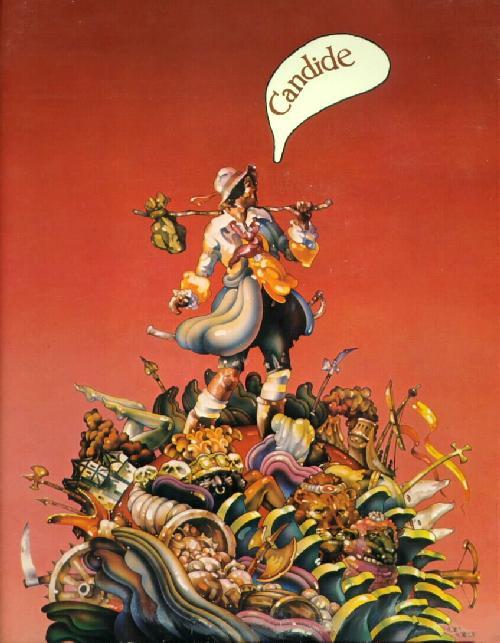
Once upon a time in Westphalia, in the castle of Baron Thunder-ten-tronckh, there lived a young boy whom nature had endowed with the gentlest of dispositions.” The young boy was of course Candide and his tutor in Voltaire’s Westphalia, the irrepressible Dr Pangloss, who teaches him that “there is no effect without a cause, in this best of all possible worlds.” The best of all possible worlds? A laughable myth says Voltaire in his skinny little novella from 1759, a non-existent fool’s paradise, which even if it did exist somewhere in the universe, is certainly not the hallowed terra firma on which humanity exists.

Before Voltaire swaggered along and dropped a brick in the jelly, people really believed that we did inhabit “the best of all possible worlds,” despite fairly obvious evidence to the contrary, like famine and death and blood fueled inquisitions, plenty of good old wars and to use a ten year old’s reasoning “all the bad things that happen in the world.” People like Alexander Pope believed it, renowned poet and sage, who famously wrote in his Essay on Man “all that is, is right.” A phrase that was echoed by the intimidatingly Germanic sounding Gottfried Wilhelm von Leibniz, who helped found the charmingly named philosophical school of thought “Optimism,” suggesting that if God is the perfect creator, then even the most terrible things that happen in the world, happen for a wonderful reason, just a bit of a downer, a slightly sad caveat, to an absolutely fan-flipping-tastic grand plan.
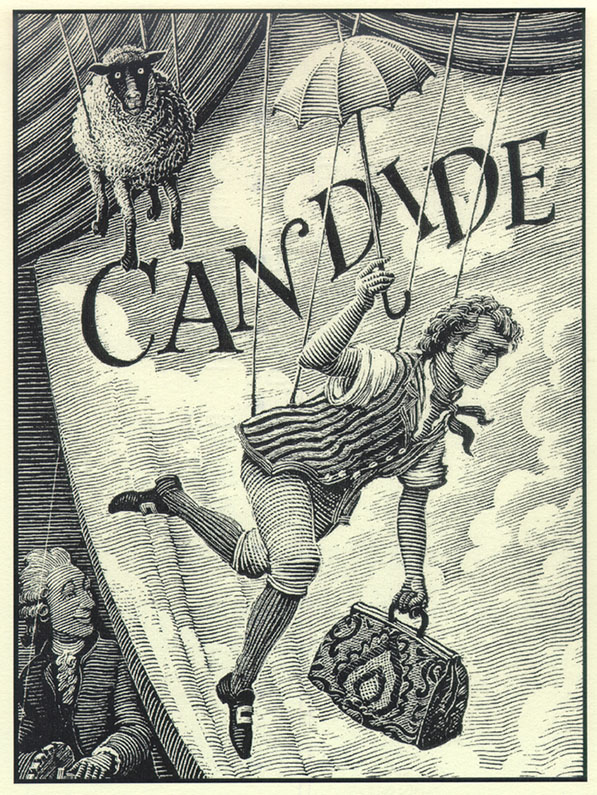
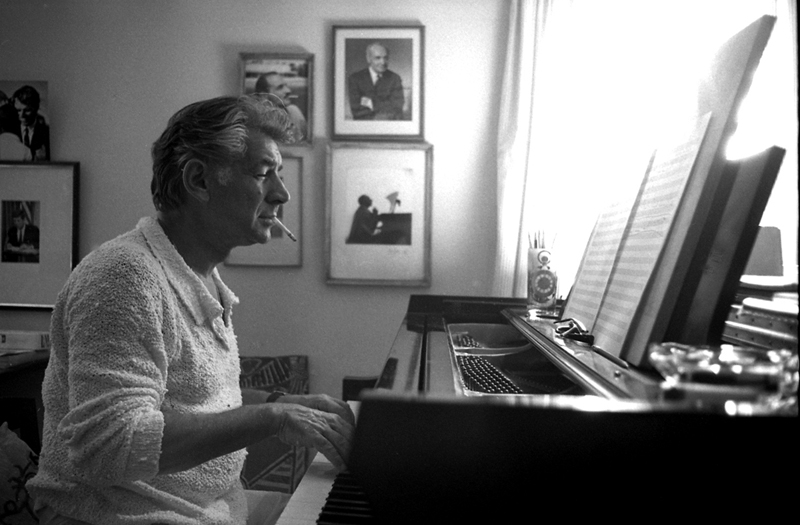
Then in 1755 an earthquake so unimaginable in scale hit Lisbon, Portugal, 100,000 died and the vastness of the damage and the amount of human suffering caused, prompted Voltaire to write “Candide” and put a blunt instrument to the beautiful charade that was “Optimism.” Whatever “is” certainly is not right he said, nor is it wrong, what “is” is simply all that there is and it is up to us to do with and build upon what we have, in other words “life is neither good nor bad, life is life and all we know,” as the chorus sing in Leonard Bernstein’s operetta, based on the book.

What, you may wonder, has this clunky lecture got to do with Charles Avery, a Scottish artist, who is about to open his first Parisian show at Le Plateau. The answer is not that much, but enough to matter. His continuing epic work “The Islanders” describes a fictional world, defining its landscape and inhabitants through sculpture, drawings, texts and installations. His fictional Onomatopoeia (the name of the islands main town), like Voltaire’s Westphalia, or Swifts Lilliput, offers a base for Avery to express his ideas,  a place to gather his thoughts together, which acts as a little Petri dish for his art. “My primary motive was to create a space where I could put all my ideas, to try and understand them in relationship with one another.” Although “The Islanders” is not a narrative work, with no unwinding plot to speak off, it is a collection that draws an awful lot from age old philosophy, reflected in the place names he has given to locations on the island, such as the Causeway of Effect, Cape Conchious-Ness and the Analitic Ocean.
“The Islanders,” much to the artist’s ire though, is often compared to the work of J.R.R. Tolkien or Mervyn Peake. “I can’t stand Hobbits.” Charles says, “Even when I was a child I had an antipathy for Tolkien, I have a little more sympathy for Peake, but they are certainly no influence.” Charles believes that the comparisons spring from people’s fixation with the odder creatures that are resident in his fictional world. Creatures such as “Mr Impossible”, “a sort of greasy platypus” and the deity, “Aleph Null” whom the artist describes as a “creature no weirder than any of the gods that humanity has dreamt up.” A giant white sculpture of the creatures head sits in the exhibition, its long nose culminating in a small effigy of itself,  a bit like a freakish version of Pinocchio had his lies been particularly nasty and if Geppetto had wielded his chisel after a couple of whiskey sours.

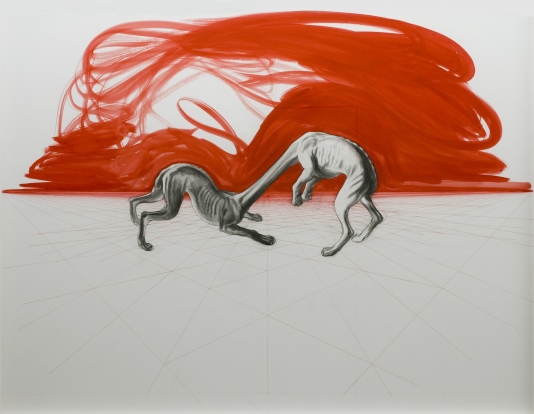
His drawings offer a fascinating, if fleeting glimpse into this world. Many of the pictures have an almost unfinished quality to them, like they were based upon passing images, momentary windows into the depths of his imagination, which he had to capture, before they were eaten up by grim forgetfulness. However hastily drawn though, these often colourless pictures, offer a great amount of almost Hogarthian detail, briefly illuminating the under-belly of his society. One depicts a market, with a bevy of rather grim looking fellows, lurching over antique and bric a brac stalls, selling old lamps and toy tin aeroplanes, a hipster in a trilby briefly considers a cigar case, while the outlines of pyramids grace the skyline behind him. “I think of the drawings photographically” he says “except I cannot take a camera to the island. There is a lot going on in the drawings that is not directly meaningful, but which amounts to texture, people caught in the moment.”

Charles though is not attempting to create something chocked full of Panglossian positivism, just as Voltaire dismissed “the best of all possible worlds” with a satirical flick of his pen, so Charles dismisses the principle religion of our day, science and its claim to offer the absolute truth, its claim to solve the mysteries behind our own existence. “Science as far as I’m concerned is like any other religion, we just happen to be living in its heyday. I’m not saying science does not work, in terms of local truth, its fine, but its claim to absolute truth is as laughable as any religions.” Our own knowledge of the mysteries behind our existence is as patchy as our knowledge of Charles’s world, you can sow something around the physical evidence, the taxidermy statues, the drawings and texts, the sculpture, but the rest of the picture is filled in by our own imagination, with colourful, flamboyant, guesswork.

Of course with a world to prune and tend, with works to add and to toy with creatively, one could imagine this becoming an all consuming, life-long project for Avery, something that he can never quite let go of or set down. He makes the point though, rather intuitively, that while there is no limit to imagination, there is a limit to life and he is currently in a phase where he is putting things in perspective. He admits that “The Islanders” take up a lot of his time and his creations now have much more pressing rivals for his attention, in his three young daughters. He sums up his current outlook by quoting a line from the James Stewart film, Harvey, “In life you either need to be very clever or very nice. I spent the first 40 years being clever, now I am being nice.” Optimism in its purest form you could say. But whether or not “The Islanders” benevolent creator is always there to oversee them, the relics of their civilization will always exist on paper or in sculpture, like the antics of the Lilliputians preserved in the pages of Swift. A creation far from the best of all possible worlds I suppose, but then again who would want that?

A Conversation With Bill Fay – Part Two

Wilco quote you as an influence, Jim O Rorke, and your music means an awful lot to the people who know of it, do you feel that you’ve made something enduring? Are you proud of the music and the albums?

It’s always a shock to me and I find the praise very moving. I see it as someone not only acknowledging me, but the musical influences of everybody else involved. I do feel that the Decca contract achieved a lot, something diverse with an enormous musical contribution from others, that created a musically varied whole.  I couldn’t ask for more than the response the music from back then is getting now. A friend of mine said to my manger Terry Noon back in the 70’s, “it’s only a matter of time before Bill’s music breaks through.” Strangely it seems he was right. It was a matter of time, 40 years.

I’m very interested in the way over time…you have expressed your songs. The original album “Bill Fay” has almost a timeless element to it with the strings, the ragged grandeur. That was gone for “Time of the Last Persecution”. I know money was probably an issue the second time around and orchestras were not as much of a possibility….but did you think that was a favourable way to express your music? Do you like the sound of that album? It’s just so very stylistically different from your other work?

It was all chance the way it went. Peter Eden the producer had just done an album with Mike Gibbs (the arranger on Bill Fay) who is a great arranger and composer and he got Mike involved. I think it was the first arranging job he had done, he told me he was up all night before the session, pacing up and down, because he had added that and added this and he didn’t know if it was going to work. So the orchestra based feel was just chance. But Ray Russell (who went on to support Bill on the “Time of the Last Persecution” album) was booked as the session guitarist and that’s when I got to know Ray, which led on to me working with the people he played with, Alan Rushton and Daryl Runswick. So again by chance, that line up became the second album. I must say though that I equally value the contribution Mike gave and Alan, Ray and Daryl gave, so it would be difficult to choose a favourite.

But say there was an orchestra available for the second album, would you have taken it, or just decided that those songs were better suited to a more sparse arrangement?

I think it would have gone the way it went. Chance again. It wasn’t like I was sitting down with someone saying “right we have the chance to do another album, how are we going to do this.” It wasn’t like that. It all moved very quickly. It was a constant state of flux that period between age 24 and 27, going from the single I made (“Screams in Your Ears”) to the last album.

There’s some extraordinary guitar playing on “Persecution” played I believe by Ray Russell, how did you feel about the sound you created there?

Ray is a great innovative and under-known guitarist. People like Nels Cline from Wilco have the greatest respect for Ray’s playing, Jim o’Rorkue does too, in fact he brought out “Live at the RCA” of Rays from 1970. But in general, mainstream wise, Ray remains under acknowledged.

The “Persecution” album and the out-takes from the sessions have a very original sound, a sharpness to them. Sometimes it leads towards the experimental as well, thinking particularly of “I Will Find My Own Way Back” on the out-takes album.

He has a sound all to himself. That song was a one-off actually; there was no rehearsing for that, it just kind of worked. I would say that I am in awe of the sonic nature of the second album. I feel we did achieve something original for the time.

So how did the writing and arranging process work? Did you have the lyrics pre-written and then worked out melodies in the studio?

I went to Ray’s house, instead of going to Mike Gibbs house, like with the first album. I went to Mike’s house for “Bill Fay” and he recorded the songs on a cassette player, working out the arrangements from that. I mean I walked into the recording studio for the first album not knowing or expecting what I walked into. I thought I had walked through the wrong door! Into another version of Beethoven’s  5th! And I was about to walk away, when I saw Mike standing there amid the orchestra. For the second album I would go round to Ray’s house and he would record the songs, he always knew how to play them, there was never any rehearsing as such.

So you wrote the lyrics as poems almost and then took them to Mike or Ray to arrange?

No, I would write on the piano and whatever tune came, the words came with the tune. It was sort of like, well some were finished in 10 minutes and they also expressed where I was at inside. It’s a mysterious process, you find a tune that you like, so you play it again and this time you sing and the words just kind of arrive.

Cosmic Boxer is one of my favourite songs, can you tell me a little about how that came to be?

Well that’s a deep song! I had a friend who was a boxer as a young man and he came to have to battle a mental illness and when he told me he used to box, it led to the writing of the song. But it could also be about anybodys personal battle and I suppose the most important element to it was “ You’re going to find your way through”, you’re going to box on and beat it and survive. Marc Almond has done a cover of the song, I don’t know how he relates to that, but he obviously associates the lyrics to the battles he has had to face in his own life. I would say I was an optimistic person and I try to bring that into the songs, songs that can also be melancholic and sad, perhaps that is what makes them so real, the whole gauntlet of emotions involved.

At any point early on did you view music as your career? The thing you wanted to do? Or was it always just a personal thing….a way to express your own ideas, beliefs and views on our existence. I guess you wanted people to hear your music, otherwise you wouldn’t have recorded. Was there a part of you that heard all those records in the 50’s and Dylan in the 60’s and thought….I kind of want to do the same thing? Put a record out?

Yes, though I suppose there’s a part of me that didn’t put myself behind a ‘career’. I think from the moment I wrote my first song and I saw a group in Wales perform it at a gig and then travelled with them in their van to a recording studio in Manchester, where they recorded it along with others, that opened up a direction for me. Music was something I wanted to do. Hearing other people’s songs didn’t bring that about, and writing a song wasn’t a conscious and deliberate act. From the beginning it was something that came naturally, learning more chords, slowly progressing, musically and lyrically. Sometimes more pop orientated songs would come, but none were deliberately written in a particular form. They just came. I think fundamentally you’re influenced by anything you’ve heard on the radio from infancy onwards. Terry Noon, I’m sure, had hopes of mainstream success as I did write songs  which could have had a wider appeal sometimes, but over 90% of what I wrote was in the more meaningful or ‘conscious song’ area and left of centre.

Were you willing to compromise creatively, for the sake of success?

I was putting myself behind my music certainly. But when the opportunity came to play live on Saturday night television on an old programme called Disco 2, the kind of freedom giving person Terry was, he didn’t say to me, why don’t you play a more mainstream song like “Be Not so Fearful”. Neither did that occur to me. Instead I sang what was current and meaningful to me, the very left of centre “After the Revolution”. When we’d finished the “Tomorrow” album, I sent tapes to 12 companies so I was putting myself again behind the music. A song which was written and recorded in the early 70s got heard by Bearsville Records, who asked to see me. I took along a tape of current home recordings which he fast forwarded. He then played one song he’d heard saying it was fantastic, calling it “déjà vu rock and roll!” He said give me 12 songs like that and you’ve got an album deal. I explained it was a one-off and said why don’t you put it out as a single if you like it that much. He said, no, you’ve got to have an album. Some would have gone home and endeavoured to come up with the 12, but it’s not something I could have done. Maybe looking back, I could have aimed to enter the live folk circuit or something like that, to kind of secure a living from what you love to do, but again, I didn’t try to do.

Escape Vehicles – A Conversation with Simon Faithfull

Melancholy can be such fun can’t it? Lying in a bedraggled heap listening to Mahler, reading Keats and then nipping downstairs for a quick coffee and a nosey at what’s on the telly. Wordsworth said melancholy is the “luxurious gloom of choice”, which has it right on the nose. It’s not like it’s much more serious and really rather boring older brother “depression”, which can have someone on the bridge at midnight, looking down into the icy waters below. No, melancholy is more of a fashion statement, something that can be switched on and off at a whim, the Oscar Wilde of mental conditions.

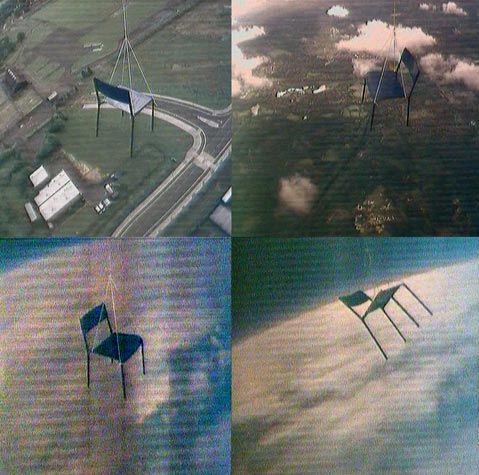
Simon Faithfull’s work has more than a whiff of the melancholic about it. The digital artist, who is about to open a new show at the Harris Museum in Preston, premiering some of his recent work, is perhaps best known for his “Escape Vehicles”, domestic chairs tethered to balloons, a suburban attempt at an easy escape. They are particularly English too, in the way that their aim is doomed to certain failure, but there is a plucky resistance about them nonetheless. Faithfull says: “The chair just allows the viewer to imagine themselves sitting and going from this mundane landscape, our normal realm, to the edge of space.”

Escaping the mundane is a theme that runs throughout Simon’s work. He has a restless character, splitting his time between London and Berlin, when not traveling to far flung destinations for the sake of his craft. His companion on these ventures is always a “Palm Pilot” a hand held computer from which he can make simple, spur of the moment drawings,  he can then email to anywhere in the world. It was a notion that dawned on him while completing a residency on the top floor of the World Trade Centre, a year or so before its untimely destruction. He describes his digitally etched emails as “almost like a pirate radio station in a way, little messages in a bottle I could just chuck out into the world, without much context”. This of course was in the days when receiving an email was still something quite special, not the daily ritual of spam and worries it has become.

The email pictures from afar represent Simon’s wish to “activate his absence”. To consider the void he leaves behind, in the fabric of a town or city when he is absent from it. It’s kind of like leaving a footprint in wet sand, you watch it and the sand slowly retakes its original form, any human traces wiped from its own ancient features. Think about the sand as a city, walk away from your carved out groove in a towns fabric and how long does it take for your dint, in the masses of people, to melt away? The email interactions are a way of seeing if his world still exists when he is not there. His original “Escape Vehicle” had the same effect and  involved attaching a camera to a weather balloon and then letting it float up into the ether, so he could watch himself disappear into the landscape, “become a dot”, witness himself within his own suburban hole, a study in the transience of existence.

His project for the Liverpool biennial, involved traveling on a container ship from England to Liverpool, Nova Scotia, again with his ever trusty “Palm Pilot” at his side. He completed 181 drawings, some of which will appear carved in stone and glass at Liverpool’s Lime Street station. He also took a copy of the cities phone book with him on the trip and turned the 181 drawings, into 181 post cards, sending them back home to random strangers, from one Liverpool to another in what he calls a “strange collapsing of space.” The back of the cards where simply marked “From Simon Faithfull, wish you were here”. He decided purposely not to leave any point of contact for the recipient to get back in touch, an example of the way Simon wants to engage with his audience, but only to a limited degree. “I guess it all comes back to my use of the ‘Palm Pilot’” he says, “ I could take pictures with the most digitally advanced camera, but the drawings I do often work on the basis of what they leave out rather than what they put in. If there is a lot of space then there is an impression made, the audience fill in the gaps in their own creative manner.”

The use of the palm pilot is also related to his interest in the concept of the drawn line. He was first introduced to the Pilot at art school, where its use was part of a technique to create a more direct link between the eye and the hand. This obsession with the straight line is reflected particularly in his work 0o 00 Navigation, which see’s the artist traverse the entire landmass of Britain following the exact path of the Greenwich Meridian with the aid of GPS. Again the project has streaks of melancholy to its nature, the absurdity of a mad-cap venture. He traveled wherever the line went, even if that meant scrambling through a hedge row or crawling through the odd boudoir window. You can imagine it becoming beautifully farcical, him passing through the middle of a church during a funeral “excuse me I’m just following the Greenwich Meridian” and then perhaps meeting someone else doing exactly the same thing, but the other way round. The farce is part of the work, the idea of something so regal, something as imperial as the Greenwich Meridian passing through someone’s larder or their downstairs lav.

Simon is not in any regards seduced by technology though. He is not some computer obsessed nerd, upholding hand held technology as the one and only future for the art world. No, he is simply accepting of technology because it is a dominating factor in our lives, whether we like it or not. “I’m not really excited or infatuated by technology,” he says “I only use it because it is around us every day and it would seem strange not to use it.” It is a refreshing take, in a world that goes into raptures whenever Steve Jobs mounts his stage in Cupertino, California to announce his latest “iwhatever”. I use technology, but I am not in love with it.

Reply Forward

Sentimental Jamboree

Not many houses smell of cigarettes in the morning anymore. He used to smoke cigars, dusting the ash into an upturned oyster shell he’d pocketed on the King’s Road. He’d ­left since, in his green Jowett Javelin, back seat chocked full of chipped candlesticks and muddy army boots, bound for antique fairs and his Sunday afternoon friends.

Lighting a Capstan cigarette, she snapped the lid of her lighter back and placed it on “Memories for You and Me” a book for mourning mothers. From her bed she surveyed a room full of his suburban treasures, rotten leftovers from an erstwhile lover she didn’t know how to be rid of. Like the brass rubbing of East Coker, bought from a thrift shop along with a wilting aspidistra and a used eiderdown.

She had met him once on Mount Vernon, below the infirmary, a parachute tangled in its pointed spires, just a remnant from one of those all too recent forgotten wars. It was one of her better memories, that moment in Mansfield Place, but sentimentality no matter what its skill to ease someone from the doldrums, was never worth a mess. The new found grim indifference of her nature, would soon help her forget.

Boom! The shock of each moment of still being alive

I’m writing this to stand up for melodrama. It’s unpopular and it’s out of fashion, so I feel the inherent need to stand up for it. Melodrama is life times one hundred. It approaches the themes that run through all of our lives, love and loss, but it makes the lovers an ageing actress and a young poet, their home an art deco palace on some Sardinian hilltop and frames their first kiss with the strains of a sixty piece orchestra. It’s overdone, it’s sugary, it’s a dead romantic age briefly resurrected.

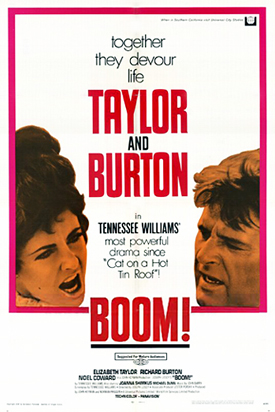
Boom is perhaps the ultimate melodrama and in the years since its release it has been characterised as an over-blown, expensive, excessive mess. Based on the Tennessee Williams play “The Milk Train Doesn’t Stop Here Anymore”, it has won a regular place on those interminable worst film lists that are trotted out every year or so and it has been dismissed as “camp” nonsense by many critics. It is however rather undeserving of the poisonous laurels it has received and is now, forty one years after its original release, being re-appraised as the film appears for the very first time on DVD.

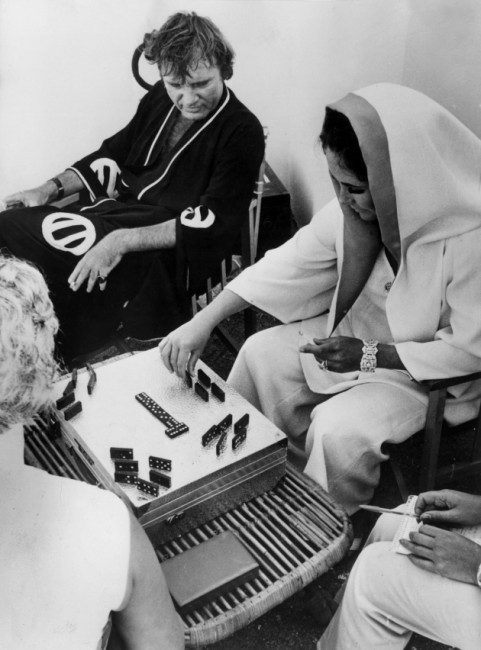
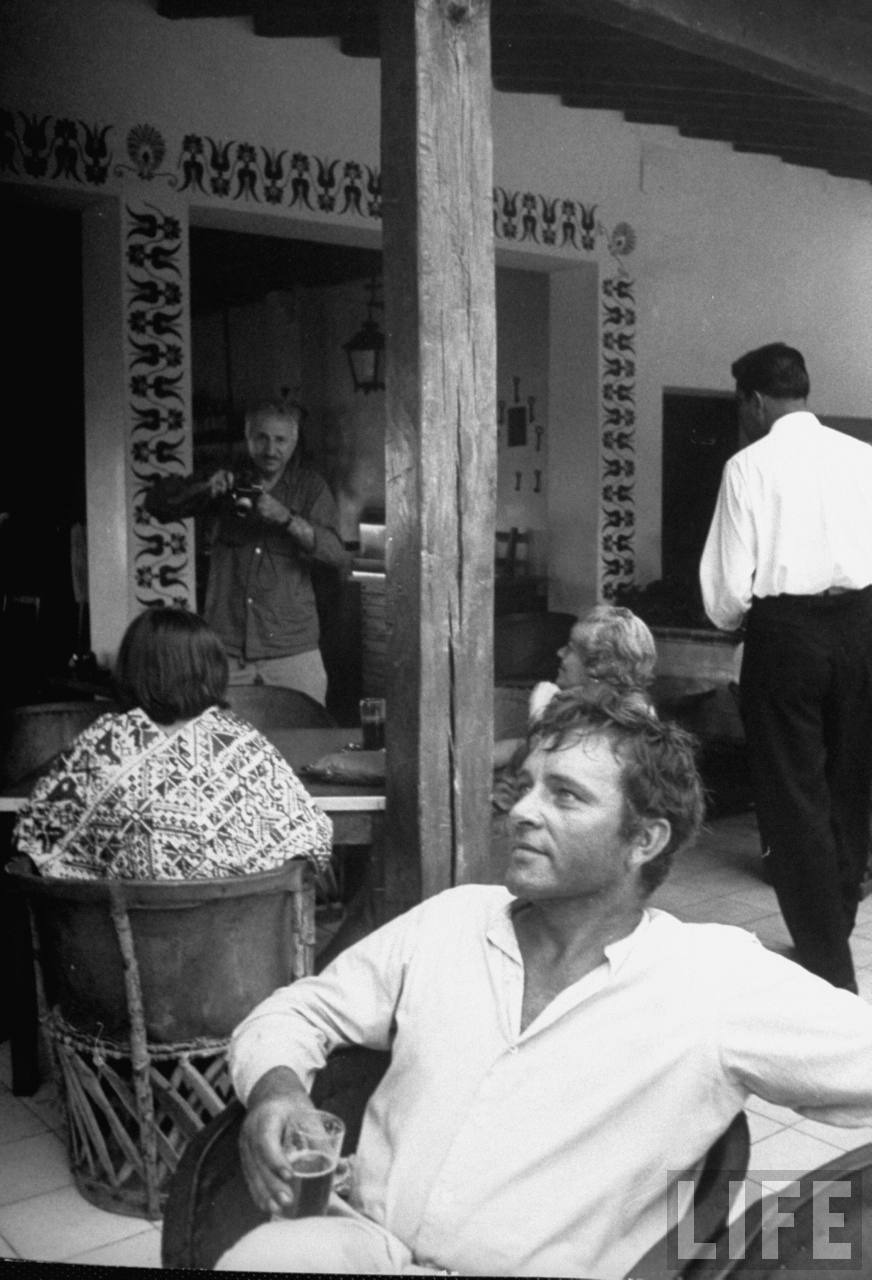
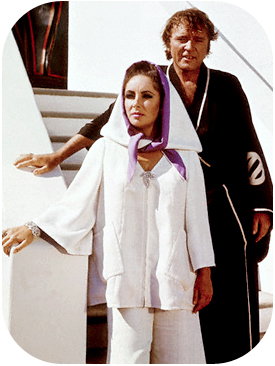
Its rediscovery in itself is something of a miracle. Up until recently the film was thought lost to the ages, before a sole remaining  print was found to render the DVD’s from. Its reputation as one of the worst “flops” in film history is well founded. It stars Richard Burton and Elizabeth Taylor and the film marked their decent from box office gold, to if not box office poison, then box office fool’s gold as the very least.

Of course with Burton having crossed the great divide in the early 1980’s and with Taylor now ensconced in her Beverly Hills mansion, Norma Desmond made flesh, quietly Twittering her way into happy oblivion, Boom can be assessed as an artistic statement and not the new Cleopatra or the latest act in a real life soap opera.

The film is also re-released at the tail end of its director, Joseph Losey’s centenary year, a year in which the late film-maker has seen a great amount of critical praise heaped upon him. Losey was never tooled for big box office; he was for the film lover, lovers of serious cinema, sultry cinema, overtly sensuous cinema. If you trim away the deflated expectations and the legend of the Burton/Taylor myth, you are left with a film that rests at the higher end of the Losey cannon, leading on to the two pinnacles of his career, Accident and The Go Between.

It is a stylish, artistic piece that considers the solitude of dying, the fine line between criminality and compassion, the ebbing away of a life’s once bright light and the aged’s lust for youth. It is however presented in a slightly off-beat fashion and parts of it should be approached with tongue firmly in cheek. One also has to try and stifle the odd laugh now and again at the overly lyrical script, which contains such gems as “I have always found a woman fragrant, like a flower, regardless of what phase the moon is in.” Lines like that, which have the makings of something lovely, but have instead been forcibly held down and drowned in a bottle of cheap perfume.

The film opens as Christopher Flanders (Burton) arrives on Mrs Goforth’s (Taylor) very private island, a multi-millionaire heiress, who is dying of an unspecified illness and is in a desperate scramble to complete her memoirs. He’s a poet of course, dying heiresses tend to marry poets, it’s kind of fashionable. He climbs the faces of the jagged rock on which her house sits like a man possessed, screaming her name “Mrs Goforth!” You would think they knew each other, a jilted lover, a potential lover. He gallantly laughs of the “private property” signs and then faces down a pack of vicious dogs, who have a good attempt at trying to rip the poor fellow to shreds, set upon him inexplicably by a rather incongruous midget, who is for some rather bizarre reason Mrs Goforth’s head security man.

In a rather bad way, he limps onto the ladies terrace, still calling for her, now amending his calling card to “Mrs bloody Goforth”. I mean wouldn’t you? After dip in the sea, infested with Meducas (poisonous jellyfish we later discover) and a nasty encounter with some blood thirsty hounds, only to be ignored! “He acts as if he knows me,” Goforth shudders as she dictates her latest batch of memoirs to her surely secretary. She only allows him to stay because the island does not boast a “beware of dogs” sign and she really doesn’t fancy a trip down to civil court or the Italian equivalent.

Christopher Flanders, the poet, is a harmonious character, he is settled in himself and there is an element of calm to him, something otherworldly. He is juxtaposed against Goforth, who is doing her up-most at raging against the dying of the light. Mostly raging. Her temper flaring, as she battles against her disease, whilst in denial about its seriousness. In old-fashioned opera style, you can’t really tell she is ill, apart from the odd vicious hammed up coughing fit, we see a woman with the skin of a goddess, who  trolleys around in huge gowns and headgear that would make even Liberace blush.

And then when you thought things couldn’t get any stranger, Noël Coward arrives, the self-styled Witch of Capri. Delivered by boat and carried on the shoulders of a Goforth lackey, rather like a religious relic lifted through the streets during a Catholic festival. “The bitch would have me over at high tide,” he pronounces, as he is deposited in front of Mrs Goforth to depart his wisdom.

He knows her visitor of course, but knows our Christopher Flanders by another more worrying moniker “Del Angel de la Morte,” “The Angel of Death”, a title gifted to him by European royalty at some blue-blood party. Why? Because he has the wonderful penchant for arriving at a ladies bedside just as she is about to breathe her last. Expire. Kick the proverbial bucket. Hop the twig.

Coward’s performance is riotously over cooked in a film that I suppose is a little beneath “the master”. Non-the less he hams it up magnificently, in a role that was originally written for a woman and offered to Katharine Hepburn,  rolling his rrr’s and clinking the ice in his whiskey glass, as he trots around the terrace, purring at Goforth.

The fact that Flanders could be the signifier, the harbinger of her impending death, makes Mrs Goforth’s relationship with him particularly stand-offish to say the least (que some classic venom fuelled Burton/Taylor berating.) But behind that is a lust (or love depending on your opinion) for him. Is she comforted by the thought of having him around as she prepares to meet her maker? Or is she simply eyeing one final notch on the bed post?

No matter what your opinion of Elizabeth Taylor’s acting ability, it is impossible to deny that when Burton and Taylor are together on screen, there is some kind of chemical reaction. They are perfect together, more often than not when quarrelling. One of the best scenes of the film is when Flanders confronts Goforth over her want for solitude and her failure to preserve her friendships. “Your suffering from the worst of all afflictions” he says, “and I don’t mean one of the body. I mean the things people feel when they go from room to room for no reason and go back from room to room for no reason, then go out for no reason and come back for no reason.” Lack of purpose. Lack of love.

“Boom!” Burton goes on to espouse, in his wonderful bass baritone voice “Boom, the shock of each moment of still being alive.” The best line of the play and the phrase that Losey decided made a better name for the work than Tennessee Williams original “The Milk Train Doesn’t Stop Here Anymore”. We often forget what a miracle our own existence is, the off-chance circumstances down through eons of years that have collided to ensure our existence at this very moment in time. Boom! Those are the moments when it dawns on us. When looking into the eyes of someone you know you love, conquering some feat you never thought you would, looking upon some object of natural beauty. One of those moments. Boom! When you think “wow, I’m actually here, this is happening to me, how utterly, utterly amazing.” Burton twins this with the crashing of the waves upon Goforth’s rocky outpost. Boom you see gets louder when the end is near, especially when you have made a lot of enemies and wasted a lot of time.

Of course Mrs Goforth shuffles of into that great F Scott Fitzgerald themed party in the sky, not before though an almost laughably over-cooked coughing scene on the terrace and not before she has tried and failed to bed Flanders, dubbing him the first man to turn down an invitation to see her no doubt awfully sumptuous linens. He does stand by her bed side though, well her death bed, removing her jewellery (interestingly) as he lets us in on his thinking. Helping people to die you see is his vocation, not something his career officer at school recommended, but a North American Indian (obviously), after he helped an elderly man on his way, off the Californian coast.

The final scene offers an attempt at resolution. Burton holds a ring he has taken from Goforth’s dead finger, over a goblet of wine, a recreation of religious symbolism, when during the Catholic communion service, a piece of bread is held aloft over a goblet of wine in an attempt to make the sacrament holy. He then throws the ring into the sea. Whether that represents the completion of Flanders compassionate mission, or the start of his pillaging of her home, before making a quick getaway, is up to the audience to decide.

Of course the question we are left with is who is Christopher Flanders? There is a fine line sometimes between compassion and criminality and it is up to the audience to decide which side of the line Chris falls upon. Is he the mysterious stranger? The otherworldly figure, who is simply there for a person when they need them most, to shuffle them peacefully into oblivion? Or is he there, at the wealthy dowager’s bedside for more conspicuous reasons. Christopher Flanders is of course more than this. Richard Burton was a little too old for the part in the film, for Tennessee Williams originally wanted Flanders to represent unreachable, unattainable youth, the thing that Goforth wants to re-live again both personally and sexually. On top of this Williams also imagined Mrs Goforth as a man, an aging queen, lusting after a youthful visitor.

Stylistically the film is quite beautiful. Based around the concept of Kabuki, Japanese dance drama, the film adopts many of its traditions, including elaborate costume and make-up. The word itself in fact, in Japanese means “out of the ordinary” or “bizarre”, both labels that fit this film perfectly. Another important strand to Kabuki is the notion of Jo-ha-kyu, the idea of timing art around a set time modulation, a slow beginning (jo), a gradual speeding up (ha) and a quick ending (kyu). The conclusion usually involving death or a tragic event, performed quickly.

The Joseph Losey fan will recognise many familiar Losey motifs in this film. He often cuts to the face of a statue, or the gothic features of a piece of art, after a particular set piece of dialogue; this is a technique he also uses effectively in The Servant and Accident. It gives the impression that the action of the film is being played out on some ancient tapestry. The camerawork is also often excellent. In one wonderful scene, the camera appears to drift through the house, drapes fluttering in the Mediterranean breeze, drifting over furniture crafted at sharp right angles, through a deserted house, the principle players gone.

So I’m standing up for Boom and I’m standing up for melodrama. The sumptuousness of it all, the sensuality, the over the top and the outrageous. Whether you see the deeper themes within the film, or just look its way simply to see something amazingly odd, it is alright for a moment, just to indulge.

“Flirting With This Disaster Became Me” The Final Days of Chet Baker

43_style-icon-chet-bakerChet Baker’s last great concert, on April 28th 1988, was one of the biggest of his life. He was 51 but looked 75, the heroin addiction that he had harboured all his life would kill him months later and his grip on his art was slipping. The idea to re-create Baker’s seminal early album “Chet Baker with Strings” on stage, in Hannover, was developed by German TV producer Kurt Giese. Its success, in fact getting it to happen at all was always on the ropes.

Baker’s existence was a life of awful contrasts. He went from handsome saviour of the jazz world to scarred heroin addled wreck, this icon of romance was a wife beater, who slept with many women, but fell in love with all but one and just days before his glittering final bow, he was playing for tips, broke, on a street corner, with a group of friends in Rome. The money raised paid Baker’s dealer.

Heroin ruled his life; some said he loved no other. Smoking crack had all butclaxtonbaker ruined his teeth and he found it impossible to play without dentures, which caused him a great deal of pain. His quality, that heart breaking melancholy moan, which his playing had sustained for so many years, was slipping. Walter Norris an engineer who had heard his sound in the weeks prior to the show had described it as dismal: “what is this” he asked “how can someone with such great talent destroy himself.”

Rehearsals for the show, which would see Baker backed by the North German Broadcasting Orchestra, were to start five days before curtain. Baker failed to show. The orchestra threatened mutiny as Giese replaced Chet’s trumpet with a taped recording for the sake of rehearsal, as desperate calls were place to find him. Rumours that Baker had backed out flied, then he called, with two nights to go. He had been to the theatre, but security had failed to recognise him and he had been turned away.

As Baker sat on stage, he was surrounded by musicians, but he was as he had always been, cold, aloof and alone. His life of living a rootless existence was closing in on him. His limitless world of running to the next state, to the next country was fading. Reality was setting in. His application for a new driving licence had been refused, he was grounded, his gums were decayinchetbakerg and a string of girlfriends were leading to agitation and heartbreak, but never love.

The night’s set contained mostly songs Chet had kept returning to throughout his career. “I Get Along Without You Very Well”, “Look For The Silver Lining”, “Tenderly”, “Almost Blue” and a nine minute version of the song that made him famous “My Funny Valentine”.

His face may have been treated harshly by heroin and his features may have become so sunken that it looked as if his whole complexion was comprised of shadows, but his voice remained light and full of the innocence that it had displayed in his youth. His music was night music; it would dissolve in the sunlight. It was the music of street corners, the music of drifting rain down a deserted thoroughfare, a coffee shop at two in the morning, the music of loneliness, of a man fractured out of his scull, who only wants to talk, to re-live a life, but can’t.

It was the final display of Baker talent and it was rapturously received by a sell-out audience. He paid his debts to Miles Davis during the show, for guiding him during his formative years. Playing “Summertime”, Chet can be heard literally channchetbaker3elling Davis on-stage. His saxophonist Archie Shepp said in the wake of the performance, “Chet had become what he always wanted to be, he was playing more like Miles Davis than Miles Davis.”
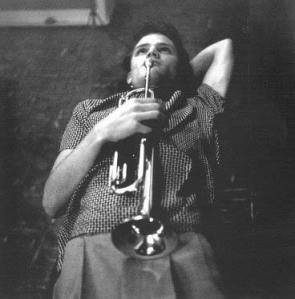
He did not however stick around to seek out his plaudits; he left moments after the final number and drove off into the night. A mental collapse would follow and a further descent into a heroin fuelled existence. As he said to a friend in the weeks after the Hannover show “I’ve used this stuff for thirty years. You can’t help me, I’m too far out.”

He died on Friday 13th of May 1988, after falling out of a hotel window in Amsterdam. Whether he fell or was pushed remains contentious for some, but there was rarely a moment when he was not high in the weeks before his death.

When Chet Baker sang the line in “Almost Blue” “flirting with this disaster became me”, its hard not to see the resonance with his own life. He preferred pursuing his own personal disaster, his addiction, rather than nurturing his talent. Some have called Chet Baker the James Dean of music, so much promise, unfulfilled. But were as Dean’s talent was snuffed out in a moment of madness, Baker’s was slowly drained from him. His brief return to form in the 1980’s and the Hannover show are a glimpse of what he could have achieved. His record’s from the 1970’s are a testament to his excesses.

chet1But it is of course on the records of the 1950’s and early 60’s that his reputation will be based. Till Bronner, a German trumpet player, who was greatly influenced by Baker described his talent best “It was really a big moment for me to hear a guy who just played melodies. To me, the old trumpet players all tend to play as hard and as loud as possible. All of a sudden this guy comes along and does the total opposite. His trumpet playing came as close as possible to the expressions of the human voice.”
“It’s so touching, Chet Baker was such a romantic guy, he must have been suffering a lot. He must have been on a constant search for love and understanding; otherwise I can’t imagine how he could have played like that.”

Suffering was perhaps his muse. If it was taken away his gift would ebb. His music transcended his pain in the same way the drugs did. But if the pain was gone, what was left? If understanding had been found, why bother to reach the dizzying heights of soulful musicality that he did? The pain walked hand in hand with his profession and like so many artists before him it was his un-doing. Or as Baker himself sang “You don’t know what love is until you’ve known the meaning of the blues, until you’ve loved a love you’ve had to lose.”

Richard Walters – The Weather Song

richardwaltRichard Walters is 23 and he’s balding. He’s balding quite seriously. A worry for any self respecting creative. Healthy hair is a signifier for a fertile mind, tussling tresses an indicator of an artistic sensibility, so the cliché goes anyway.
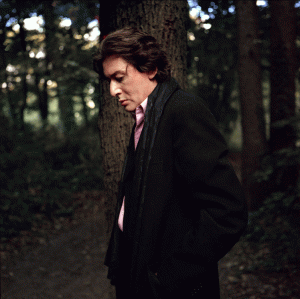
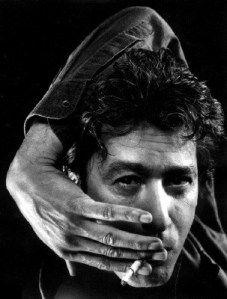
All the greats who have crossed the threshold into old age have, by and large, maintained a healthy mane. Look at Bob Dylan, his nicotine stained locks still flow quite healthily as he approaches his 68th year, as do Paul McCartneys, even if he does require the odd dip into the Just For Men jet black from time to time. Current new folk favourites Devendra Banhart, Sufjan Stevens and Andrew Bird have absolutely no trouble in that department. And just look at some of the musical world’s heroes who have aged and gone bald. Paul Simon. Van Morrison. Both haven’t sailed even close to a good album since their hair went south.

Richard’s hair has passed the stage were it can be creatively combed to cover up the unsettling truth, if his cranium were a season, it would be late Autumn, if the amount of hairs on his head signified his remaining time on earth, he would be wheezing.

Not to worry though, I suppose Bonnie Prince Billy  is proof evident that male pattern baldness is not a barrier to musical success and Walter’s mutinying mop does not yet signal the draining away of his talent. The Weather Song,  a single from his first album “Animal” is a quietly effective ballad, a whimsical, ode to the trouble that love can sometimes bring.
RichardWalters001
As with probably anyone who has tried to make a folk record since the 1960’s there are echoes of Nick Drake in the timid, whispered vocal twinned with some excellent acoustic guitar playing. The recording sets out with a home made feel, as if it was captured on an 8 track recorder in the back bedroom. In the final minute or so, it pans out and Richard is backed by a string section, it’s a nice touch and covers over the fact that the lyrics are not exactly thrilling.

It’s a pleasant song, not groundbreaking or particularly exciting but evidence enough that Walters’s harbours  a talent that should be watched, proof, I suppose, that you shouldn’t judge a man by his hairline.

Ma Petite Entreprise – The Life of Alain Bashung

alain-bashung

I have a rather bad habit of discovering a new artist, buying one of their records, promptly falling in love and then absorbing the rest of their back catalogue in the space of a week. It’s a bad habit. It’s gorging. It causes indigestion. You end up missing the nuances, the hidden textures. And then I get full, I can’t stand anymore and I cast my new favourite aside.

I have nearly committed that sin again this week, taking in four Alain Bashung albums since last Monday. I have decided to stop, four albums in, so I don’t have his entire discography on my shelves two weeks after hearing his name. Stop and consider. Ruminate on what I’ve heard. And what I have heard is frankly quite amazing.

Alain Bashung is a name lost to most English people. He hasn’t entered the British cultural lexicon in the same way he bear hugs the French cultural lexique. He now, most probably never will, having died earlier this year, too young at the age of 61. Lung cancer gets even the cool, from time to time, after a lifetime of cigarettes.

He is in many ways the successor to Serge Gainsbourg, who was himself the successor to George Brassens and many others, the line stretching back to the conception of the French love song, the chanson. A word that can strike fear into some. People hear it and think of Charles Aznavour and his unique brand of cod emotion, Jacques Brel and his wonderful mouth frothing gurgling, spread eagled over swells of strings and crashes of percussion cascading out of the Olympia. They associate it with Edith Piaf,  for being the irrepressible Edith Piaf.1250133494

Alain Bashung is Chanson updated. Its Chanson with the gentlemanly lilt removed, absent are the lounge suit, cigarette and obligatory glass of whisky (not always obligatory).This is Chanson with swagger. Sometimes Dylanesque, sometimes Punk, sometimes orchestral and sometimes electronic in a way that you never thought the French could muster.

In the 80’s he was heavily influenced by British-post punk and New Wave releasing a string of critically and popularly acclaimed albums such as 1979’s Roulette Russe and 1980’s Pizza. His 1983 album Figure Imposee saw him collaborating with his hero Serge Gainsbourg, setting him on an experimental path from which he wouldn’t relent. Except for Passe le Rio Grande in 1986 which directly followed the former and was a last ditch attempt to regain popular appeal. The album saw Bashung coating his songs in synths and appearing on the cover in a kind of New Romantic style pose, that ended up making him look like a cross between Boy George and Julian Clary.

But it his album Fantasie Militarie, that is often considered his “masterpiece”, it is difficult to track down, especially if you don’t want to pay shockingly erratic sums. I ordered it cheep of Amazon France, for a pocketful of Euros, only for it to be dispatched from Halifax. How that works I have no idea.

Bashung - Fantaisie militaireThe album is a cacophony of styles from sweeping strings and confessional melodies to electronic landscapes and modern day Scott Walker experimentalism. Backed by many famous musical luminaries including Adrian Utley from Portishead, Bashung displays so many musical styles that it is quite extraordinary. On some of his albums his style turns on a sixpence. Take his early 90’s album Chatterton, which see’s a number of experimental electronica tracks, complete with solo David Sylvianesque trumpet flourishes, but then begins to develop  Country style tinges as the album concludes. A bizarre twist, dubbed by the French press as “New Wave Country”.

I love the French language, it’s graceful and beautiful to enunciate, but after numerous attempts to try and master it, my efforts tend to become mired in the fine details of feminine and masculine verbs and the like. Throw that kind of confusion in with my sometimes rather strong northern accent and I end up sounding a little bit like John Prescott mixed with an intoxicated Alain Delon. Par-laay-vuwe, eh up-eh-up.

I can however deceiver some of the lyrics and they prove themselves to be inventive, mysterious and wry. For example the bridge in his hugely successful (in France) single Osez Josephine goes “A l’arrière des dauphines, Je suis le roi des scélérats, A qui sourit la vie” which roughly translates as “Standing behind the Dauphins (medieval French princes) I am the king of the villainous. At whom, life smiles”.

You have to hear the song to get it, the rocky melody, which is complemented by bashung_fume_une_cigaretteextravagant guitar riffs. It’s also got a wonderful video, featuring Bashung playing guitar in an Elvis costume accompanied by a beautiful woman, in the middle of a circus ring, while a white horse gallops around the arena edge. Baffling, yet so original.
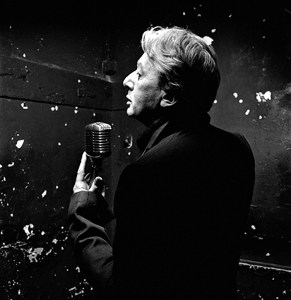
Being able to understand the lyrics of course has no real bearing on whether you like a song, the only bellwether is for lyrics to sound genuine, to sound like the singer is trying to emote something that they desperately want you to hear. Bashung has a kind of threatening intimacy, even in his more upbeat songs there is a sense of foreboding and when his emotions do cascade forward like in Fantasie Militarie’s Le Nuit Je Mens, it produces an extraordinarily high voltage moment. The same is true even in his more experimental work such as on 2002’s crtically acclaimed album L’imprudence.

He was certainly a cool character’ of that there seems to be no doubt, weather posing for photographs smoking a cigarette upside down, or growing vegetables in a Parisian rooftop garden, amid the chimney pots and spires, he seems to have had a certain presence. A kind of “Fuck You” attitude reigns thought-out his work and life. The French generally have an air of “Fuck You I’m better”, but it’s usually sugar-coated in corduroy and whispers. Here it’s straight up. In your face. Fuck You.

Alain-Bashung-noir-et-blancHe died earlier this year on the 14th March. It passed me by to be honest at the time, although France was apparently plunged into a state of mourning and his funeral attended by the cultural who’s who of Gaul. It’s easy to say these days, in a knee-jerk reaction to the sometimes superfluous culture of today, that there are no living icons anymore, that they’ve all long since departed and all we’re left with is a second class art, that can only try and live up to what’s gone before. Sometimes I feel tempted to agree. But then you discover someone like this, an icon, up until a few months ago, a living icon, who sailed completely under my radar, yet utterly revolutionised his home culture. The greats are still there, you just have to look a little harder to find them.

Meeting Cosmo Jarvis

Cosmo Jarvis is an 18 year old,Cosmo Jarvis live at Manchester Academy New Jersey born, part Armenian, Devon raised, singer songwriter, with a name that suggests he was a character on The Invaders. He claims to have written over 500 self penned songs and directed nearly 100 short films, his creativity often being fired by the irritating little things in 21st century life, or as he less verbosely puts it “the shit things that are shit” in dear little England nay the world in 2009. Lightweight, over-publicised celebrities are a particular pet hate of his, lately turning his Armenian ire on the likes of Britney Spears, Jessica Alba and Audrey Tautou (I’ve always quite liked her, but I didn’t want to upset him by disagreeing).

His new single “She’s Got You” is a wonderful mêlée of world music sounds, mixed with a feel good indie melody. It’s got strong Radio 1 airplay after being championed by the number one reason to dislike New Zealand, Zane Lowe, which to some people is the equivalent of being kissed squarely on the lips by a leper. But Cosmo doesn’t care, earlier in the month he supported Muse at their big homecoming brew ha ha, he has an album, partly home recorded on the verge of release and he spoke to 4ortherecord the morning after playing London’s very lovely Troubadour Club.

4TR: So how did you get into music, what led you into the position that you are in now?

Cosmo: Well I went to sixth form and that didn’t really pan out very well. But I always liked music and I wanted to pursue that. All the way through school I was writing and recording in my bedroom, but never with any idea that I would do it as a career. Ultimately though I just said “fuck it”, I’m going to make music, why not try building my life around something I want to do.

4TR: I read somewhere that you’ve written hundreds of songs, what prompts you to sit down and write?

Cosmo: Anything really, when I think the end product is going to be interesting. I don’t write songs separately from the recording process though, I don’t write songs on the guitar for example. The writing is part of putting the record together and recording, which I do at home.

4TR: You write songs that have a go at celebrity culture to, I’ve read you’ve written songs about Jessica Alba (star of 2008’s Mike Myers vehicle “The Love Guru) and Britney Spears (balding baby dropper and poster-girl for the Republican Party), not complimentary ones thank goodness.

Cosmo: (Groan) Oh that song is so old, everyone keeps bringing that one up!

4TR: Is celebrity culture something you want to highlight as amiss though?

Cosmo: I don’t know if it is anymore, maybe it used to be, I just kind of realised it’s all bollocks. It was just when I was younger, I mean these women……man, it’s mental. Now I just tend to write about shit things that are shit.

4TR: So you’re casting yourself as a bit of an angry young man?

Cosmo: Yeah, I suppose, sometimes people probably think I’m just a bit of a prick though…..a bit of an arsehole! I do like to challenge things sometimes though.

4TR: What would you say your influences are musically? There are lots of different sounds on your single “She’s Got You”, African beats, mixed with reggae and ska.

Cosmo: I like a lot of different world music and music from different cultures and I’ve taken a lot from that. But then again, some songs will have non of that, they’ll just be really indie, really electric, really orchestral. That particular song I just got into the jive of it. I guess it was most influenced by that song……..what the fuck is it called……it’s in Matilda…..

4TR: (Slightly baffled)  Uhm……I’m not sure.

Cosmo: Send Me On My Way, I think (later figured out to be “Send Me On My Way” by Rusted Root) Anyway it’s a really happy song, it has a nice little beat and the bass is really important and holds it together. It wasn’t supposed to be anything fucking profound, just a nice little song.

4TR: How has touring been for you, your totally new to that, how have you found it?

Cosmo: For me it’s not my main thing touring, touring is a side effect of me making recordings in my bedroom. It’s alright, you get to meet some amazing people and a gig is good when it’s done well and it works well. Sometimes I play solo acoustic and sometimes I play with a five piece band.

4TR: So do you always record in your bedroom, do you ever go into the studio, or do you just like recording yourself?

Cosmo: Yeah, totally that’s the only reason I do any of it. A couple of tracks on the album were done in the studio, which is easy because my uncle owns one, which I can use. In the past I’ve made a couple of tracks with him and a couple with a producer, but that didn’t really work, I’m pretty much a fascist when it comes to music! I don’t like other people interfering. Even if their fucking right, I tell them to fuck off, even when I know I’m wrong. (Laughs) That’s the only part of life I’m like that in though!

4TR: Do you see yourself as someone who is always going to record away from the studio?

Cosmo: I think so, unless somewhere down the line I need to record an orchestra for example, I can’t do that in my bedroom! What I did for the record was, when I needed to record a piano part, or an organ part, or an oboe part, I went to the studio to do that and then brought it home and mixed it in my bedroom.

4TR: How was Muse? You supported Muse at their recent homecoming concert in Devon. What was that like as an experience?

Cosmo: It was one of the weirdest things I’ve ever done. I live around there and my old music teacher used to teach them. She told me all this crazy shit, like they stole a double bass from school. I didn’t see them but it was mental.

4TR: Your new album comes out on the 2nd November. Can you describe it for me in a few words.

Cosmo: It’s an accumulation of songs from the last three years basically. Each song has a totally different production; no two of them are really the same. Some of it is cheesy shit, but I like cheesy shit! Some of it is a bit reggeish, others folky. It’s got everything, with instrumentals and hidden tracks all thrown in for good measure.

4TR: Is there any particular route you want to pick in the future, you’ve mentioned many different sounds.

Cosmo: I want to start doing soundtracks to movies at some point and start to use a whole host of different instruments. Many times a song is limited to the instruments I’ve got at home, so I would certainly like to develop my sound. Which direction I’m going to focus on I’m going to leave to time to decide.

4TR: Last question, who is your musical hero and what if push comes to shove is your favourite album?

Cosmo: I would say Tom Waits, he’s got a generally “self made” element to his music, which I like. He makes some of his own instruments and he writes songs with his wife (Kathleen Brennan). I could never do that! (Muffled voices in the background) Oh yeah, I don’t have a wife. As for album, I would probably say Rain Dogs by Tom Waits. The last track on that “Anywhere I Lay My Head”, is probably my favourite song of all time.

4TR : Well that’s about it on the question front Cosmo, good look with the album, the rest of the tour and thanks awfully for talking to us.

Jesco White – The Dancing Outlaw of Bandytown

Sanity, it seems benefits from the mundane. A happy medium is healthy for ones mental mechanics. But sometimes the mundane isn’t always an option. Dominic Murphy’s new film “White Lightnin” examines the collapsing male mind and uses the rip-roaring, gas-sniffing life of Appalachian trailer dweller, Jesco White, the dancing folk legend and inspiration for many an alt-country song, to do so. It is a re-imagining of his sordid, tragedy ridden existence, with a  fictional ending which shows Jesco (played by Edward Hogg in his first lead role) descend into madness and murder, events that could have occurred had his demons got the better of him. A “dark fairy story that considers a mind totally out of control” is what it’s creator calls it, with hillbilly dancing, hells angels, the raucousness of trailer life and Carrie Fisher all thrown in for good measure.

Parts of the American south have always seemed to have a collective screw loose, Jesco “The Dancing Outlaw” White being a case in point. His mind was fractured early by sniffing gas and injecting heroin and worn down by tortured years in jails and asylums. He had numerous shootouts with the police and faced the kidnap of his son and murder of his father ( an event the films Jesco never recovers from). The golden thread running through his life though is Appalachian mountain dancing, a skill passed from father to son. It involves the ability to look cool while generally flailing ones limbs around to hillbilly music. He still performs today, touring sporadically, and sporting his own My Space, which showcases some of his favourite videos from years past, including one of country heroine and songstress Cousin Emmy, who plays “You Are My Sunshine” via the whistles and squeaks of a deflating balloon. Backed by Pete Seeger on guitar of course. Eccentricity at its purest.

Jesco the dancer is a wonderfully original character, who Ed says “ seems to burn brighter than those around him when you meet him in the flesh.” In his calmer moments he is a southern gentleman, God fearing and father to his numerous children. He has alter egos to, that he drifts in and out of. He is Elvis. He dresses up like him and re-records his songs in his “home studio”, a tape recorder hanging from a string in his living room. From time to time he even channels Marilyn Monroe.

When his temper does catch fire it’s not in the same way as Dominic’s film character. His temperament is more sarcastic and gloriously irreverent compared to his doppelgangers violent rage. When the County authorities refused to bury the body of one of his countless Uncles in the local cemetery, he bought a sit-on lawn mower, poured petrol over it, drove the contraption  into the morgue and set it ablaze. It caused apparently, quite a stir.

But whereas the real Jesco has held onto the light, the films Jesco walks the same thin line, but falls over the fiery side. He struggles with and fails to contain his anger at his fathers murder by two hicks who lash the old man to the back of their pick-up and then hit the gas. His anger and need for revenge wars with an intense jealousy, that destroys his marriage to comfortable Southern Belle, Cilia (Carrie Fisher.) “We just took Jeso’s temper in real life to its logical extreme” says Dominic, the extreme being the graphic murders of his father’s killers and a policeman who gets in the way of his rage.

Ed Hoggs, Jesco is a cross between Charles Manson and the demon brother of Neil Diamond, resplendent in sparkly black shirt, his manic dancing charms his audiences in red-neck watering holes. But temper and jealousy are two fatal gashes in his unstable character, at one point he jumps from the stage, charges a hillbilly Lothario who is chatting up his wife and almost does the poor fellow in. It is a wonderful performance, full of outrageous effrontery, as he switches from softly spoken southern charmer, to blood curdling psychotic screamer with perfectly timed ease. “I felt some sympathy for Dominic’s Jesco” says Ed “ he’s a guy who just can’t get away from trouble, it dogs him.”

“White Lightnin” is Ed Hogg’s first role in a feature and enters the film world after serving his apprenticeship at the National Theatre. “He’s a highly technical and well trained actor” says Dominic, who had to ease away Ed’s need to know exactly what would happen in a scene that was about to be shot. Of course such knowledge does not lend itself to the kind of spontaneity required for a part that would naturally lend itself to the very un-British “method” school of acting: “ Method acting is  training yourself to be able to put the self in an emotional state, whereas British actors tend to represent emotion. I didn’t let him rehearse a scene physically, so this gave him the anxiety which helped arouse the rage in his performance.”

It is a grim landscape that is presented here, probably very colourful to the outsider, but presented by Dominic in a grey rusty tone. A colour that suggests malaise, like when a person realises their in an irretrievable situation and the colour drains from their face. From everything. The film has that kind of feel. That hell is just over the mountains and its embers are dulling your vision.

Amid the grim colours and violence the film offers a religious puzzle, and seems torn between devout belief and dismissive nonchalance . At one point Jesco asks Cilia where she is going as she heads out of the trailer, “to church”,  she replies in a voice that suggests she would rather go and watch wood warp than do anything of the sort. But at the same time after the murders, Jesco flees to an old wooden shack in the Appalachian forest to seek, fight for and to punish himself physically in order to gain redemption. The last shot of the film sees him lying in a field in a crucifixion style pose as Amazing Grace plays in the background.

Ed describes the final scenes as “A man trying to put himself on a level playing field with his God” in many ways its self-flagellation, trying to suffer the pain he has inflicted on others. It suggests that sooner or later one has to level with oneself. A person can put themselves through total hell without seeing the inside of a jail cell, that’s punishment in the eyes of the state, not the self. The films harrowing conclusion tries to prove that a warring conscious can be Calgary itself. Jesco see’s this through in a mountain cabin alone as bloody solitude cleanses his mind.

Of course beneath Jesco, Appalachian dancing, religion and the myth of the American south, there is a story of a man on the brink of his own sanity, not angry at his existence but at the constant barrage of unlucky circumstance. The typical male depressive of literature haunted by the need for revenge, jealousy lost love and the unstoppable passage of time, pushed to fall into mania until the Earth becomes as Hamlet said “nothing but a stale promontory, a foul and pestilent congregation of vapours.” And if you get to that sorry point you can either pull a Jescoesque bloody vent at the world (not advisable). Or like the real one you can sit down, take a deep breath, throw on your Elvis suit and watch Cousin Emmy play “You Are My Sunshine” on a gradually deflating balloon.